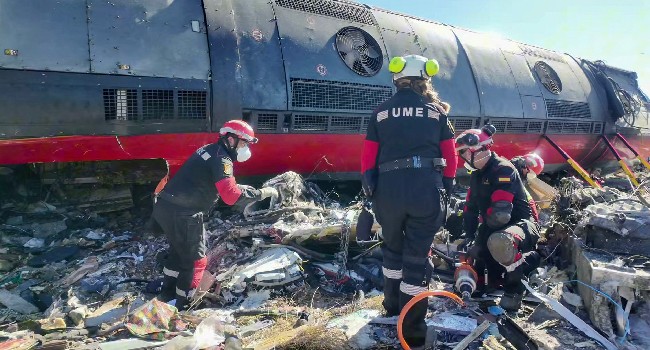




The still image from video taken and released by Spain’s Emergency Military Unit (UME) on October 28, 2026 shows the scene of a train crash between a high speed Renfe AVE train and Iryo train around 150kms south of Madrid between Urda and Los Yebenes in the province of Toledo.
At least 64 people have been killed and more than 100 others injured in a collision involving two high-speed trains south of Madrid, Spain, on Wednesday, with authorities warning that the death toll could rise.
The crash, one of Europe’s deadliest rail disasters this century, occurred in the central region of Castilla-La Mancha, where emergency responders found one train lodged into another.
Several carriages were overturned and lay amid twisted metal at the bottom of an embankment as emergency vehicles rushed to the scene.
The leader of Castilla-La Mancha, Emiliano García-Page, disclosed the updated death toll while speaking to reporters at the site.
“We are speaking of approximately 64 (dead), but this is probably going to grow even more,” he said, revising an earlier figure of 31 fatalities.
A spokeswoman for the regional government said more than 100 people had sustained injuries, with 58 taken to hospitals. Fifteen of those hospitalised were reported to be in critical condition.
Helicopters hovered over the crash site as rescue teams searched for survivors, while several vehicles from a funeral service arrived in the area.
Spain’s state-owned railway operator, Renfe, confirmed that services on the main high-speed line connecting Madrid with southern Spain had been suspended following the collision involving one of its trains and a service operated by private railway company Iryo.
Iryo said its train, which was carrying 147 passengers and five staff members, including the driver, had been struck from behind by the Renfe service.
Manuel Ortiz, 49, a resident of Urda, a village about 130 kilometres south of Madrid, told AFP that he had spent the morning transporting survivors in his car.
According to Ortiz, passengers on the Iryo train told him their train had been stationary when the collision occurred.
He described the scene as “horrific, horrible”, adding that the area smelled of metal following the crash.
Rail Safety Under Scrutiny
The latest disaster has renewed concerns about railway safety in Spain, particularly following another deadly train collision earlier this year.
The accident also comes at a politically sensitive time for Socialist Prime Minister Pedro Sánchez, who faced criticism over the earlier disaster and is seeking to extend his eight-year premiership in an early general election scheduled for November 29.
Sánchez’s office said the prime minister was travelling to the crash site.
In a message posted on X, he said he was “shocked” by the incident and extended his “love, solidarity and support to all the victims and their families”.
Condolences also poured in from across Spain and other parts of Europe.
The Spanish royal household said it was “shocked and concerned” by the accident, expressing support for the victims, their families and emergency responders.
A spokeswoman for the European Union said the bloc was prepared to assist Spain if necessary, while European Commission President Ursula von der Leyen said Europe mourned with the victims following what she described as devastating news.
The Spanish Football Federation also postponed 24 matches in the opening round of the Copa del Rey as a mark of respect and solidarity with those affected.
Spain has invested heavily in its high-speed railway network over the years, developing the world’s second-largest system after China. The network is widely regarded as a major national infrastructure achievement.
However, the latest collision follows another fatal accident in January, when two high-speed trains collided near Adamuz in southern Spain, killing 46 people and raising fresh questions about railway safety.
That crash was Spain’s deadliest train disaster since 2013, when 80 people died after a train derailed on a curved section of track near Santiago de Compostela in the country’s northwest.
Both major rail accidents recorded in Spain this year occurred on the line connecting Madrid with the southern city of Seville.
The cause of Wednesday’s collision remained unclear at the time of reporting. The crash occurred on a straight section of track under sunny, dry weather conditions.
AFP reported seeing five people dressed in white overalls examining the tracks and taking photographs as investigators began their work.
The affected route is among Spain’s busiest railway corridors. It was also the country’s first high-speed rail line, opening in 1992 to coincide with the Universal Exposition held in Seville.