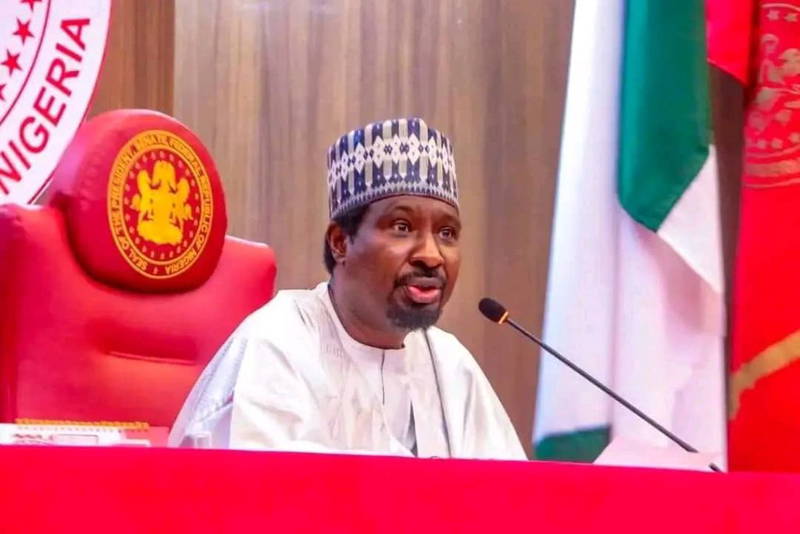
Deputy Senate President, Barau Jibrin.
Deputy President of the Senate, Senator Barau Jibrin, has faulted former Vice-President Yemi Osinbajo’s assessment of Nigeria’s economy and democratic governance, arguing that the administration of President Bola Tinubu is taking steps to address the country’s longstanding challenges.
Barau, who represents Kano North Senatorial District under the All Progressives Congress (APC), acknowledged the concerns raised by Osinbajo, particularly those based on Afrobarometer surveys covering Nigeria and other African countries.
However, he maintained that inadequate communication between the government and citizens had contributed to the negative perception of the country’s economic and democratic conditions.
The Deputy Senate President spoke in Yola, Adamawa State, during a public lecture titled “Democracy and Development: Rethinking the Leadership Question,” organised to mark the 59th birthday of Governor Ahmadu Umaru Fintiri.
Osinbajo, who served as vice-president under former President Muhammadu Buhari from 2015 to 2023, had expressed concern about the challenges facing democratic governance across Africa despite nearly three decades of uninterrupted democratic rule in several countries.
Citing Afrobarometer survey findings, the former vice-president highlighted widespread dissatisfaction with democratic institutions, economic hardship, declining public confidence in government and diminishing youth participation in electoral politics.
He noted that although 64 per cent of Africans preferred democracy to other forms of government, only 38 per cent were satisfied with how democracy was functioning in their respective countries.
Osinbajo also cited findings showing that 59 per cent of Africans considered their national economies to be in poor condition, while 51 per cent believed their economies had deteriorated.
He further highlighted the rising cost of living, unemployment, inadequate healthcare and declining voter turnout, warning that persistent economic hardship could erode public confidence in democracy, particularly among young people.
In a statement issued by his Media Office on Wednesday, Barau described Osinbajo’s presentation as thought-provoking and intellectually stimulating but argued that the government was working to address many of the challenges identified.
He said the disconnect between government policies and public perception was partly due to insufficient communication between political leaders and citizens.
“I know he is a very good orator, a good public speaker and an intellectual to the core,” Barau said, while explaining that he had initially decided against preparing a speech to avoid turning the birthday celebration into an occasion for speeches.
Commenting on Osinbajo’s presentation, he added: “What I want to say is this: one important reason for the gloomy picture portrayed by the surveys, particularly those conducted by Afrobarometer, is what the professor talked about and specifically observed: the issue of communication between the leaders and the led.
“There is no proper communication.”
Barau maintained that the federal and state governments were implementing measures to address the challenges raised by the former vice-president, particularly in education, infrastructure and economic development.
On education, he said the government was expanding access to learning opportunities to accommodate Nigeria’s growing population and large youth demographic.
He stressed that ensuring access to education, especially for children from disadvantaged backgrounds, was essential to tackling the country’s long-term development challenges.
“Before now, it was very difficult for a child who did not have the means to go to school. Now, everyone, except a child who does not want to go to school in Nigeria, can go to school with the NELFUND introduced by this administration,” he said.
The Deputy Senate President also emphasised the importance of infrastructure development in promoting economic growth and improving living standards.
He cited ongoing road projects, including the Lagos-Calabar Coastal Highway and the Badagry-Sokoto Highway, alongside projects in the North-East and North-West, as evidence of the administration’s efforts to address the country’s infrastructure deficit.
“When we talk about economic prosperity, you cannot achieve it without a certain level of infrastructure, including road networks, water supply and other essential infrastructure,” he said.
According to Barau, road construction and other infrastructure projects were ongoing across the country to stimulate economic activities and support development.
“This is what is happening currently in this country under President Bola Ahmed Tinubu’s administration. Roads are being constructed everywhere to propel the process of bringing economic prosperity. That is being done.
“It is a long journey, but it is being done. Yet, there is no proper communication,” he added.
He called for sustained engagement between government officials and the public to ensure that Nigerians were adequately informed about government policies, projects and intervention programmes.
Addressing the country’s economic difficulties, Barau argued that Nigeria’s rising cost of living should also be considered against the backdrop of global economic pressures.
He attributed increases in the prices of energy, goods and services partly to international conflicts and disruptions to global supply chains, particularly those affecting food production and energy markets.
He cited the Russia-Ukraine war and tensions in the Middle East as factors contributing to higher energy prices and increased production costs worldwide.
Barau also pointed to disruptions around the Strait of Hormuz, a major international oil transit route, as one of the factors contributing to volatility in global energy markets.
“The fact is that these challenges are not peculiar to Nigeria; they have an international dimension. The rising cost of living is partly attributable to conflicts in different parts of the world, including the Middle East, as well as the ongoing war between Russia and Ukraine.
“These conflicts have disrupted global supply chains, driven up energy prices and increased the cost of goods and services worldwide,” he said.
Barau, who is the First Deputy Speaker of the ECOWAS Parliament, maintained that the economic turbulence affecting countries across the world had also affected Nigeria, arguing that the country could not remain insulated from global economic developments.