

South Africa has formally protested to Nigeria’s High Commissioner, Femi Fani-Kayode, over the controversy surrounding the presentation of his letters of credence and his subsequent comments on social media.
The South African Broadcasting Corporation (SABC) reported the development on Tuesday, citing a statement by the country’s Department of International Relations and Cooperation (DIRCO).
According to the statement, DIRCO Director-General, Zane Dangor, had met with Fani-Kayode to formally communicate South Africa’s concerns over events that followed the presentation of his diplomatic credentials to President Cyril Ramaphosa.
“During the meeting, the Director-General conveyed South Africa’s concern regarding events that transpired following the presentation of the High Commissioner’s Letters of Credence to His Excellency President Cyril Ramaphosa, as well as subsequent remarks made on social media,” the statement said.
Dangor reaffirmed the importance of protecting the longstanding bilateral relationship between Nigeria and South Africa, founded on mutual respect, friendship and cooperation.
He also reminded Fani-Kayode of Article 41 of the 1961 Vienna Convention on Diplomatic Relations, which requires diplomatic agents to conduct official business with the receiving country through its Ministry of Foreign Affairs.
“In this regard, it was emphasised that all official communication should be conducted through established diplomatic channels, including DIRCO,” the statement added.
Despite the disagreement, South Africa reiterated its commitment to strengthening its strategic partnership with Nigeria and sustaining constructive diplomatic relations based on African solidarity and mutual respect.
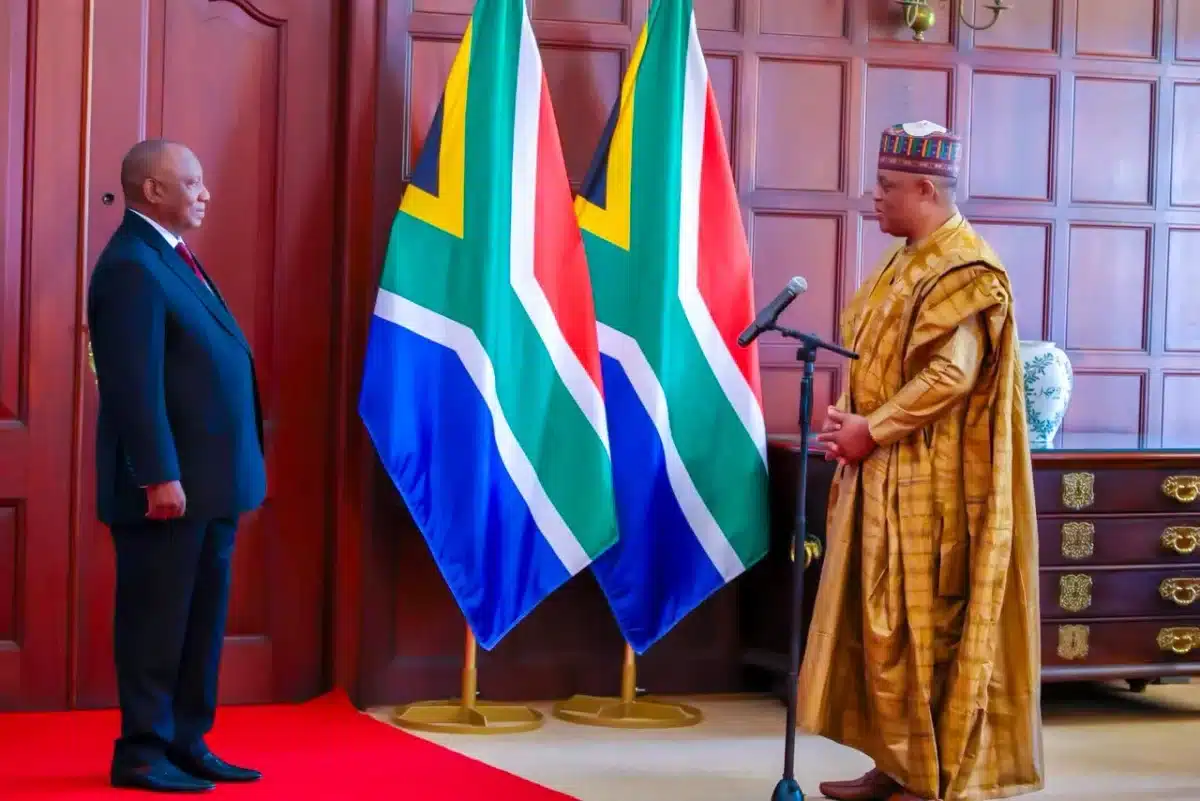
The diplomatic protest followed a controversy that erupted after Fani-Kayode presented his letters of credence to Ramaphosa at the Presidential Guest House in Pretoria on Friday, alongside ambassadors from 14 other countries.
The former Minister of Aviation had accused the South African Presidency of deliberately excluding his introduction and speech from the livestream of the ceremony, alleging that the addresses of the other diplomats were broadcast.
In a post on his X handle after the event, Fani-Kayode said all 15 ambassadors were formally introduced and given the opportunity to deliver speeches, but the South African Presidency excluded the Nigerian delegation from the broadcast.
He wrote: “Every single one of the 15 Ambassadors that were present were introduced formally and gave a speech. Curiously the South African Presidency refused to air the introduction of my goodself and the Nigerian delegation or to air my speech.
“They went a step further by cutting us out of the livestream completely and went back on livestream only after my speech was concluded.”
Fani-Kayode also claimed that he raised the issue with Ramaphosa during a photo session after the ceremony, adding that the South African President directed relevant officials to address his complaint.
He subsequently declined an interview request from the SABC, citing dissatisfaction with the treatment of the Nigerian delegation.
However, Ramaphosa’s spokesperson, Vincent Magwenya, disputed the envoy’s account, insisting that the President did not intervene in the operations of the public broadcaster.
Magwenya explained that Ramaphosa had only referred Fani-Kayode to Sophie Mokoena, the SABC’s acting political and foreign editor, as the appropriate person to address his complaint.
“The SABC is a public broadcaster. The President carries no legal or political mandate to interfere with its operations or intervene with its editorial processes,” Magwenya said.
He described Fani-Kayode’s handling of the complaint as “grossly inappropriate”, arguing that the Nigerian envoy had misunderstood what he characterised as a minor operational issue.
The South African Presidency later released a separate video of Fani-Kayode’s speech on its YouTube channel, hours after the envoy protested its exclusion from the initial livestream.
The disagreement also sparked an exchange between the Nigerian High Commission and Magwenya, with the mission defending Fani-Kayode and maintaining that Ramaphosa had intervened to resolve the matter.
The meeting between Dangor and Fani-Kayode represents a formal diplomatic response to the dispute, with South Africa emphasising the need for diplomatic representatives to conduct official communications through established channels.