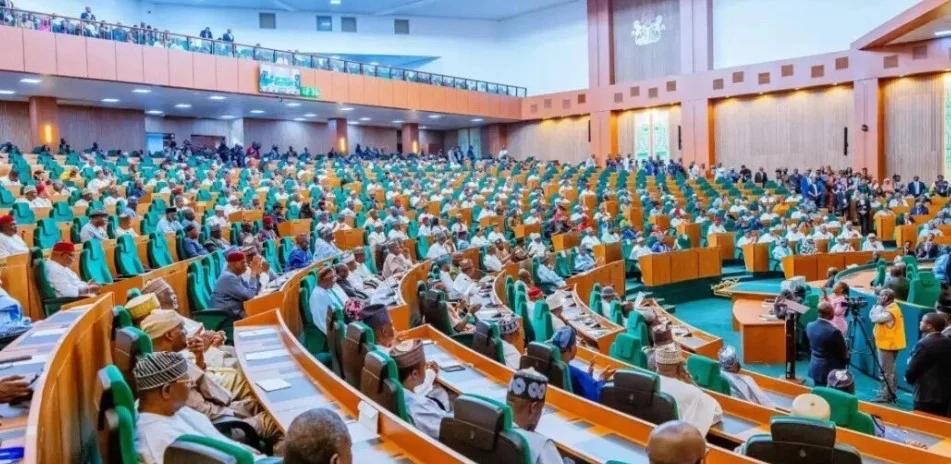

The House of Representatives on Wednesday descended into a rowdy session as lawmakers clashed over a motion seeking to invite President Bola Tinubu to explain the alleged non-implementation of constituency projects and delays in the release of budgeted funds.
The tension erupted during consideration of a motion sponsored by the member representing Aba North/Aba South Federal Constituency, Alex Ikwechegh, who criticised the poor funding of appropriated budgets and the persistent delay in releasing capital funds to Ministries, Departments and Agencies (MDAs).
The debate followed a constitutional Point of Order raised by the member representing Okpe/Sapele/Uvwie Federal Constituency, Benedict Etanabene, who informed the House of a circular from the Office of the Accountant-General of the Federation suspending funding for zonal intervention projects pending fresh verification requirements.
The issue sharply divided lawmakers, with members across party lines expressing frustration over the slow implementation of projects approved by the National Assembly.
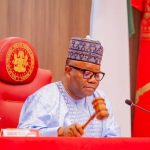
Although the motion received broad support, attempts by some lawmakers to oppose aspects of it were drowned out by loud protests, forcing Speaker Tajudeen Abbas to repeatedly restore order.
Presenting the motion titled, “Urgent Need to Address the Poor Funding of Appropriated Budgets and Delayed Releases to MDAs as Revealed During the 2026 Budget Defence Sessions,” Ikwechegh argued that the credibility of the National Assembly’s appropriation process depends not only on passing the budget but also on the timely release and utilisation of approved funds.
He said reports from the 2026 budget defence sessions revealed that several ministries and agencies received little or no capital releases in 2025 despite approved appropriations.
The lawmaker also recalled protests by indigenous contractors in 2025 and early 2026 over unpaid certificates for completed and verified government projects, noting that many had been pushed into financial distress after borrowing to execute contracts.
Ikwechegh reminded the House that President Tinubu, during the Federal Executive Council meeting of December 10, 2025, directed the immediate settlement of verified contractor liabilities estimated at about ₦1.5 trillion and approved the establishment of an inter-ministerial committee to reconcile records and facilitate payments.
He noted that the National Assembly subsequently approved borrowing of more than ₦1 trillion to settle verified contractor debts, while provisions were also made in the 2026 Appropriation Act for outstanding liabilities.
However, he expressed concern that despite the presidential directive and legislative approvals, the release of funds to MDAs had remained sluggish, stalling critical projects, increasing contract costs, exposing contractors to insolvency and undermining public confidence in the budget process.
Ikwechegh also criticised a Treasury circular dated June 29, 2026, reportedly issued by the Office of the Accountant-General of the Federation, which requires a Certificate of Verification and Compliance from the Federal Ministry of Special Duties and Intergovernmental Affairs before payments for constituency projects can be processed.
According to him, the directive creates another layer of bureaucracy capable of frustrating the implementation of duly appropriated and executed projects despite the President’s call for faster execution.
While commending Tinubu for directing the settlement of verified contractor liabilities, Ikwechegh urged the President to ensure the directive is fully implemented and appealed to him to engage with the House on the challenges affecting budget implementation.
Earlier, Etanabene urged the House to invoke its constitutional oversight powers by inviting President Tinubu and members of his economic team to explain the reported suspension of constituency project funding.
Citing Sections 4, 88 and 89 of the 1999 Constitution (as amended), he argued that the National Assembly has a constitutional duty to hold the Executive accountable for implementing budgets it approved.
He said lawmakers were increasingly unable to explain to their constituents why projects captured in the budget had not been executed, adding that Nigeria was effectively implementing the 2024, 2025 and 2026 budgets simultaneously.
However, Speaker Tajudeen Abbas ruled that the aspect of the motion seeking to invite the President could not be adopted, describing such a move as inconsistent with parliamentary practice.
The House subsequently adopted the substantive resolutions of the motion, urging the Federal Ministry of Finance, the Budget Office of the Federation, the Office of the Accountant-General of the Federation and the Central Bank of Nigeria to prioritise the timely release and cash-backing of appropriated funds, publish a clear release schedule for the 2026 fiscal year and conclude the verification and payment of outstanding contractor liabilities within a publicly announced timeline.