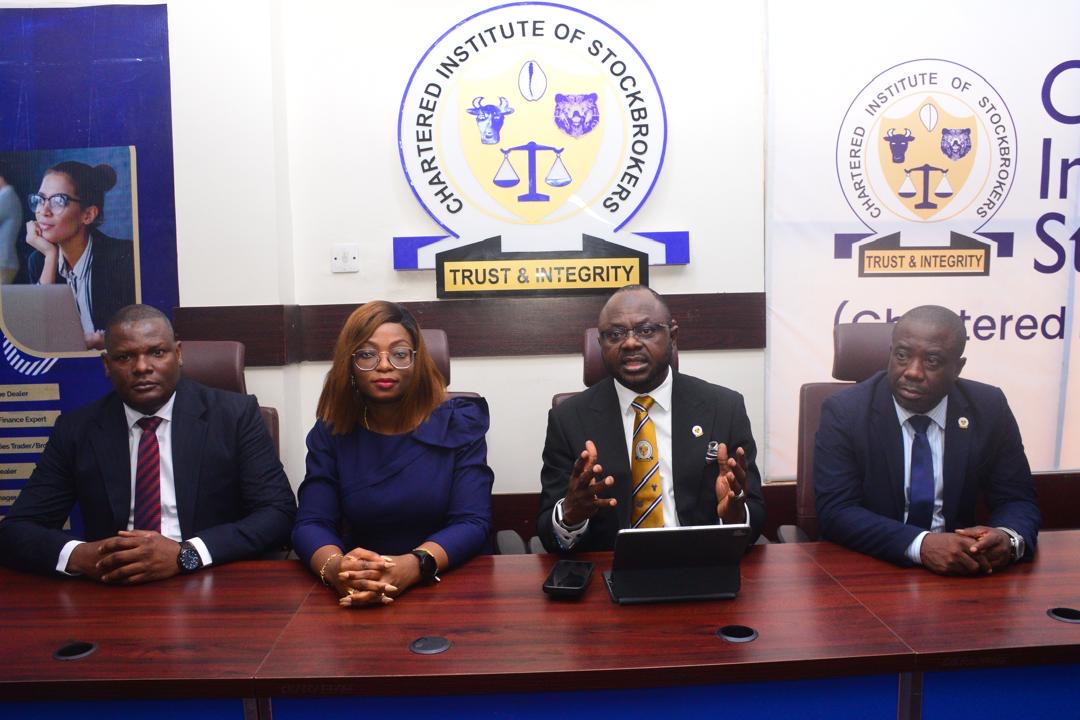






L-R: Chairman, Finance Sub-Committee, 30th Annual Conference of Chartered Institute of Stockbrokers (CIS), Ola Belgore; Vice-Chairman, Yele Osunsanya; Chairman, Saheed Bashir; and Registrar and Chief Executive, Ayo Adeonipekun, during pre-Conference Media Interactive Session ahead of 2026 CIS Annual Conference in Lagos yesterday
With Nigeria’s GDP growth at 4.43% in Q2 2026, securities dealers under the aegis of the Chartered Institute of Stockbrokers (CIS) will use its 30th Annual Conference in Lagos to examine how record capital mobilisation can translate into faster growth, productive investment and shared prosperity.
The Chartered Institute of Stockbrokers (CIS) is set to use its 30th Annual Stockbrokers’ Conference to push for a stronger link between capital raised through Nigeria’s capital market and measurable economic outcomes, including job creation, industrial growth, infrastructure development and increased household wealth.
The conference, themed “ From Capital Mobilised to Prosperity Realised: Financing Nigeria’s Next Era of Growth and Global Competitiveness ,” from November 4-5, 2026 at Harbour Point, Lagos, will bring together policymakers, regulators, market operators, investors and international stakeholders to examine how the capital market can become a more effective engine of long-term economic development.
Chairman of the Conference Committee, Saheed Bashir, said the theme was inspired by the need to move the national conversation beyond the size and performance of the capital market to what mobilised capital ultimately delivers to the real economy.
According to him, the value of listed companies has risen to about ₦160 trillion from roughly ₦30 trillion in May 2023, while the market is currently hosting the country’s largest capital raise through the Dangote Petroleum Refinery and Petrochemicals IPO, involving 4.1 billion shares at ₦525 per share.
“Still, a rising index is not the same as a rising standard of living,” Bashir said, stressing that capital mobilisation must translate into productive investment and broader economic benefits.
He said Nigeria needs a deliberate “transmission mechanism” linking funds raised in the capital market to manufacturing, agriculture, infrastructure and small and medium-sized enterprises, supported by transparent reporting on the utilisation of proceeds.
Bashir also identified deeper institutional investment, macroeconomic stability and a shift from measuring market performance solely by market capitalisation to tracking jobs, output and household wealth as critical to achieving the desired impact.
He said the capital market should increasingly serve as the economy’s principal source of long-term finance, particularly for infrastructure and productive assets that require patient capital.
The Dangote Refinery IPO, he noted, provides an example of how public capital can be deployed to support productive capacity, with the primary offer designed to channel funds into the company and support its expansion plans.
The conference will also examine measures required to attract greater domestic and foreign participation, including improved market access, efficient repatriation of investment proceeds, transparent foreign exchange arrangements, investor protection, digital onboarding and a stronger pipeline of quality listings.
Bashir said stockbrokers would remain central to this process, describing them as “the market’s front door and its ambassadors.” He identified professionalism, research, technology, investor access and efficient execution of large transactions as key areas where the profession must continue to raise standards.
The conference is expected to produce a policy communiqué containing recommendations to government and key financial-market regulators, as well as an outcome framework for measuring the impact of capital mobilisation on the wider economy.
It will also consider product innovation, retail participation, market infrastructure, technology, ethics and capacity building as part of efforts to position Nigeria’s capital market for its next phase of development.
The event comes as the Institute marks three decades of its annual conference and follows the historic emergence of Dr. Fiona Nyako Ahmed Ahimie, FCS, as the Institute’s 14th President and first female President.