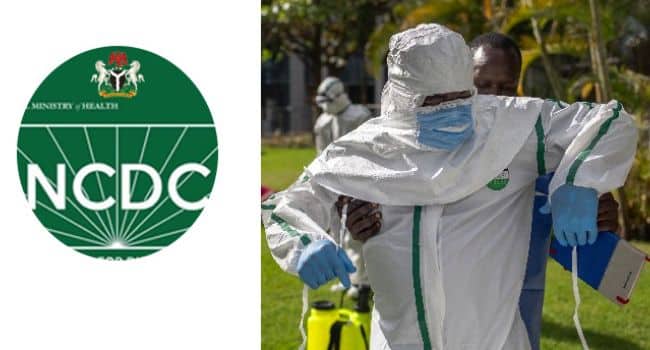




This combo photo shows the NCDC logo and a health worker in a personal protective wear.
The Nigeria Centre for Disease Control and Prevention (NCDC) has confirmed that none of the 62 people exposed to Nigeria’s imported case of the Bundibugyo strain of Ebola Virus Disease (EVD) contracted the infection after completing the mandatory 21-day monitoring period.
The agency announced the development on Friday, following the discharge of the last person under surveillance, confirming that no secondary transmission of the virus was recorded.
The NCDC Director-General, Dr. Jide Idris, disclosed this during a briefing on the country’s response to the imported Ebola case confirmed in the Federal Capital Territory (FCT) on October 20, 2026.
He said 13 of the 62 contacts developed fever or other symptoms during the monitoring period but subsequently tested negative for the virus.
Idris also disclosed that the agency investigated seven suspected Ebola cases reported in Adamawa, Rivers, Borno, Lagos and Ekiti states over the past three weeks, all of which tested negative.
However, he cautioned against interpreting the completion of contact monitoring as an official declaration that Nigeria is Ebola-free.
He explained that the country would sustain heightened surveillance and preparedness, particularly as Ebola infections continued to be reported in the Democratic Republic of Congo.
“Interestingly too, for any country to declare Ebola-free, that would be done by the World Health Organisation based on its own protocols,” he said.
According to Idris, the imported case was detected after healthcare workers raised an alert through the NCDC’s event-based surveillance system, triggering an investigation involving FCT health authorities and other relevant institutions.
Following confirmation of the infection, the National Emergency Operations Centre was activated, while an Incident Management System was established to coordinate the national response.
He said the intervention involved tracing and monitoring individuals who might have been exposed, strengthening infection prevention and control measures in healthcare facilities, training health workers and distributing protective equipment and other emergency supplies.
The agency also intensified public communication and engagement with community leaders to tackle misinformation and encourage public cooperation with health authorities.
Ebola Patient Recovers After Treatment in Switzerland
Providing an update on the index patient, Idris said she initially received medical treatment in Nigeria before being evacuated to Switzerland on October 26 for further care.
He disclosed that laboratory tests conducted upon her arrival in Switzerland confirmed that she was still positive for the virus.
However, she subsequently recovered, tested negative and was discharged from the hospital.
Addressing concerns surrounding her evacuation, the NCDC chief dismissed suggestions that the decision indicated a lack of confidence in Nigeria’s healthcare system.
He maintained that the private hospital where she was initially treated had managed her condition appropriately before the evacuation.
“It is not a matter of trust issues. The hospital here managed the case properly and as best as it could do,” he said.
NCDC Retains Highest Ebola Response Level
Despite the successful completion of contact monitoring, Idris said the NCDC Emergency Operations Centre remained activated, with the Incident Management System operating at Level 3, the highest response level for Ebola.
He disclosed that all 36 states and the FCT had been integrated into the national preparedness framework, although their levels of readiness varied.
According to him, 10 states with international airports and borders were initially identified as high-risk locations, while preparedness guidelines had also been issued to other states.
“All the states are queued in. They may be at different stages of preparedness, but that is what we are urging them to do,” he said.
Idris said the NCDC would continue supporting state governments through training, the provision of initial emergency supplies and other interventions to strengthen their capacity to detect and respond to infectious disease threats.
He added that surveillance would remain active at international points of entry in collaboration with Port Health Services.
NCDC Warns Against Assuming Every Fever Is Malaria
As Nigeria approaches the December festive season, the NCDC director-general urged residents and international visitors to seek prompt medical attention whenever they become unwell, particularly if they have recently travelled or may have been exposed to an infectious disease.
He warned against the common practice of assuming that every fever is malaria, advising patients to provide healthcare workers with accurate information about their travel history and possible exposure to infections.
Idris also called on organisers of religious gatherings, political rallies, concerts, festivals and sporting events to provide adequate sanitation, safe drinking water and medical support, while ensuring that suspected illnesses were promptly reported.
He said the agency had developed public health guidelines to guide organisers and participants at large gatherings.
The NCDC chief further reminded international travellers arriving in Nigeria to complete the Nigeria Health Declaration Form before arrival and provide accurate information about their health status and travel history.
“There is no reason for panic. What is required is continued vigilance, early reporting and cooperation with public health authorities,” he said.
Earlier, the Mandate Secretary of the FCT Health Services and Environment Secretariat, Adedolapo Fasawe, disclosed that the initial alert came from a private healthcare facility after its medical team reviewed the patient’s travel history and suspected Ebola infection.
She said the FCT Rapid Response Team was immediately deployed to the hospital, adding that members of the team also completed a three-week isolation period and remained healthy.
Fasawe commended the hospital for promptly reporting the suspected infection and urged other private healthcare facilities to immediately notify the NCDC or FCT health authorities whenever they encounter suspected cases.
She attributed the successful management of the incident to collaboration among the NCDC, the Federal Ministry of Health and Social Welfare, development partners and the FCT administration.