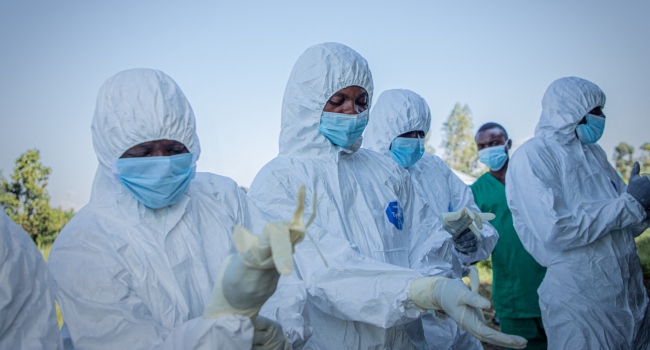
The Nigeria Centre for Disease Control and Prevention (NCDC) has increased the number of primary contacts being monitored following Nigeria’s confirmed Ebola case to 53, as investigations expand to identify people potentially exposed to the virus.
The contacts include 44 people linked to the health facility where the patient received treatment, while investigations have also been extended to an emergency room she visited earlier.
The NCDC Director-General, Dr Jide Idris, disclosed this on Sunday during a press briefing on the country’s contact-tracing efforts, explaining that health officials were identifying additional individuals who might have been exposed through the initial contacts.
The latest figure represents an increase from the 44 contacts initially announced by the Federal Government after the Ebola case was confirmed in the Federal Capital Territory on October 20.
The World Health Organisation (WHO) had earlier reported that the patient, a woman who recently travelled from Uganda, developed symptoms on October 7 and sought medical attention on October 11 before her infection was confirmed.
Idris said nine additional primary contacts had been identified outside the group of 44 associated with the health facility.
They include three members of the patient’s household and individuals who attended to her at an emergency room before she was transferred to the facility where Ebola was subsequently confirmed.
“As of now, we have 53 primary contacts. Of these, 44 are people from that health facility where the patient was treated,” Idris said.
He explained that contact tracing extended beyond individuals who had direct contact with the patient, as investigators were also working to identify people who might have been exposed through those already being monitored.
“For each person, we are going to ask questions. We have to establish who they have been in contact with. If we can identify those people, they will also be monitored,” he said.
According to the NCDC chief, investigations into the patient’s medical history revealed that she had visited an emergency room before arriving at the facility where her Ebola infection was confirmed.
He said the agency had commenced efforts to trace people who attended to her during the earlier visit, with three healthcare providers from the emergency room among the additional contacts identified.
The investigation also covers healthcare workers involved in collecting samples from the patient, underscoring the importance of strict infection prevention and control procedures when managing suspected Ebola cases.
Idris said the NCDC was intensifying efforts to strengthen infection prevention and control measures in healthcare facilities while addressing gaps in preparedness and technical capacity at the state and local government levels.
“When our infection prevention and control teams visit a facility, they assess the systems in place and identify areas that need to be corrected,” he said.
He added that the agency had continued to train healthcare personnel in infection prevention and control, describing capacity building as a critical component of the national response.
“Capabilities and competencies at the subnational level are not as high as they should be. We are responsible for building those capabilities. That is why training is one of our most important priorities,” Idris stated.
The NCDC said individuals on the contact list who remain asymptomatic would be monitored, including through regular temperature checks. Anyone who develops symptoms would require immediate medical assessment and appropriate intervention.
The contact-tracing exercise forms part of Nigeria’s response to the confirmed Ebola case caused by the Bundibugyo virus, a strain associated with an outbreak affecting countries in Central and East Africa.
The Federal Government has urged public and private healthcare facilities to maintain a high index of suspicion, promptly isolate suspected cases, adhere to infection prevention protocols and report suspected infections to the relevant public health authorities.
The WHO has also stressed that the rapid identification of cases, effective contact tracing and strict infection prevention and control measures are essential to containing the outbreak and protecting healthcare workers and communities.