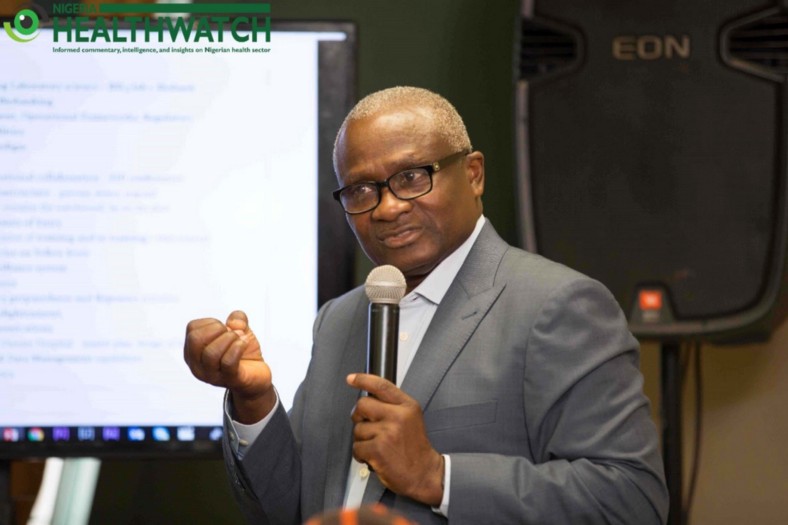
NCDC DG, Dr. Jide Idris. | Photo credit: Nigeria Health Watch
The Nigeria Centre for Disease Control and Prevention (NCDC) has approved an emergency payment of ₦100,000 per person weekly to support individuals placed in isolation or quarantine as part of efforts to contain the Ebola outbreak in the Federal Capital Territory (FCT).
The NCDC Director-General, Dr Jide Idris, disclosed this on Sunday during a press briefing on the agency’s response to the outbreak, explaining that the financial support became necessary after some contacts raised concerns about the cost of feeding, accommodation and providing for their families while undergoing monitoring.
According to Idris, the intervention is intended to ease the financial burden on individuals required to comply with public health measures and ensure their cooperation with contact-tracing efforts.
“We are paying for their accommodation; we are paying for their feeding. Some of them are asking for a stipend to maintain their families,” he said.
He added, “We are providing ₦100,000 per person per week just to maintain their comfort and feeding, because they were complaining.”
The NCDC chief explained that the payment was not part of the agency’s original response plan but had become necessary because of the emergency.
“This was not planned for, but it is an emergency. We will continue to review it as we go along,” Idris stated.
He also cautioned that the responsibility for providing such support should not rest solely on the FCT administration, stressing that other states must be prepared to offer similar assistance if outbreaks occur within their jurisdictions.
“This is not the responsibility of the FCT alone. What we have to do for the FCT, we have to do for any other state, just in case,” he said.
Idris urged state governments to make adequate financial and logistical provisions to support contact tracing, isolation and other emergency response activities.
The intervention comes as health authorities intensify efforts to prevent further transmission following the confirmation of an imported Ebola case in Abuja on October 20.
As of Sunday’s briefing, Nigeria had recorded one confirmed case, with 53 primary contacts identified for monitoring. They include healthcare workers, household members, domestic staff and personnel involved in collecting samples from the patient.
Idris said the contacts were being categorised according to their level of exposure and monitored by public health teams. Anyone developing symptoms would undergo immediate medical assessment and appropriate testing.
The NCDC has also established isolation arrangements for contacts requiring them, with health officials monitoring their condition throughout the 21-day incubation period following their last possible exposure.
The agency’s director-general disclosed that one contact who reported feeling unwell had tested negative, while surveillance and follow-up activities continued.
Meanwhile, the NCDC is strengthening infection prevention and control measures in healthcare facilities, training medical personnel and supporting the availability of protective equipment and laboratory supplies.
The confirmed case involves a woman who travelled to Nigeria from Uganda and tested positive for the Bundibugyo strain of the Ebola virus. She reportedly developed symptoms on October 7, sought medical attention in Abuja on October 11 and was confirmed positive on October 20.
The World Health Organisation has classified the infection as an imported case, with investigations continuing to establish the likely source of exposure.
The wider regional outbreak has also affected the Democratic Republic of the Congo and Kenya, highlighting the importance of cross-border surveillance, rapid identification of cases and effective contact tracing.
Nigeria previously contained an Ebola outbreak in 2014 through prompt case identification, contact tracing, isolation and coordinated public health interventions.
Idris said the NCDC was drawing on lessons from that experience to strengthen preparedness across the country, emphasising that containing the current outbreak would require cooperation among government agencies, healthcare workers, affected contacts and the general public.
He urged Nigerians to rely on verified information, avoid spreading rumours and cooperate with public health officials conducting contact tracing and monitoring.