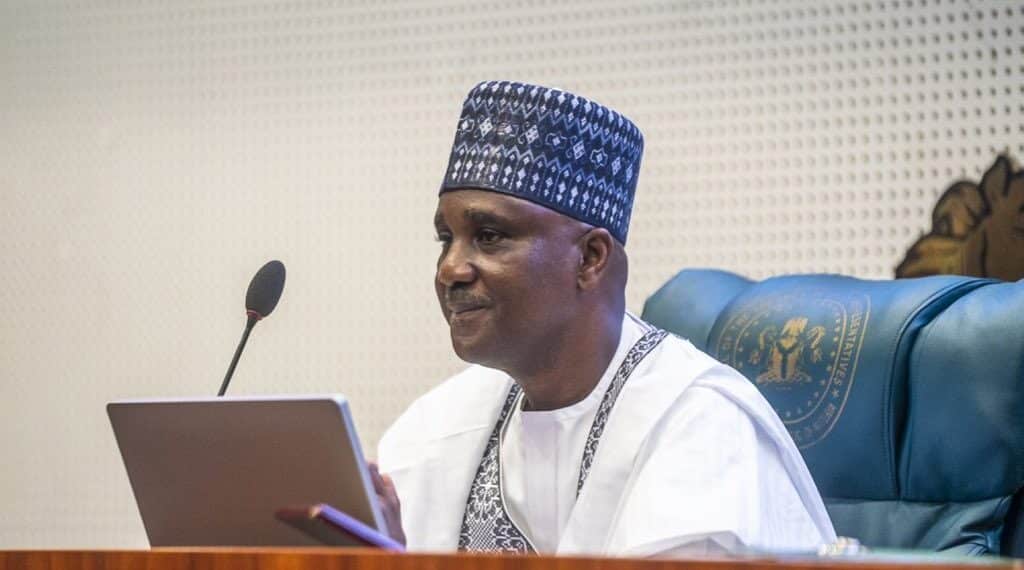

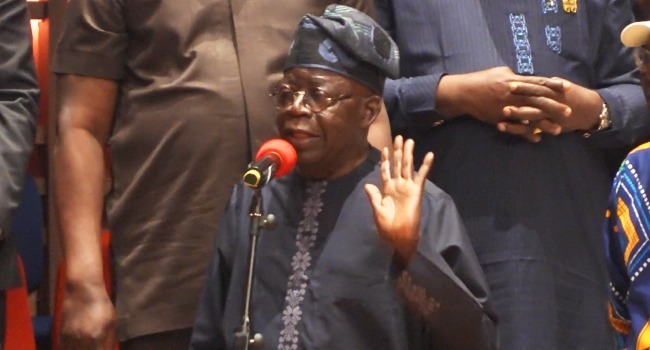

FILE PHOTO: House of Reps Speaker, Abbas Tajudeen.
The House of Representatives has deferred consideration of a motion seeking an investigation into the implementation of the electricity Service-Based Tariff System, pending the submission of a report by its Ad-hoc Committee on Power Sector Reform next Wednesday.
The committee’s findings are expected to guide possible fresh legislative interventions in the electricity sector.
The motion, sponsored by Kwara lawmaker Aluko Yinka, was brought up during Wednesday’s plenary. It sought a probe into the Nigerian Electricity Regulatory Commission’s (NERC) Service-Based Tariff System and the classification of electricity consumers into Bands A to E.
The lawmaker raised concerns over alleged discriminatory electricity distribution practices and the failure of distribution companies (DisCos) to provide customers with the minimum supply hours promised under the tariff arrangement.
Providing an update on the committee’s assignment, a member of the panel, David Agada, said it had concluded consultations with regulatory agencies, electricity distribution and generation companies, and other industry stakeholders.
He disclosed that the committee had also visited Lagos and Rivers states to engage stakeholders and assess the challenges facing electricity consumers.
Agada added that the investigation covered outstanding electricity debts owed by government ministries, departments and agencies.
His remarks, however, prompted the Speaker of the House, Tajudeen Abbas, to question why the committee was still operating, given his earlier directive dissolving all ad-hoc committees and requesting the submission of their reports.
Members of the panel explained that they had completed their assignment and were preparing to present their findings to the House the following week.
Abbas subsequently directed lawmakers to defer consideration of Aluko’s motion until Wednesday, when the committee is expected to submit its report. The motion was accordingly stepped down.
Earlier, Aluko told the House that NERC introduced the Service-Based Tariff System to ensure that electricity charges reflected the quality and duration of power supply available to consumers.
He explained that the policy was intended to promote accountability in electricity distribution by ensuring that customers paid according to the level of service received.
However, he argued that its implementation had resulted in unequal access to electricity, with affluent neighbourhoods, commercial districts and high-profile consumers allegedly enjoying better supply than rural and low-income communities.
The lawmaker also expressed concern that consumers on Band A, who are entitled to a minimum of 20 hours of electricity daily, were not consistently receiving the stipulated supply.
He said customers in Bands B to E also continued to experience prolonged power outages despite paying bills under the existing tariff structure.
Aluko further criticised repeated electricity tariff increases, arguing that higher charges had increased the financial burden on households and businesses without corresponding improvements in power supply.
He accused some DisCos of engaging in practices such as targeted load shedding against customers in lower tariff bands, estimated billing and arbitrary transfers of consumers between tariff categories.
The lawmaker also drew attention to the metering gap in the electricity market, noting that millions of consumers remained without prepaid meters and were therefore exposed to inaccurate billing and possible exploitation.
He warned that the combination of high tariffs, unreliable electricity supply and questionable billing practices was putting additional pressure on small businesses, undermining industrial activities and constraining economic growth.