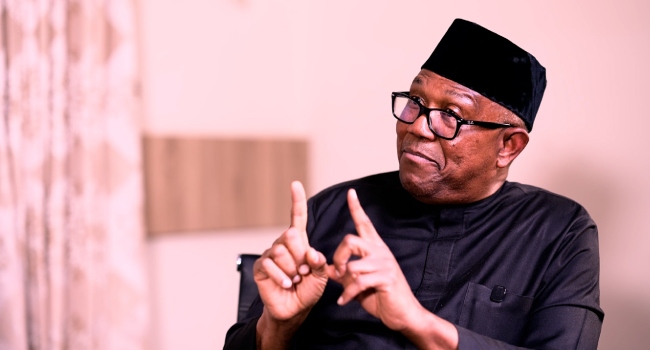


Former Anambra State Governor and presidential candidate of the Nigeria Democratic Congress (NDC), Peter Obi, has rejected claims that he left behind $123.77 million in external loans for the state, insisting that he neither borrowed from financial institutions nor issued any bond on behalf of Anambra during his tenure.
Obi made the clarification on Friday in a post on his X handle while responding to the controversy surrounding external financing tied to development projects implemented during his administration.
The Anambra State Government had stated that eight external financing facilities linked to projects undertaken during Obi’s tenure had a combined contracted value of $123.77 million, with $92.35 million outstanding as of June 30, 2026, according to figures from the Debt Management Office (DMO).
Obi, however, argued that the figures should not be presented as a single debt incurred by his administration.
He said the government should distinguish between the total amount approved for multi-year development programmes, the amount actually accessed by Anambra during his tenure and the balance outstanding when he handed over power on March 17, 2014.
“The government has combined these distinct categories, added them together, and described the resulting US$123.77 million as ‘loans left by Peter Obi.’ That is an incorrect application of public-sector accounting,” he said.
According to Obi, the eight facilities were largely World Bank and International Fund for Agricultural Development (IFAD) development programmes negotiated by the Federal Government, with participating states accessing the funds through subsidiary arrangements.
He maintained that the facilities were not conventional commercial loans personally secured by him, although he acknowledged that the state had repayment obligations under the respective programmes.
“Regarding the multilateral funding inaccurately described as ‘debt owed by Peter Obi’ in Anambra State, I wish to state unequivocally: As Governor of Anambra State, I did not approach any financial institution to borrow funds or issue a bond on behalf of the state,” Obi said.
The former governor also cited the then Director-General of the DMO, Abraham Nwankwo, who, according to Obi, stated at his farewell ceremony that Obi was the only state governor during Nwankwo’s 10-year tenure who had not approached him for a loan facility.
Obi further questioned the figures being attributed to Anambra’s external debt, saying DMO records showed that the state’s external debt stood at about $18 million when he assumed office in March 2006, approximately $30 million when he left office in March 2014 and about $45.15 million by December 31, 2014.
He therefore challenged the state government to explain how it arrived at $123.77 million as facilities inherited from his administration when, according to the DMO figures he cited, Anambra’s external debt was about $30 million at the time he left office.
Obi also said his administration left no unpaid salaries, gratuities or pensions, as well as no verified debts owed to contractors or suppliers who had completed government-certified projects.
He claimed that more than $150 million remained as the dollar component of investments made by his administration when he left office, adding that the funds could have generated about $10 million annually if left untouched.
According to him, the income generated from the investments over the years could have been sufficient to offset the $92.35 million outstanding funding cited by the state government while still leaving additional resources for investment.
The former governor said, however, that he would not engage in a prolonged dispute over his tenure in Anambra, insisting that his focus remained on issues affecting Nigerians.
Obi also dismissed speculation of a disagreement with his successor, Chukwuma Soludo, saying he had no dispute with Soludo or any other governor.
“I am not seeking the office of governor in any state, and I will not seek that position again, even if the Constitution is amended,” he said.
He urged governors to allow presidential candidates and other political contestants to campaign freely in their states irrespective of their political affiliations, saying voters should ultimately decide who represents them.
Obi said he had remained silent on the debt controversy in recent days because he was mourning his late elder brother and friend, Chief Okey Ezeibe.
“I respectfully urge everyone to concentrate on the existential challenges confronting Nigeria and the hardships endured by its citizens, rather than on the needless distractions that have become widespread in our politics,” he said.