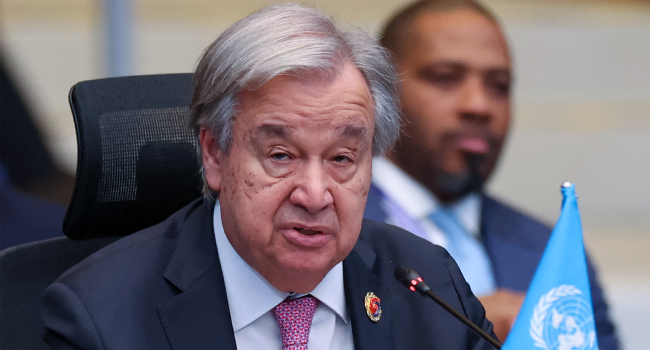













UN Secretary-General Antonio Guterres speaks during the 15th ASEAN – United Nations (UN) Summit at the 47th Association of Southeast Asian Nations (ASEAN) Summit in Kuala Lumpur on October 27, 2025. (Photo by Chalinee Thirasupa / POOL / AFP)
The United Nations Secretary-General, Antonio Guterres, has warned that the world is entering a “danger zone” of extreme weather as a powerful El Niño climate phenomenon intensifies.
Guterres, in a statement on Thursday, said the “supersized” El Niño was expected to peak later this year and was almost certain to persist until February, with its effects potentially extending into 2027.
“El Niño is being supersized before our eyes. The science leaves no room for doubt: the planet is in uncharted waters, and those waters are heating up,” Guterres said.
He added that rising sea-surface temperatures and increasing global temperatures were putting communities at greater risk of extreme weather events.
“The race now is between rising risks and our commitment to take climate action and protect people. We must win that race,” the UN chief said.
The World Meteorological Organization (WMO) said El Niño was already firmly established and expected to intensify into a “very strong” event in the coming months.
The UN weather agency warned that the phenomenon could significantly alter rainfall and temperature patterns while increasing the risks of floods, droughts and extreme heat.
Although El Niño is a natural climate phenomenon and is not caused by climate change, scientists expect it to amplify the warming effects of a planet already experiencing rising temperatures due to the continued burning of fossil fuels.
‘Massive Blow’ to Communities, Economies
WMO Secretary-General Celeste Saulo warned that the unusually strong El Niño could have severe consequences for communities and economies around the world.
“This exceptional El Niño… has the potential to deliver a massive blow to communities and economies across the world,” Saulo said.
She noted that droughts and floods were already causing disruption and destruction in various parts of the world and warned that the impacts could worsen as the phenomenon strengthens.
Saulo urged disaster management authorities and climate-sensitive sectors, including agriculture, health, energy and water, to intensify preparations.
“There is no time to lose,” she said.
El Niño occurs when surface waters in the central and eastern equatorial Pacific Ocean become unusually warm, triggering changes in global wind, pressure and rainfall patterns.
The phenomenon typically occurs every two to seven years and lasts between nine and 12 months. Its counterpart, La Niña, is characterised by cooler-than-normal sea-surface temperatures in the same region.
The WMO said the current El Niño was being fuelled by exceptionally warm conditions across the tropical Pacific and was expected to reach the highest category of intensity.
The agency said there was an “exceptionally high likelihood of nearly 100 percent” that El Niño would persist through February.
Pacific Ocean Heating Up
El Niño can influence weather and climate patterns thousands of kilometres away from the tropical Pacific. While each event varies, major El Niño episodes are often associated with droughts in parts of the Amazon, Indonesia and Australia, disruptions to monsoon patterns in India and changes in rainfall across tropical regions.
For September to November, WMO forecasts indicate an increased likelihood of above-normal temperatures across almost all land areas, alongside rainfall patterns reflecting what the agency described as a “classic atmospheric response” to a strong Pacific El Niño.
The sea-surface temperature index used to measure El Niño conditions rose to an average of 1.5°C above normal between May and July.
Weekly readings between late July and mid-August climbed further, ranging from about 2.2°C to 2.6°C above average, indicating that the phenomenon was continuing to intensify.
In some areas, temperatures below the ocean surface were also more than 8°C above average during July and early August, highlighting the exceptional warmth developing across the Pacific.