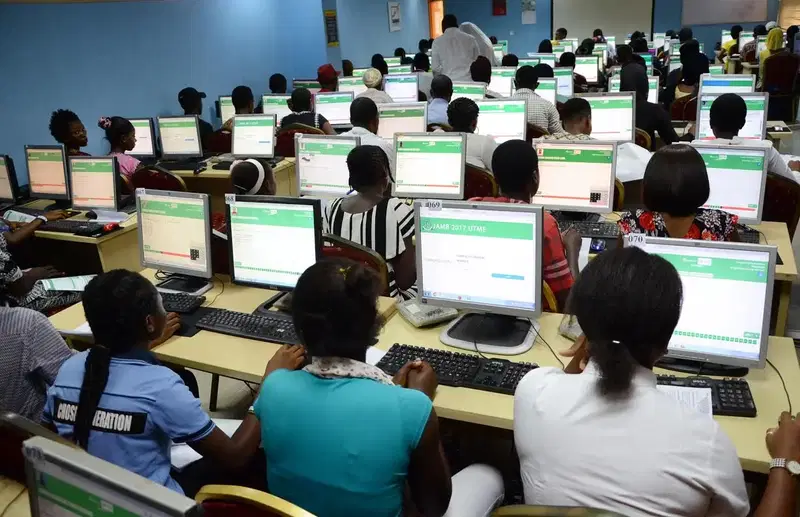
Only 108 out of approximately 39,000 underage candidates who sat the 2026 Unified Tertiary Matriculation Examination (UTME) have met the Federal Government’s requirements for possible admission into tertiary institutions.
The candidates emerged from a rigorous screening process designed to assess their academic performance and psychological, emotional and intellectual readiness for university education.
Minister of Education, Dr Tunji Alausa, disclosed this on Wednesday in Abuja while receiving the two highest-scoring candidates and six other outstanding underage candidates in the 2026 UTME. They were presented to him by the Registrar of the Joint Admissions and Matriculation Board (JAMB), Prof. Segun Aina.
Alausa said the multi-stage screening exercise was designed to ensure that exceptionally gifted children seeking early admission could demonstrate the maturity and preparedness required for higher education.
He disclosed that 2,244,149 candidates registered for the 2026 UTME, while 2,174,396 sat the examination. Approximately 39,000 of those who took the examination were below the prescribed minimum admission age of 16.
According to the minister, candidates seeking exemption from the age requirement were required to score at least 320 out of 400 in the UTME, representing 80 per cent.
They were also required to attain a minimum of 80 per cent in their post-UTME examinations, meet the stipulated 80 per cent threshold in the assessment of their O-level results and pass a screening exercise evaluating their psychological, emotional and intellectual readiness for university education.
Alausa said only 391 underage candidates scored at least 320 in the UTME, while subsequent assessments reduced the number eligible for possible admission to 108.
He noted that the successful candidates represented approximately 0.005 per cent of those who sat the examination.
Addressing the students, the minister described them as exceptionally gifted and emphasised the government’s responsibility to identify and nurture young talents capable of developing innovative solutions to Nigeria’s challenges.
“You are the geniuses in our society,” he said.
Alausa clarified that the minimum admission age of 16 was not intended to discourage gifted children or prevent them from advancing academically. Rather, he said, the policy was designed to ensure that younger candidates possessed the maturity needed to cope with university life.
He said feedback from the screening exercise was encouraging, particularly regarding the candidates’ confidence, intellectual abilities and responses to questions aimed at determining their preparedness for higher education.
The minister stressed that academic excellence alone was insufficient to justify early admission, noting that university education also required emotional stability and the ability to navigate complex social and intellectual environments.
He urged the successful candidates to view their abilities as a responsibility to society and use their talents to contribute to national development and global innovation.
“You are the ones that will change Nigeria and change the world with your innovations,” he said.
Alausa linked the recognition of exceptional young talents to Nigeria’s broader development prospects, describing the country’s youthful population as a significant resource that must be properly educated and harnessed.
He estimated Nigeria’s population at 220 million, with an average age of 18.5 years, adding that approximately 70 per cent of the population was below 30.
According to him, the Federal Government’s education reforms are aimed at expanding opportunities for young Nigerians and strengthening the country’s capacity to transform their potential into innovations that improve lives.
The minister congratulated the candidates on behalf of President Bola Tinubu and the Federal Ministry of Education, expressing confidence that their abilities could produce breakthroughs with far-reaching benefits.
The eight recognised candidates, including the two highest scorers in the 2026 UTME, received plaques and certificates from the minister.
Owoeye Daniella Jesudunsin emerged as the highest-scoring candidate with 372 marks, while Enwere Kingsley Ikenna came second with 370.