













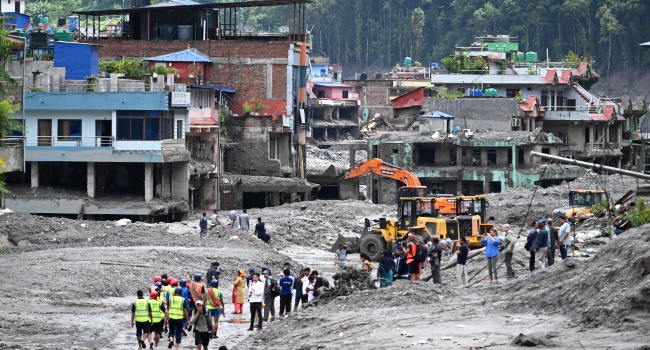
Workers use excavators to clear the mud in the aftermath of flash floods at the Dhunge Bazaar in Nepal’s Nuwakot district on August 29, 2026. Photo by ARUN SANKAR / AFP
Devastating floods near Nepal’s border with China have killed at least 675 people in Nepal, the country’s disaster authority said Saturday.
Chinese state media earlier reported seven deaths in Tibet following Wednesday’s disaster, bringing the combined death toll to 682.
The number of people reported missing in Nepal stood at 2,426 after a sharp increase earlier Saturday.
According to the National Disaster Risk Reduction and Management Authority, the missing include 517 foreigners and 933 workers employed on hydropower projects along the river where the torrent struck.
The list also includes 45 Nepali Army soldiers, 40 police officers, and 19 immigration and customs officials.
The disaster struck an area home to major energy infrastructure projects. Authorities added the 933 hydropower workers to a missing persons list that already included trekkers and pilgrims travelling toward Tibet’s sacred Mount Kailash.
Survivors who escaped the devastation say they have lost everything and are now facing an agonising wait for news of missing relatives, while confronting the daunting prospect of rebuilding their lives from scratch.
“All the settlements near the river were swept away. There is nothing left,” survivor Buddhi Ram Dangol told AFP.
Samjhana Thing said she had been waiting three days for news of her missing brother.
“We don’t know anything. Hopefully he is in a safe place,” she said.
‘Enormous’ Trauma
The humanitarian impact of Wednesday’s catastrophe has been “enormous,” the Red Cross said, warning that as many as 93,000 people may have been affected and that the death toll could rise further.
Emergency teams have been racing to rescue survivors and recover bodies in devastated areas, where widespread destruction has left food and water supplies running dangerously low.
The search has also been complicated by fears of additional flooding.
The deluge of ice, mud and debris caused massive lakes to form, with one such formation posing a direct threat to emergency workers searching the region for survivors.
Nepali police urged rescuers to “immediately move to a safe location” after receiving information that “a water dam has burst again on the Tibetan side.”
In Tibet, where Chinese authorities remain the only official source of information, Beijing temporarily suspended rescue operations in the worst-hit area of Gyirong over concerns about renewed flooding before later reporting that the threat had eased.
China’s state news agency Xinhua reported early Saturday that two villagers had been rescued in the area.
![[UPDATED] Nepal-China Flood Death Toll Rises to 675 as Missing Persons Near 3,000](https://skypenewsnaija.com.ng/wp-content/uploads/2026/08/IMG_9054-150x150.jpeg)
![[UPDATED] Nepal-China Flood Death Toll Rises to 675 as Missing Persons Near 3,000](https://skypenewsnaija.com.ng/wp-content/uploads/2026/08/IMG_9057-150x150.jpeg)