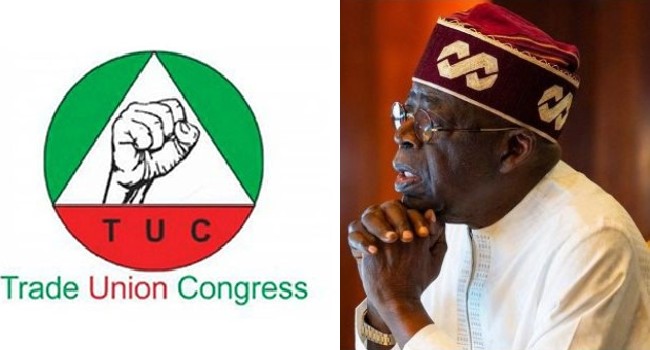
The Trade Union Congress of Nigeria (TUC) has rejected the Federal Government’s proposed ₦70,000 monthly transport support for workers over six months, demanding an immediate salary increase and full implementation of the agreement reached with the Joint Health Sector Unions (JOHESU).
President Bola Tinubu had approved the transport intervention for public service workers across all levels for six months, beginning in November 2026, following a conciliation meeting between the Federal Government and the leadership of the Nigeria Labour Congress (NLC).
However, the TUC maintained that workers needed sustainable salary increases rather than temporary interventions that might not adequately address the rising cost of living.
In a statement following its National Administrative Council meeting held in Abuja on October 8, the union disclosed that it had written to the Federal Government through the Office of the Secretary to the Government of the Federation, outlining its concerns about the economic hardship facing workers and the wider population.
According to the TUC, its letter, dated October 8, 2026, called for an immediate review of workers’ salaries to cushion the impact of rising living costs.
The congress argued that the government did not need to wait for negotiations over a new national minimum wage before increasing workers’ salaries, noting that there was no law prescribing a maximum wage in the country.
The union also argued that the Federal Government could raise the salary of the lowest-paid worker to ₦300,000, citing some state governments that had increased their minimum wages above ₦100,000.
“Some states today have raised their minimum wage above ₦100,000 such that the Federal Government can raise the pay of the lowest worker to ₦300,000, for example, from the current ₦70,000, and then apply the applicable consequential adjustment,” the TUC stated.
It maintained that although negotiations over the minimum wage remained important, they should not prevent the government from implementing an immediate salary increase.
The congress disclosed that its leadership had held consultative meetings with government officials, including the Secretary to the Government of the Federation, during which it reiterated its position.
According to the union, the proposal for a temporary wage award was raised during the discussions but rejected by its leadership.
Why TUC Rejected Temporary Wage Awards
The TUC said its opposition to the proposed intervention was based partly on the previous wage award agreed between the Federal Government and organised labour on October 2, 2023.
The arrangement was intended to remain in place until a new national minimum wage was negotiated in 2024. However, the union alleged that the implementation was incomplete, leaving some workers unpaid.
It said some workers were still owed one or two months of the previous award, while others never received any payment.
“How do we go back to the same wage award that never benefited all workers? How can workers be expected to trust fresh promises when previous obligations remain outstanding?” the congress asked.
The union also alleged that payments under the 2023 arrangement were irregular, with some workers who received up to four months of the ₦40,000 monthly award experiencing gaps of one or two months between payments.
It further claimed that more than 80 per cent of state governments and the informal sector did not implement any form of wage award.
Against this background, the TUC reiterated its demand for a salary increase covering all government workers, describing regular salaries as a more dependable and far-reaching means of supporting employees.
The union insisted that the sacrifices made by Nigerian workers should not be undermined by temporary measures that fail to provide lasting relief.
TUC Calls for Measures to Reduce Cost of Living
The congress also warned that the current economic difficulties extended beyond federal government employees to state and local government workers, pensioners, private-sector employees and those in the informal economy.
It said rising prices of food, transportation, healthcare and other essential goods and services had placed considerable pressure on households across the country.
The TUC called on governments at all levels to introduce measurable interventions to reduce the cost of essential goods and services, ensure the timely payment of salaries and pensions, protect existing jobs and curb exploitative labour practices.
It also urged the government to revitalise the productive sector to create decent employment opportunities.
The union stressed that such interventions must be inclusive, adequately funded and supported by clear implementation timelines.
It added that the government needed to move beyond policy announcements and demonstrate tangible improvements in the living conditions of Nigerians.
TUC Demands Implementation of JOHESU Agreement
On the dispute involving the Joint Health Sector Unions, the TUC called on the Federal Government to immediately implement the outstanding agreement reached with the health workers.
The congress disclosed that its President, Comrade Festus Osifo, had led an organised labour delegation, including JOHESU leaders and a representative of its sister congress, in efforts to resolve the industrial action that lasted several months.
Following several meetings at the office of the Minister of Health, a final conciliation meeting was held at the office of the Minister of Labour and Employment, where both parties agreed on a communiqué.
The Federal Government delegation was led by the Minister of Labour and Employment, Dr Muhammad Maigari Dingyadi, alongside the Minister of Health and Coordinating Minister of Social Welfare, Prof. Ali Pate, and the then Minister of Finance and Coordinating Minister of the Economy, Wale Edun.
The TUC said JOHESU suspended its industrial action in good faith following the agreement, but alleged that the government had yet to fulfil its obligations.
According to the congress, the settlement provided for the resolution of all outstanding issues relating to the Consolidated Health Salary Structure (CONHESS) adjustment without further delay.
However, the union said the adjustment remained unimplemented seven months after the agreement was reached.
“This continued failure to honour an explicit commitment violates the principle of good faith, undermines confidence in collective bargaining and is absolutely unacceptable to the TUC,” the statement said.
The congress called on the Federal Government to implement the agreed CONHESS adjustment immediately, honour the JOHESU agreement, publish a clear implementation timetable, provide the necessary budgetary provisions and resolve all outstanding issues in consultation with the relevant unions.
It warned that health workers should not be expected to continue delivering essential services while agreements reached with them remained unfulfilled.
“The TUC demands tangible action, not further assurances. It will stand firmly with the affected affiliates and health workers and pursue every lawful and legitimate measure necessary to secure compliance,” the union stated.
‘Workers’ Welfare Is Not a Privilege’
Reaffirming its position, the TUC said Nigerian workers were not seeking favours but demanding social and economic justice to protect their dignity and livelihoods.
The congress pledged to continue defending workers’ rights, drawing attention to government non-compliance and pursuing legitimate measures to ensure that agreements were honoured.
“Workers’ welfare is not a privilege. Agreements must be honoured. Workers’ rights must be respected.
“Government must comply,” the statement added.
The TUC said it was rejecting what it considered inadequate temporary relief and instead demanding fair wages for all categories of workers, stronger social protection for vulnerable Nigerians, measures to reduce the cost of living and full implementation of outstanding agreements.
The congress added that it was awaiting the outcome of a scheduled meeting with the Federal Government before deciding on its next course of action.