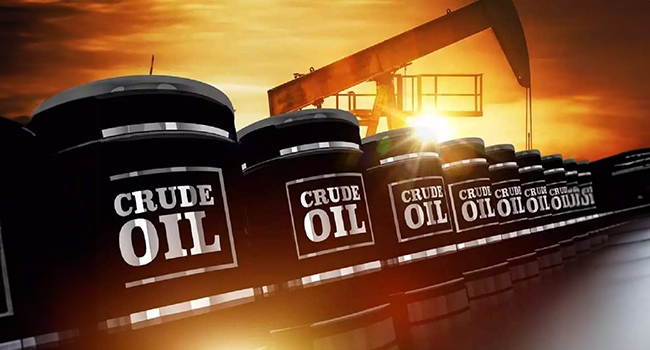












Oil prices extended their gains on Tuesday as prospects for a deal to reopen the Strait of Hormuz weakened, raising fresh concerns about inflation and increasing expectations of at least one US interest rate hike this year.
Crude prices have risen by about 10 per cent over the past week as the United States and Iran appear no closer to reaching an agreement on the strategic waterway, despite earlier optimistic comments from the White House.
Brent crude futures fell 10 cents, or 0.11 per cent, to $87.62 a barrel by 0405 GMT, while US West Texas Intermediate (WTI) crude futures declined 5 cents, or 0.06 per cent, to $82.08 a barrel.
The latest setback came after US President Donald Trump said on Monday that he would seek compensation from Iran for conflict-related damages as part of any peace negotiations. He cited attacks and killings over several decades that he alleged were backed or carried out by Tehran.
Trump’s comments came in response to Iran’s demand for US war reparations as a condition for resolving the crisis.
The US president had said a day earlier that he was “low-keying” his approach to the conflict, suggesting that he was prepared to rely on economic pressure rather than launch further military strikes.
However, the latest exchange between Washington and Tehran appears to have reduced hopes for a quick agreement. On Monday, both major crude benchmarks jumped about five per cent before extending their gains on Tuesday.
“In the absence of any positive headlines on negotiations to reopen the strait, pressure on oil prices has been upward,” Jason Wong of BNZ said.
Stephen Innes, global strategist at Quintex Intel, said both sides were effectively using oil supplies as leverage without directly escalating military action.
“Washington is trying to choke Iran’s ability to get its crude out, while Tehran is squeezing the artery through which everybody else’s crude gets through,” Innes said.
“It is quite the game of chicken.”
Inflation Concerns Return
The prospect of oil prices remaining elevated has renewed concerns about inflation and increased expectations that interest rates could rise.
Although an unexpected decline of more than 20,000 jobs in the US economy last month eased some concerns about a Federal Reserve rate hike, renewed upward pressure on energy prices could complicate the central bank’s policy decisions.
Cleveland Federal Reserve President Beth Hammack told Yahoo Finance on Monday that a single 25-basis-point rate adjustment would likely have limited impact on the economy.
“I would say in general, one 25-basis-point move probably doesn’t do a whole lot for the economy,” she said, adding that several moves could be necessary, although she did not want to prejudge the number.
Investors are now awaiting the release of US consumer price data on Wednesday, which could provide important clues about the Federal Reserve’s next policy decision.
The US-Iran deadlock and rising crude prices have heightened the importance of the inflation figures, particularly as markets assess the potential impact of higher energy costs on consumer prices.
Asian Markets Mixed
Asian equities were mixed on Tuesday following a subdued session on Wall Street.
Shanghai, Wellington, Taipei and Manila recorded modest declines, while Hong Kong, Sydney, Singapore and Seoul posted gains. Tokyo markets were closed for a public holiday.
Key Figures Around 0215 GMT
- Hong Kong — Hang Seng Index: Up 0.1% at 25,946.16
- Shanghai — Composite: Down 0.5% at 3,948.19
- Tokyo — Nikkei 225: Closed for holiday
- West Texas Intermediate: Up 0.3% at $82.40 per barrel
- Brent North Sea Crude: Up 0.3% at $87.97 per barrel
- Euro/Dollar: Up at $1.1546 from $1.1543 on Monday
- Pound/Dollar: Up at $1.3512 from $1.3508
- Dollar/Yen: Down at 159.18 yen from 159.31 yen
- Euro/Pound: Up at 85.46 pence from 85.45 pence
- New York — Dow Jones: Down 0.1% at 53,975.98 at close
- London — FTSE 100: Down 0.4% at 10,862.50 at close