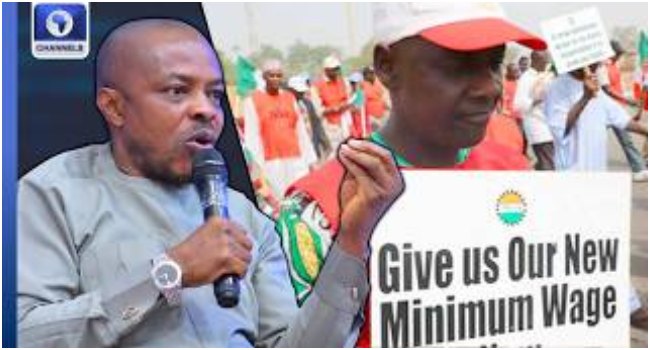
The President of the Nigeria Labour Congress (NLC), Joe Ajaero, has called on the Federal Government to review the minimum wage, arguing that several state governments initially considered incapable of paying higher wages are now paying workers above the federally approved ₦70,000.
Nigeria’s ₦70,000 minimum wage became law on July 29, 2024, following President Bola Tinubu’s signing of the National Minimum Wage Act.
Speaking on Channels Television’s Sunrise Daily on Friday, Ajaero explained that organised labour accepted the ₦70,000 minimum wage partly because the President urged it to consider the financial capacity of state governments.
According to him, Tinubu indicated during negotiations that the Federal Government could afford a higher wage but expressed concerns about the ability of subnational governments to meet such an obligation.
“Part of the reason we agreed on 70,000, the president said, and I quote, you know, I can afford to pay 150,000, you know, but the sub-nationals, you have to put them into consideration in deciding, you know, this 70,000 Naira minimum wage and we were keyed into it,” Ajaero said.
The NLC president disclosed that negotiations had stalled at ₦60,000 before direct discussions between labour leaders and the President resulted in the ₦70,000 agreement.
“That was a negotiation between us and the president directly, not the minimum wage committee,” he said.
However, Ajaero argued that subsequent wage increases by state governments had raised questions about the affordability concerns that influenced the negotiations.
He cited Imo State as paying ₦104,000, while other states were reportedly paying ₦100,000, ₦85,000, ₦84,000 and ₦75,000.
“I think the least could be 72 or more. All the states are paying more than the federal government,” he said.
Ajaero questioned why the Federal Government had maintained the ₦70,000 rate despite the higher wage levels he said were being implemented by state governments.
He urged the administration to reassess its position and consider a review of workers’ wages in light of the prevailing economic realities.
“So I think it’s incumbent on the federal government to go back to the drawing board and find out what is happening,” he said.
NLC Rejects 30-Day Fuel Discount as ‘Panicky Measure’
Commenting on the Federal Government’s 30-day petrol discount initiative, Ajaero said the intervention had not altered organised labour’s two-week ultimatum demanding fresh minimum wage negotiations and other measures to ease workers’ economic hardship.
He questioned the effectiveness of the temporary discount, arguing that it did not adequately address labour’s concerns about petrol prices and the declining purchasing power of workers.
“It’s better we take it from the point of the ultimatum we gave two days ago. And this piece of information has not altered anything,” he said.
The labour leader described the announcement as a “panicky measure” and questioned how the discount at Nigerian National Petroleum Company Limited (NNPC) retail outlets would influence prices charged by other fuel marketers.
“Other marketers are not like the NNPC. So they should tell us what other marketers will sell,” he said.
Ajaero noted that petrol sold for between ₦650 and ₦750 per litre when labour agreed to the ₦70,000 minimum wage, arguing that the government needed to provide clearer information about the discount and its implications for consumers.
He also questioned what would happen after the 30-day initiative expires.
“We need to get the whole information from them and know what it’s actually all about,” he said.
“Within 30 days, after 30 days, what happens?”
Minimum Wage Talks, Interim Wage Award Top Labour’s Demands
Clarifying the demands behind the two-week ultimatum, Ajaero said labour was seeking renewed minimum wage negotiations, an interim wage award to cushion workers’ hardship and appropriate pricing for Premium Motor Spirit (PMS), commonly known as petrol.
He explained that the proposed wage award would serve as a temporary intervention while negotiations towards a new minimum wage arrangement were concluded.
“Exactly. It’s around minimum wage, not a wage award. Around minimum wage, a wage award as an interventionary measure between now and when the minimum wage will be concluded,” he said.
“And then getting the appropriate pricing for a PMS. Those are three key items.”
Ajaero also called for tax relief for workers, noting that the measure formed part of an agreement reached between organised labour and the Federal Government in 2023 but had yet to be implemented.
Asked whether the government consulted labour before announcing the petrol discount, the NLC president accused the administration of failing to maintain meaningful dialogue with the union.
He alleged that the government had not engaged the NLC adequately in recent years and had failed to respond to its correspondence.
“The federal government does not dialogue. In the last two, three years, you know, no conversation. Letters are not even attended to,” he said.