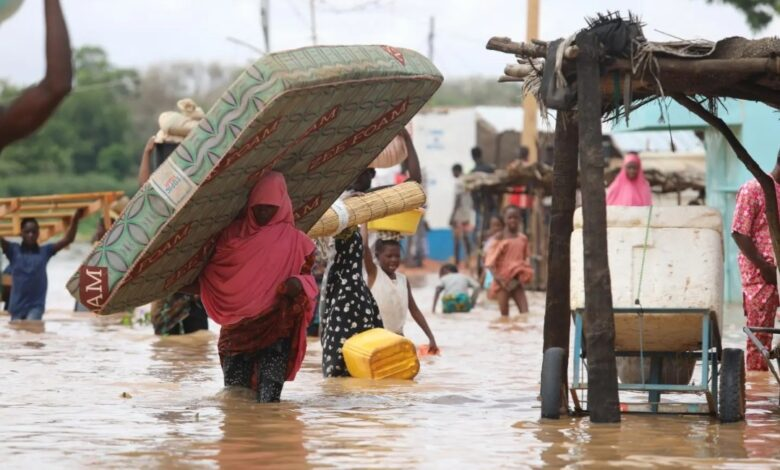












The Nigeria Hydrological Services Agency (NiHSA) has issued a flood alert, warning that 17 states across the country are likely to experience flooding between July 21 and July 27, 2026.
The warning was contained in the agency’s National Flood Advisory (Alert No. NFA-2026-200), which forecasts a medium flood risk in the affected states.
According to the Director-General and Chief Executive Officer of NiHSA, Arc. Umar Mohammed, the states include Bauchi, Edo, Imo, Kaduna, Plateau, Benue, and 11 others.
Mohammed said the forecast points to imminent localized flooding along major river channels and floodplains, stressing the need for proactive risk management, early evacuation, and coordinated action among relevant agencies to safeguard lives, livelihoods, and critical infrastructure.
He revealed that water levels at key hydrological monitoring stations—including Saminara on the Karam River, Waya Dam Site on the Waya River, and Amber on the Amber River—have exceeded watch and warning thresholds.
“Our hydrological monitoring network indicates that river stages at critical monitoring stations have exceeded watch and warning thresholds. With 16 gauging stations recording elevated water levels, communities along major river channels face imminent localized flooding. We strongly advise state governments, local authorities, and residents in flood-prone areas to take immediate precautionary measures,” Mohammed said.
The advisory identified 16 critical gauging stations nationwide as being at risk and outlined the likely impact across several states.
In Bauchi State, about 1,841 communities, 145 schools, 101 health facilities and eight markets are exposed to flooding. Edo State has 148 vulnerable communities, 131 schools, 123 health facilities, four markets, seven religious centres and seven hectares of farmland at risk.
Imo State could see flooding affect 415 communities, 423 schools, 198 health facilities, 49 markets, 111 religious centres and 75 hectares of farmland. Kaduna has 168 communities, 16 schools, three health facilities and three religious centres in vulnerable locations.
Plateau State has 205 communities, 137 schools, 44 health facilities, 16 markets, 81 religious centres and 64 hectares of farmland identified as being at risk, while Benue State has five communities, eight schools, two health facilities and four religious centres listed in the advisory.
NiHSA urged the National Emergency Management Agency (NEMA), State Emergency Management Agencies (SEMAs), local government authorities and community leaders to implement precautionary measures without delay.
The agency advised residents living on floodplains to evacuate immediately with their families, livestock and essential belongings to designated safe shelters. It also called on emergency agencies to pre-position food, medical supplies, water treatment materials and other relief items in strategic locations.
In addition, NiHSA urged communities to activate early warning systems, clear blocked drains, culverts and waterways, avoid walking or driving through flooded roads and fast-flowing water, and continue monitoring daily flood advisories for updated information.