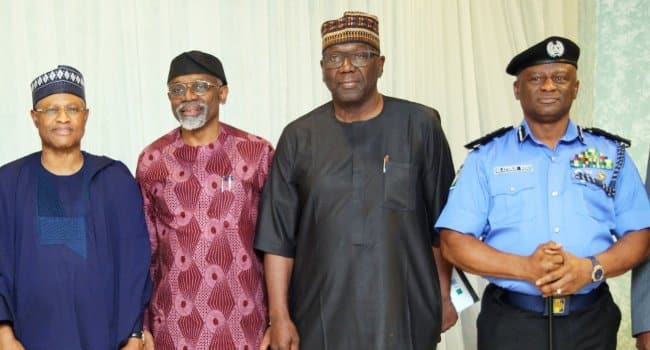
L-R: Governor Uba Sani of Kaduna State, Chief of Staff to the President, Femi Gbajabiamila; Governor AbdulRahman AbdulRazaq of Kwara State; and Inspector-General of Police Tunji Disu, after a meeting of the Presidential Working Group on police reform at the State House in Abuja on October 15, 2026. Photo: X/@aonanuga1956
The Presidential Working Group on Police Reform has announced that the National Policing Bill is 90 per cent ready for transmission to the National Assembly, with the process expected to be completed within the next two weeks.
Chief of Staff to President Bola Tinubu and Chairman of the Working Group, Femi Gbajabiamila, disclosed this on Thursday while addressing journalists after a steering committee meeting at the State House, Abuja.
Gbajabiamila said the committee might hold one more meeting to review outstanding issues and ensure that all relevant areas had been adequately addressed before transmitting the bill to the National Assembly.
“The National Policing Bill is more or less ready for transmission to the National Assembly. We will probably have one more meeting after this to cross the t’s and dot the i’s and make sure every area is covered. So, we are 90 per cent ready,” he said.
According to a statement issued by the Special Adviser to the President on Information and Strategy, Bayo Onanuga, Gbajabiamila added that state governors had raised a few observations that would be addressed before the bill was finalised.
“The governors have one or two observations, and we should be ready in about a week or so,” he stated.
Gbajabiamila described the proposed legislation as “the most consequential Bill of the administration so far,” noting that it had undergone extensive deliberations since the Working Group’s steering committee commenced discussions on August 3.
On concerns that some states might delay the passage of the Sixth Constitution Alteration Bill, which seeks to establish state police, Gbajabiamila expressed confidence that the proposed amendment enjoyed broad national support.
His remarks followed reports that only about six states out of the 36 states and the Federal Capital Territory had passed the constitutional amendment.
He, however, maintained that there was a national consensus on the need for the reform, questioning why any state would reconsider its support for the initiative.
“I see no reason why anyone will want to have a rethink on it,” he added.
The meeting was attended by the Chairman of the Nigeria Governors’ Forum and Kwara State Governor, AbdulRahman AbdulRazaq; Ogun State Governor, Dapo Abiodun; Kaduna State Governor, Uba Sani; and the Inspector-General of Police, Tunji Disu.
Also present was the Attorney-General of the Federation and Minister of Justice’s representative, Solicitor-General and Permanent Secretary of the Federal Ministry of Justice, Beatrice Jedy-Agba.
Other members of the committee include the Chairman of the Policy Advisory Committee, retired Justice Abdullahi Liman; Head of the Nigeria Police Reform Secretariat, Olu Ogunsakin; and Special Adviser to the President on National Assembly Matters (House of Representatives), Lanre Smart.
The Senior Special Assistant to the President on Planning and Research, Nnadubem Moghalu, who also serves as the committee’s secretary, was present alongside representatives of the Nigerian Bar Association and the National Security Adviser, represented by AIG Abraham Thomas.