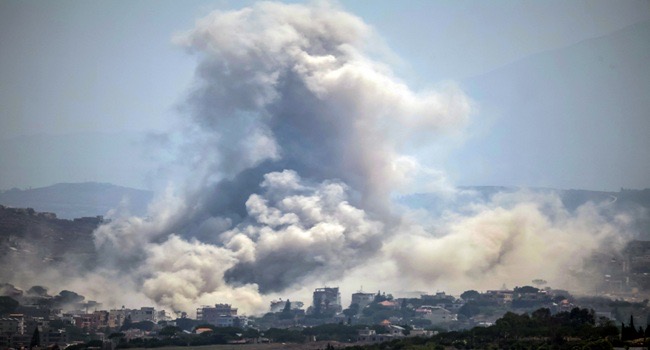









This image taken from the vicinity of the village Zawtar al-Sharqiyah in southern Lebanon, shows smoke rising from the site of an explosion carried out by the Israeli military, in the village of Kfar Tibnit on July 23, 2026.(Photo by ibrahim AMRO / AFP) /
Iran and the United States have paused hostilities, raising hopes for renewed diplomacy after days of intense military exchanges that disrupted Gulf shipping and threatened global energy supplies.
Iran announced on Sunday that it had suspended retaliatory attacks against US allies in the Middle East, while US Ambassador to the United Nations Mike Waltz said President Donald Trump was allowing negotiations “a little bit of room” despite American forces remaining on high alert.
The development follows a series of US airstrikes on Iran that lasted 13 consecutive nights before coming to a halt. According to Iranian army spokesman Mohammad Akraminia, Tehran has also stopped its retaliatory operations in response to the pause in US attacks.
“These attacks continued until two nights ago, but over the past two nights the Americans have stopped their attacks,” Akraminia said. “Since our strategy has essentially been retaliatory, we have also halted our retaliatory operations.”
The conflict, which intensified after fighting around the strategic Strait of Hormuz disrupted diplomatic efforts, expanded to include attacks on US military bases, commercial shipping and Gulf allies. Unconfirmed Iranian media reports on Sunday claimed an oil tanker had been damaged by a sea mine.
The lull has renewed hopes for a diplomatic breakthrough, although some US media reports suggested the pause may also be linked to concerns over dwindling supplies of Patriot missile interceptors and other defensive munitions.
Waltz rejected those claims during separate appearances on Fox News and NBC’s Meet the Press, insisting the US military had sufficient resources to continue operations if necessary.
“I want to be crystal clear. The US military has everything it needs to conduct this campaign as effectively as required,” he said.
Israeli Prime Minister Benjamin Netanyahu is expected to meet Trump at the White House on Tuesday, where he is likely to push for continued pressure on Tehran, particularly over its nuclear programme.
While Iran maintains its nuclear programme is strictly for civilian purposes, the United States and its allies argue it is aimed at developing nuclear weapons.
Speaking to Fox News, Netanyahu backed Trump’s efforts to prevent Iran from acquiring nuclear weapons.
“If he can do so without returning to intense military fighting, that’s fine. Why not? But one way or the other, they have to end their nuclear programme. With a deal or without a deal, that has to come to an end,” he said.
Meanwhile, The New York Times reported that plans to intensify the US military campaign had been put on hold partly because of shrinking munitions stockpiles, citing sources familiar with the matter.
Trump also faces growing concerns over the risk of a broader regional conflict, strained relations with Gulf allies and potential economic fallout. Speaking on Friday, the US president said he had yet to decide whether to resume full-scale military operations.
“We’re talking to them right now. I think they’re getting more and more serious,” Trump told reporters.
The conflict, which Trump had earlier predicted would last only four to five weeks, is now approaching its fifth month and has increasingly weighed on his approval ratings ahead of the November US midterm elections.
Despite the tensions, daily life in Tehran appeared largely normal on Sunday, with businesses operating as usual despite heavy traffic and an ongoing heatwave.
Elsewhere, the conflict continued to spread. Iran-backed Houthi rebels claimed on Sunday that they shot down a Saudi drone over northwestern Yemen, a day after announcing attacks on Saudi Aramco oil facilities in Jizan and Yanbu in retaliation for Saudi airstrikes on Houthi positions.