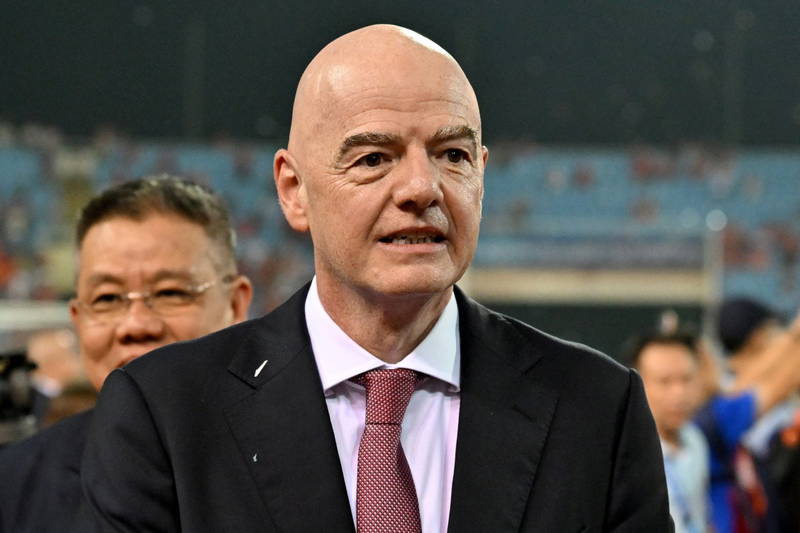
The chairman of the English Football Association (FA), Debbie Hewitt, has challenged FIFA President Gianni Infantino to provide answers and release documents relating to a controversial commercial rights proposal, warning that his failure to do so would raise questions about his continued leadership of world football.
Hewitt, who is also a FIFA vice-president, disclosed that Infantino apologised to the FIFA Council over the abandoned FIFA Forward Enterprise (FFE) proposal during a meeting in Zurich on Thursday. However, she said the FIFA president failed to address several key concerns raised by Council members.
The proposal, which Infantino withdrew within days of its emergence, would have transferred part of FIFA’s commercial rights to a private investment firm.
According to the BBC, the three-and-a-half-hour meeting also examined the suspension of a red-card ban imposed on United States striker Folarin Balogun, the FIFA Peace Prize awarded to US President Donald Trump, and funding for national football associations.
Hewitt described the meeting as unusually frank but expressed disappointment that FIFA had not provided documents specifically requested by Council members regarding the FFE proposal.
“One of the disappointing things is that we didn’t get answers to anything that we had specifically requested — for example, getting the papers from FFE,” she said.
She insisted that Infantino must address the outstanding questions, arguing that continued silence would undermine confidence in his leadership.
“I think the man has to answer those questions and if he doesn’t answer those questions now, he’s not fit to be FIFA president — and that was what was shared in the meeting,” Hewitt said.
According to her, Infantino’s apology focused primarily on his failure to present the proposal to the Council rather than providing a comprehensive explanation of the circumstances surrounding it.
“What he really apologised for was not bringing it to the Council. If you regret it that deeply, share it with us,” she added.
Hewitt said access to the documents was necessary to establish whether those involved in the proposal could be trusted and determine whether further action, including possible criminal proceedings, was warranted.
European football’s governing body, UEFA, has also challenged FIFA over the proposal. It has reportedly initiated legal proceedings in three United States courts in an effort to obtain documents relating to the FFE plan.
Asked whether Thursday’s meeting had changed her position on Infantino, Hewitt said she had received no new information that would alter her assessment, apart from his apology.
“From my position, nothing has shifted. I’ve no new information that makes me feel any differently, other than we do have a president who is apologetic,” she said.
Balogun Ban and Trump’s Peace Prize Under Scrutiny
The suspension of the red-card ban imposed on Balogun following his dismissal at the 2026 FIFA World Cup was another major issue discussed at the meeting.
The decision reportedly followed a request by US President Donald Trump for the case to be reviewed.
According to the BBC, a proposal was presented to the FIFA Council to amend the organisation’s disciplinary code to prevent a similar situation from recurring.
Under the proposed changes, FIFA’s disciplinary committee would be prohibited from suspending an automatic one-match ban resulting from a red card.
Hewitt argued that the Balogun decision, alongside the FFE proposal, had damaged football’s reputation.
“What happened in July did not serve football… whether it’s the Balogun case, the FFE case… the reputation of football was put under serious threat,” she said.
She warned that political influence over decisions affecting matches could have serious consequences for the sport.
“Once behaviour starts to influence what happens on the pitch, then I think it’s a dark day for football and a number of people said that in the room,” she added.
The FIFA Peace Prize awarded to Trump also came under scrutiny, with Council members examining how the award was conceived, who authorised it and whether it should be withdrawn or reformed.
Hewitt said FIFA’s social committee would investigate the circumstances surrounding the award and submit its recommendations to the Council in December.
She also criticised Infantino’s engagement with political leaders and other dignitaries, arguing that FIFA’s leadership should prioritise the interests of its 211 member associations.
“When he puts other dignitaries in front of his 211 associations, then he’s lost what football is about,” she said.
Infantino Expected to Seek Third Term
Infantino is expected to seek a third term as FIFA president in March 2027, although opposition figures have yet to rally widespread support behind a challenger.
Former Tottenham Hotspur and Switzerland defender Ramon Vega has declared his intention to contest the election, but the extent of his support among FIFA member associations remains uncertain.
Some senior figures in European football have also called on former Arsenal manager Arsène Wenger to challenge Infantino, although it remains unclear whether he would be willing to enter the race.
Candidates must secure nominations from at least five FIFA member associations, with the deadline for nominations set for November 18.
Hewitt said it was important for FIFA members to have a choice in the election, noting that Infantino was re-elected unopposed in 2019 and 2023.
“I think it’s important to Gianni to have somebody who stands with a different manifesto, and good for FIFA to have that choice,” she said.
She added that any challenger should prioritise football, unite the global game and demonstrate the determination to implement reforms.
The FIFA Council is expected to consider the findings of the investigation into the Peace Prize in December, as calls for greater transparency over controversial decisions continue to emerge from within football’s governing body.