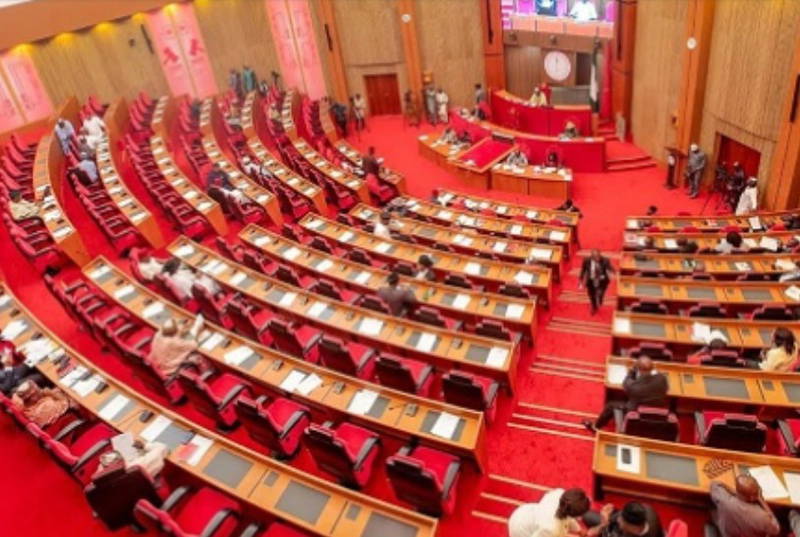

The Senate has urged the Federal Government to release emergency funds from the service-wide vote to strengthen disease surveillance and enforce mandatory health screening at all international airports, seaports and designated land borders to prevent the spread of Ebola and other epidemic-prone diseases.
The resolution followed a motion of urgent national importance sponsored by Senator Francis Faduyile, who raised concerns over the spread of the Bundibugyo Ebola virus and the potential threat to Nigeria’s public health system.
Faduyile noted that the outbreak, which began in the Democratic Republic of the Congo (DRC), had spread to other African countries, including Uganda and Kenya, increasing the risk of infected travellers entering Nigeria through third countries.
He also cited the Nigeria Centre for Disease Control and Prevention’s (NCDC) assessment of a high risk of Ebola importation, recalling that a single infected traveller brought the disease into Nigeria through Lagos in July 2014.
The Senate acknowledged the Federal Government’s existing preventive measures, including the introduction of health declaration forms and enhanced screening at entry points.
However, it expressed concern that screening requirements had been restricted to travellers from selected countries, potentially creating gaps in Nigeria’s disease surveillance system.
The lawmakers also highlighted inadequate staffing and equipment at several entry points, alongside the continued reliance of Port Health Services on the Quarantine Act of 1926.
They warned that Nigeria’s existing disease burden, including Lassa fever, cholera and diphtheria, made it imperative for the country to strengthen its preparedness against another major public health emergency.
Consequently, the Senate called on the Federal Ministry of Health and Social Welfare, the NCDC and Port Health Services to make health screening compulsory for all arriving international passengers, regardless of nationality or country of departure.
The proposed measures include completing health declaration forms, temperature checks and symptom assessments, with enhanced screening for travellers who have visited or transited through affected areas within the preceding 21 days.
The upper chamber also recommended exit screening for departing passengers during declared public health emergencies.
It further urged the Federal Ministry of Health and Social Welfare, the Federal Airports Authority of Nigeria and the Nigeria Immigration Service to ensure that all entry points had adequate numbers of trained Port Health officers, thermal scanners, protective equipment and isolation facilities.
The Federal Government was also urged to ensure that isolation and treatment centres were adequately equipped and prepared across the 36 states and the Federal Capital Territory.
On the legal framework for disease control, the Senate called for the replacement of the Quarantine Act of 1926 with modern public health legislation aligned with the International Health Regulations (2005).
It also urged the relevant ministries responsible for finance, budget and economic planning to provide adequate funding for the NCDC and Port Health Services in the 2027 budget and release outstanding appropriated funds.
Nigeria Confirms Ebola Case
Meanwhile, the Federal Government on Wednesday confirmed an Ebola Virus Disease case in the Federal Capital Territory (FCT).
The Coordinating Minister of Health and Social Welfare, Muhammad Pate, disclosed in Abuja that laboratory tests had confirmed the imported case.
According to the minister, the patient is a woman with a recent travel history to Uganda who returned to Nigeria with symptoms on October 7. Her condition reportedly worsened four days later before laboratory tests confirmed the infection.
However, Ugandan authorities have disputed reports of an Ebola outbreak in their country.
Uganda’s Ministry of Health said the location where the patient was exposed to the virus remained under investigation, adding that travelling through Uganda alone was insufficient to establish where the infection occurred.
The ministry also stated that the Nigerian government had yet to provide detailed information about the patient’s travel itinerary and clinical history, which it said would assist further investigations and any necessary contact tracing.
The outbreak of the deadly viral haemorrhagic disease has raised concerns across Africa since it was reported in the DRC in May.
Kenya reported its ninth Ebola case on Tuesday, according to the report.
The outbreak in the DRC has also taken a devastating toll, with health authorities reporting more than 9,000 confirmed cases and over 4,000 deaths, making it one of the country’s most serious Ebola outbreaks.