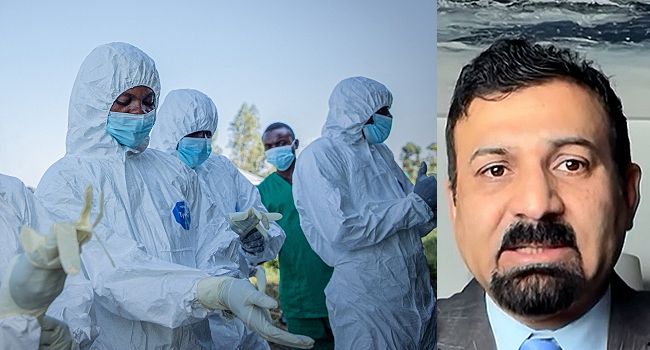
A United Kingdom (UK) Virologist at the University of Lancaster, Muhammed Munir, speaking on Channels Television’s The Morning Brief on Monday, October 26, 2026.
A United Kingdom-based virologist at Lancaster University, Muhammed Munir, has warned that the prolonged incubation period of the Bundibugyo strain of Ebola could make early detection difficult, as infected individuals may not develop clinical symptoms for two weeks or longer.
Munir raised the concern during an interview on Channels Television’s The Morning Brief on Monday, stressing the need for heightened surveillance and prompt reporting of suspected infections.
He explained that the virus could remain undetected in an infected person for an extended period before symptoms begin to appear.
“One of the complex things with the Ebola virus compared to many other infections that we currently are dealing with is that it has a very long incubation period, which means that if a person is infected today, the clinical signs could turn out to be in two weeks or at the end of the three weeks’ time,” he said.
According to the virologist, the extended incubation period could make it difficult for individuals to identify where they contracted the infection, particularly if they had travelled to an affected area weeks earlier.
He noted that an infected person could still be carrying the virus without showing obvious clinical signs, making effective surveillance and monitoring of contacts essential to containing the disease.
Munir’s warning comes amid an Ebola case involving a 42-year-old woman in the Federal Capital Territory, Abuja, who reportedly travelled from Uganda through Addis Ababa before arriving in Nigeria on October 3.
The woman was said to have developed symptoms four days after her arrival and was admitted to a private health facility on October 10, where she received treatment.
Health authorities subsequently began monitoring individuals identified as contacts of the index case to prevent further transmission.
In an update on Sunday, the Nigeria Centre for Disease Control and Prevention (NCDC) disclosed that the number of contacts linked to the case had increased to 53.
Virologist Questions Origin of Infection
Munir also questioned the circumstances surrounding the identification of the index case, particularly reports suggesting a possible link to the Democratic Republic of Congo (DRC).
He argued that if the woman had travelled only to Uganda before arriving in Nigeria, without visiting the DRC, the circumstances would warrant further investigation into the possible source of the infection.
“If the person who has been considered as the index case hasn’t been to DRC and has only been to Uganda, that really raises some of the serious questions,” he said.
He added that if the infection had been acquired in Uganda, it would raise concerns about the possibility of ongoing transmission in the country, despite the status of the outbreak being reported there.
The virologist’s comments underscore the importance of establishing the likely source of infection through epidemiological investigations, travel histories and contact tracing.
Early Reporting Critical to Containment
Munir also urged individuals who suspect they may have contracted Ebola to seek medical attention promptly, warning against fear or embarrassment that could discourage them from reporting their symptoms.
He stressed that early reporting and timely medical intervention were essential to identifying cases, tracing contacts and preventing further spread of the virus.
“So, one should not feel shy about accepting those facts because until we really look at those cases, we are not going to have a good handle on the infection,” he said.
His advice comes as Nigerian health authorities continue surveillance and contact-tracing efforts in response to the reported case, with public health officials emphasising the importance of cooperation in containing potential transmission.