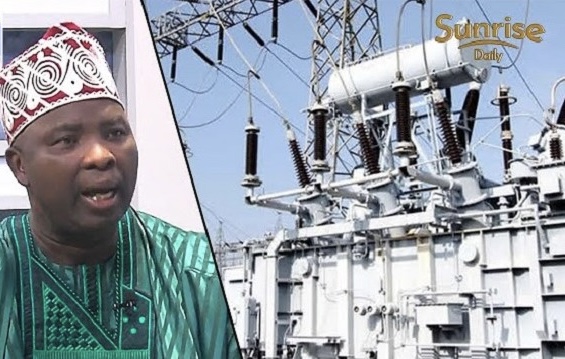
A combo of the Chief Executive Officer of the Association of Nigerian Electricity Distributors (ANED), Sunday Oduntan and electricity installations.
Electricity Distribution Companies (DisCos) have apologised to Nigerians over persistent power outages across the country, acknowledging the hardship caused by weeks of inadequate electricity supply.
The Managing Director and Chief Executive Officer of the Association of Nigerian Electricity Distributors (ANED), Sunday Oduntan, tendered the apology on Monday during an interview on Channels Television’s Sunrise Daily.
“I’d like to first of all start by apologising to Nigerians. Apology is needed; it is essential because Nigerians have been taken through this problem over the past few weeks,” he said.
Oduntan also expressed concern over what he described as a resurgence of the blame game among stakeholders in the electricity sector, recalling that similar disagreements contributed to the industry’s challenges between 2016 and 2019.
He noted that during the period, distribution companies blamed transmission operators, the Transmission Company of Nigeria (TCN) pointed to generation companies, while power generators blamed gas suppliers and payment-related challenges for inadequate electricity supply.
“Our major problem is that we have started that very wrong route that we went through between 2016 and 2019. What is that? Blame game,” he said.
He warned that the return of such disagreements would further complicate efforts to address the country’s electricity challenges.
The ANED chief also questioned recent statements by the Nigerian Independent System Operator (NISO) and the Nigerian National Petroleum Company Limited (NNPC) regarding the causes of the persistent power shortages.
According to him, NISO had attributed the supply constraints partly to low water levels and inadequate gas supply, while the NNPC subsequently issued a statement indicating that gas was available.
Oduntan, however, said the NNPC needed to provide further clarification on whether outstanding payments were affecting gas supply to electricity generation companies.
“From the NNPC statement, it is very clear that they came to tell us half-truths. What I would have expected NNPC to do is to go ahead and talk to us whether there are payment issues. We need to know whether gas was paid for and delivered, who did, who didn’t,” he said.
He urged the Minister of Power to take the lead in resolving the disagreements by convening a meeting of the relevant stakeholders to establish the actual causes of the electricity shortages and agree on practical solutions.
Oduntan stressed that stronger leadership and coordination among gas suppliers, the NNPC, transmission operators and other industry players were necessary to address the crisis.
“This back and forth blame game between gas suppliers, NNPC and, of course, TCN or NISO, I think the Minister of Power needs to take charge.
“There is a need for this leadership because, at the end of the day, they need to call them together,” he said.