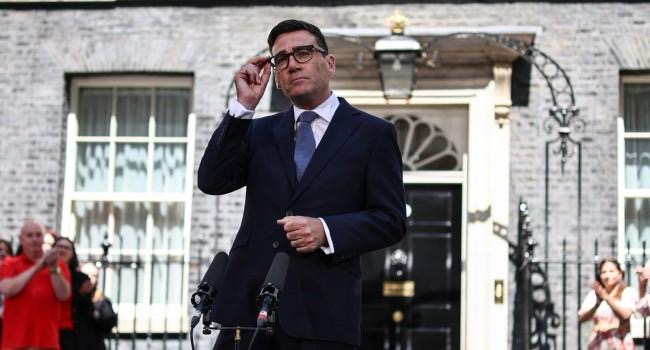





Britain ushered in its seventh prime minister in a decade on Monday as Andy Burnham officially took office following the resignation of Keir Starmer.
Burnham, a veteran Labour politician, assumed office after Starmer stepped down in June amid months of plunging approval ratings and mounting pressure from Labour MPs. He was later overwhelmingly endorsed by the party to succeed him.
Speaking outside 10 Downing Street after being invited by the King to form a government, Burnham acknowledged the country’s recent political instability, saying he was “acutely conscious” of the need to restore stable leadership.
Labour had previously criticized the Conservatives for the frequent changes in leadership during their time in government. However, the party has now experienced a similar fate, replacing its own leader less than two years after securing a landslide victory in the July 2024 general election.
Starmer’s election victory ended 14 years of Conservative rule. During the campaign, he repeatedly condemned what he described as the “chaos” of Conservative leadership changes, as the party had rotated through five prime ministers between 2016 and 2024.
With Burnham’s appointment, Britain has now had seven prime ministers since the beginning of 2016.
David Cameron (May 2010 – July 2016)
David Cameron’s premiership came to an end after Britain voted to leave the European Union in the June 2016 Brexit referendum. Having campaigned for the UK to remain in the bloc, Cameron resigned following the historic vote.
Theresa May (July 2016 – July 2019)
Theresa May inherited the challenge of delivering Brexit after years as home secretary. Seeking a stronger mandate, she called a snap election in 2017, but the gamble backfired, leaving the Conservatives without a parliamentary majority.
After repeatedly failing to secure parliamentary approval for her Brexit deal and suffering heavy losses in the 2019 European Parliament elections, May resigned.
Boris Johnson (July 2019 – September 2022)
Boris Johnson led Britain through Brexit and the COVID-19 pandemic, winning a commanding victory in the December 2019 general election.
His government, however, became engulfed in a series of scandals that eroded public and party confidence. Mounting resignations by ministers and aides eventually forced him from office.
Liz Truss (September 2022 – October 2022)
Liz Truss served just 49 days as prime minister—the shortest tenure in British history.
Her proposed tax-cutting mini-budget triggered turmoil in financial markets, shook investor confidence, and pushed the UK economy toward crisis, leading to a swift loss of support within her own party.
Rishi Sunak (October 2022 – July 2024)
Rishi Sunak took office promising stability after the Truss administration. Although he restored some confidence in government, he struggled to unite the divided Conservative Party.
Faced with persistent inflation and a worsening cost-of-living crisis, Sunak failed to reconnect with voters, and the Conservatives were defeated by Labour in the 2024 general election.
Keir Starmer (July 2024 – July 2026)
Keir Starmer entered office with a commanding parliamentary majority after ending more than a decade of Conservative rule.
Internationally, he received praise for his stance against US President Donald Trump over the Iran conflict and for maintaining European backing for Ukraine.
Domestically, however, his government faced growing criticism over welfare reforms, rising business costs, and continued economic pressures on households. Labour also struggled to contain the rise of Nigel Farage’s Reform UK, suffering significant losses in local elections in May.
Starmer’s leadership was further overshadowed by controversy surrounding the appointment and subsequent dismissal of Peter Mandelson as Britain’s envoy to Washington over scrutiny of Mandelson’s past links to the late convicted sex offender Jeffrey Epstein.
With Burnham now in office, Britain begins yet another chapter in what has been one of the most politically turbulent decades in its modern history.