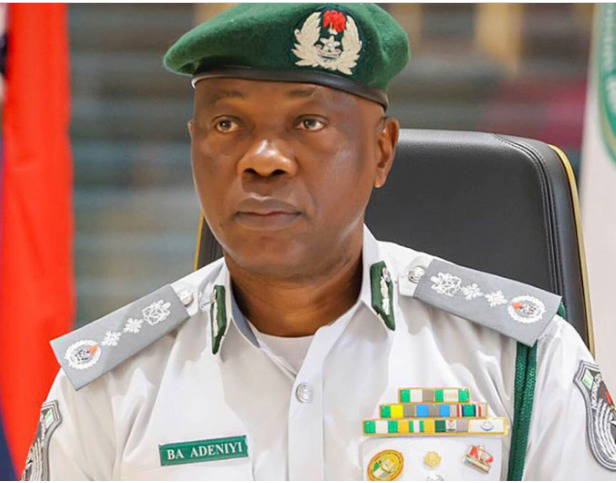
Customs Comptroller-General, Bashir Adewale Adeniyi
The Nigeria Customs Service (NCS) has called for a review of import duty concessions worth N1.68 trillion granted in 2024, warning that poorly targeted waivers could undermine government revenue and weaken funding for essential public services.
The Comptroller-General of Customs, Bashir Adeniyi, said the review was necessary to determine whether the concessions were achieving their intended economic objectives or unnecessarily depriving the government of revenue.
Adeniyi spoke on Tuesday at the third Distinguished Personality Lecture of the TETFund Centre of Excellence in Security Management, University of Ibadan, Oyo State.
Delivering a lecture titled, “Why Customs Matters: Revenue, Security and Nationhood in a Borderless World,” he said reviewing tax concessions should form part of broader efforts to strengthen revenue mobilisation through improved compliance, digitalisation, intelligence-led enforcement and transparent trade procedures.
The Customs chief disclosed that the Service generated N7.28 trillion in 2025, surpassing its target of N6.58 trillion. Collections reached approximately N4.03 trillion in the first half of 2026, against an annual target of N11.07 trillion.
He said the figures underscored the growing importance of Customs to Nigeria’s public finances and the need to eliminate revenue leakages without imposing unnecessary burdens on legitimate businesses.
According to Adeniyi, Customs revenue is not exclusively for the Federal Government, as import duties contribute to the Federation Account for distribution among the three tiers of government.
He cited the revenue-sharing formula as 52.68 per cent for the Federal Government, 26.72 per cent for state governments and 20.60 per cent for local governments.
He added that, under the new tax laws, 90 per cent of value-added tax collected on imports was allocated to state and local governments.
“When a smuggler evades duty, he does not cheat an abstraction called government. He cheats a pupil, a nurse and a farmer,” Adeniyi said.
The Comptroller-General traced the Service’s revenue growth from N3.2 trillion in 2023 to N6.105 trillion in 2024 and N7.28 trillion in 2025, attributing the increase to improved compliance, accurate valuation, digital systems and stronger enforcement.
He said the NCS intended to meet its 2026 revenue target by plugging leakages rather than obstructing legitimate trade.
“We will pursue the target through compliance, data and facilitation, not through harassment at the ports, because a target met by choking trade would be a false victory,” he said.
Customs Targets Trade Misinvoicing, Revenue Leakages
Adeniyi identified illicit financial flows and trade misinvoicing as major threats to Nigeria’s revenue base and the integrity of its trading system.
He explained that trade misinvoicing occurs when importers or exporters manipulate the declared value or description of goods to evade taxes, customs duties and other financial obligations.
He noted that Africa’s tax-to-GDP ratio stood at approximately 16.1 per cent, compared with 33.9 per cent for countries in the Organisation for Economic Co-operation and Development, highlighting the continent’s challenges in mobilising domestic revenue.
According to him, Customs can help narrow the gap by improving the accuracy of declarations, strengthening risk assessments and ensuring that taxable transactions are properly evaluated.
He said the Service was deploying digital platforms and data analytics to improve import assessments, detect suspicious declarations and reduce delays at the ports.
Adeniyi disclosed that the B’Odogwu cargo-processing platform handled approximately 16,000 entries and generated N120 billion in revenue within its first three months of operation at the Port and Terminal Multi-Services Limited Command.
He also highlighted the National Single Window initiative, which went live on March 27, 2026, to connect trade-related government processes and eliminate duplication in documentation.
According to him, a study conducted at Tin Can Island Port showed that cargo release took nearly five days on average, with more than 90 per cent of the time spent waiting.
He said the Service was working towards reducing cargo clearance time to 24 hours in the long term, with an interim target of two days. The plan also includes using scanning technology instead of physical examination for 99 per cent of cargo.
The Customs chief added that 51 companies certified under the Authorised Economic Operator programme had reduced their cargo clearance time from 168 hours to 41 hours, while demurrage costs had fallen by approximately 90 per cent.
He said the improvements demonstrated that revenue collection and trade facilitation could complement each other when procedures were efficient and compliance was properly enforced.
Customs Links Revenue Protection to National Security
Adeniyi said revenue protection was inseparable from national security, citing several seizures of weapons, illicit drugs, counterfeit medicines and prohibited wildlife products.
He recalled the interception of 399 pump-action rifles and hundreds of firearm components concealed in a container discharged from the vessel MV Velika at Tin Can Island Port in July 2026.
The seized weapons were handed over to the National Centre for the Control of Small Arms and Light Weapons, while the case remained before the Federal High Court.
He also cited the seizure of 844 rifles and 112,500 rounds of ammunition at Onne, Rivers State, in June 2024, as well as the handover of 1,599 firearms seized between 2018 and 2024 to the national centre in February 2025.
On public health, Adeniyi disclosed that Customs intercepted 25 containers of fake and unregistered medicines worth approximately N9.2 billion in July 2025.
He further cited the seizure of 3.76 tonnes of pangolin scales in Lagos in April 2025, representing at least 1,900 animals.
According to him, enforcement operations since 2021 had resulted in the seizure of more than 25 tonnes of pangolin scales and over one tonne of ivory, with 12 convictions secured.
He identified fuel smuggling, drug trafficking and the illegal movement of food commodities as other activities threatening public safety, economic stability and government revenue.
Customs Rejects Blanket Border Closures
On border management, Adeniyi advocated intelligence-led enforcement and stronger cooperation with neighbouring countries, arguing that blanket border closures were less sustainable than targeted controls.
He said Nigeria’s land-border closure between August 2019 and December 2020 curtailed some smuggling activities but failed to dismantle the networks responsible for illegal trade.
“The lesson is that a nation is protected by intelligent control of its border, not by sealing it. Closure is a blunt instrument, while intelligence, data and joint patrols with our neighbours are sharper ones,” he said.
He called for stronger collaboration with border communities and neighbouring countries, while encouraging traders to use legitimate channels under regional trade arrangements such as the ECOWAS Trade Liberalisation Scheme.
Adeniyi also stressed that Nigeria’s participation in the African Continental Free Trade Area depended on effective customs administration to verify the origin of goods and ensure compliance with preferential trade arrangements.
He disclosed that imports from other African countries accounted for approximately four per cent of Nigeria’s total imports in 2025, indicating considerable potential for expanding intra-African trade.
The Comptroller-General proposed a structured partnership with the University of Ibadan’s Centre of Excellence in Security Management to strengthen research into border economies, trade compliance and illicit financial flows.