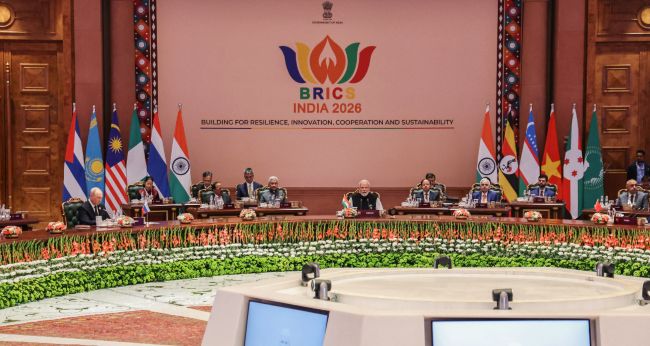




In this pool photograph distributed by the Russian state agency Sputnik, India’s Prime Minister Narendra Modi (C) speaks as Russia’s President Vladimir Putin (L) listens during the BRICS Summit in New Delhi on September 12, 2026. (Photo by Alexander KAZAKOV / POOL / AFP)
Leaders of the 11-member BRICS group, including China, Russia, Iran and India, have called for calm and “maximum restraint” in the Middle East, overcoming internal divisions to adopt a joint statement at their summit in New Delhi on Saturday.
Chinese President Xi Jinping, who joined Russian President Vladimir Putin, Iranian President Masoud Pezeshkian, Indian Prime Minister Narendra Modi and other leaders at the summit, said the ongoing conflict in the Middle East “does not serve the common interests of the international community.”
BRICS foreign ministers had failed to reach agreement on a joint statement during their meeting in New Delhi in May, amid differences among Iran, Saudi Arabia and the United Arab Emirates over the war that began with US-Israeli strikes on February 28.
However, after intensive diplomatic efforts by India, leaders reached an agreement on Saturday as the bloc seeks to strengthen its global influence while addressing conflicts, trade tensions and energy security.
“We express deep concern over the continued escalation of tensions in Middle East/West Asia,” the joint statement said, urging members to exercise “maximum restraint” and avoid actions that could further worsen the situation.
BRICS was established in 2009 as a platform for major emerging economies seeking greater representation and influence in global institutions traditionally dominated by Western powers.
Opening the two-day summit, Modi told Xi, Putin, Pezeshkian and other leaders that the bloc should help reshape the global system.
“We have to transform this pyramid of privilege into a platform of partnership,” Modi said.
He noted that BRICS countries account for about half of the world’s population, 40 per cent of global GDP and more than a quarter of global trade.
Balancing Act
Maintaining unity within the expanded BRICS bloc remains a major diplomatic challenge.
India has maintained relations with both Iran and US ally Israel while also seeking to preserve its strategic relationship with Washington.
Pezeshkian attended the summit shortly after saying that the Middle East does not need the United States to act as a “regional policeman”. His remarks came amid the ongoing US-Iran conflict and tensions surrounding the strategically important Strait of Hormuz.
On the sidelines of the summit, Pezeshkian met Abu Dhabi Crown Prince Khaled bin Mohamed bin Zayed Al Nahyan.
India has also sought to manage the energy crisis triggered by the US-Iran conflict partly by relying on Russia, despite Moscow’s ongoing war in Ukraine and pressure from Washington and other Western governments.
Modi held talks with Putin on Friday after welcoming the Russian leader with an embrace. Putin, who last visited India in December 2025, remains one of New Delhi’s key strategic partners.
Xi, Modi Seek to Manage Differences
Xi’s attendance at the summit has attracted particular attention as it marks his first visit to India since 2019 and represents the latest sign of a cautious improvement in relations between the two nuclear-armed neighbours.
Xi received a red-carpet welcome in New Delhi, including an honour guard and performances by traditional dancers.
“Although our two countries are different in many respects, they are fully capable of complementing each other’s strengths, supporting one another, achieving mutual success and advancing together,” Xi said during his meeting with Modi, according to a video released from New Delhi.
The visit comes six years after a deadly military confrontation along the disputed Himalayan border. Relations have since shown signs of improvement through the resumption of flights, visa services and high-level diplomatic contacts.
However, the long-running territorial dispute remains unresolved, with both countries maintaining significant military deployments along their roughly 3,500-kilometre border.
India’s foreign ministry said after the meeting that the two leaders reaffirmed their commitment to finding “a fair, reasonable, and mutually acceptable resolution” to the boundary dispute.
Modi also stressed the importance of both sides adhering to existing agreements and understandings on border issues, the ministry said.
Despite the diplomatic thaw, deep mistrust persists, with the disputed frontier, India’s widening trade deficit with China and broader strategic rivalry continuing to complicate bilateral relations.
Xi called for greater economic cooperation between the two countries, as well as efforts to promote a more balanced global economic order.
Meanwhile, dozens of Tibetans protested in New Delhi on Friday against Xi’s visit. The demonstrators, many of them exiles who fled Chinese rule, waved placards opposing the Chinese president’s presence in India.
The protests reflect the broader political sensitivities surrounding Xi’s visit and the unresolved tensions between the two Asian powers.