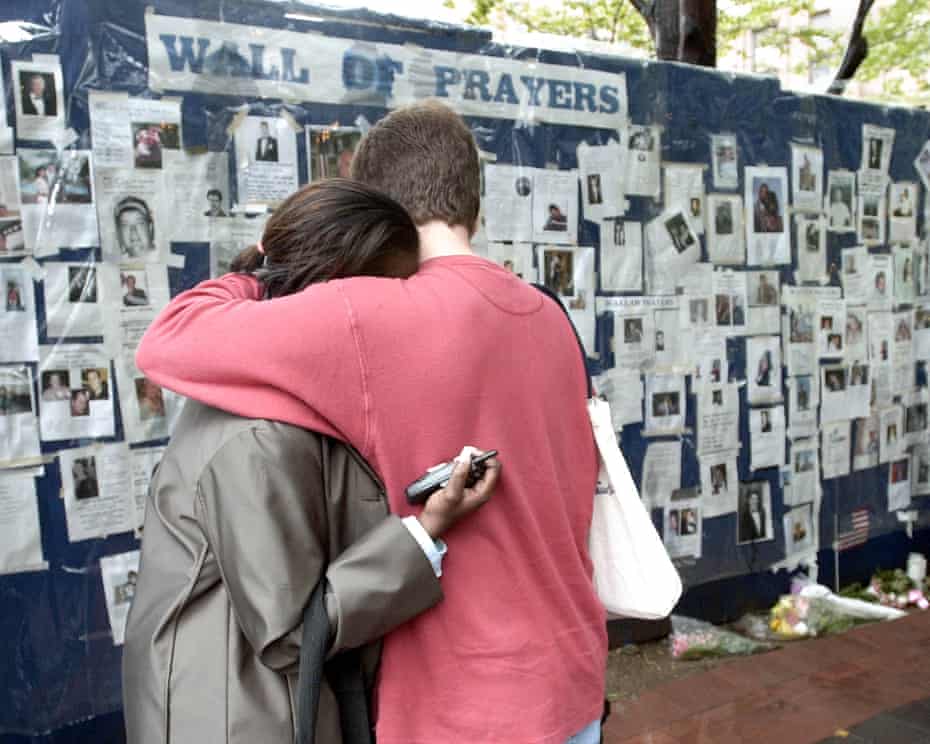






As the United States marks the 25th anniversary of the September 11 terrorist attacks, which killed nearly 3,000 people in New York City, Washington DC and Pennsylvania, Americans are reflecting on how that day transformed their lives — and the country itself.
Readers shared memories of the patriotism and sense of unity that swept across the nation in the immediate aftermath of the attacks. But many also pointed to the darker legacy of 9/11, including expanded government surveillance, prolonged wars overseas and the rise of Islamophobia at home.
For Americans who were adults when the attacks occurred, September 11 represented a profound rupture with the past. For those who were too young to remember the day, its consequences became the backdrop to the complicated and often violent world in which they grew up.
“When 9/11 first happened, everyone became your friend. We were all together in this loss, and the country felt like home everywhere,” wrote Jennifer Jasensky, a 55-year-old paralegal from Milford, Connecticut.
“Driving down a suburban street, every house displayed an American flag. It was a beautiful sight, like something out of a book or Hallmark movie.”
Elizabeth Zorko, a retired election administrator in Omaha, Nebraska, recalled experiencing the same extraordinary sense of connection.
“I remember meeting the eyes of total strangers and there was a look that wasn’t there before, as if a deep personal connection had been forged by this shared horrific experience,” she wrote.
From Unity to Division
That initial sense of solidarity soon gave way to anger and political division, particularly as the United States entered wars in Afghanistan and Iraq.
The George W Bush administration presented the conflicts as necessary components of the broader war on terror. But for some Americans, the wars became one of the most consequential and troubling legacies of September 11.
“We launched two forever wars that were wholly ineffective at making us safer militarily, and only sank our prestige in the world — especially [in] Europe and the Middle East — at the cost of thousands of American soldiers and countless Iraqi civilians,” wrote Benjamin Price, a 50-year-old attorney from Savannah, Georgia.
Price also questioned the contrast between America’s response to foreign terrorism and its approach to domestic violence.
“While we would take seemingly any measure to fend off potential foreign terrorism, domestic terrorism in our own country seemed to become a monthly occurrence with absolutely no measures to widen or strengthen domestic gun laws,” he wrote.
Dan J, a 42-year-old from Vermont, said the attacks became a justification for hostility toward an entire part of the world.
“From day one, the attacks on 9/11 have been used to demonize and dehumanize an entire region of the world,” he wrote.
“We allowed 9/11 to bring our nation together, not in grieving or resilience, but in group hatred. I was ashamed of us then, and as we have allowed this country to become more absorbed in hatred, xenophobia and isolation now, the shame is stronger.”
Growing Up Muslim After 9/11
For Muslim Americans, the consequences of the attacks were often deeply personal.
One Guardian reader, who asked to remain anonymous, described growing up as a devout Muslim in the years following September 11.
“The most it impacted me was during elementary through high school,” he wrote. “I grew up in the Bay Area where people are generally more tolerant and educated, so the worst experiences I have are mostly with regard to jokes and being poked fun at by classmates in school.”
Outside the classroom, he said, he noticed a broader cultural shift.
“The Middle East became associated exclusively with danger and terrorism,” he wrote, despite the region being the birthplace of the Abrahamic religions and home to some of the world’s oldest civilizations.
A New Normal
Many readers identified the USA PATRIOT Act and the Aviation and Transportation Security Act — legislation passed in response to the attacks — as some of the most visible ways 9/11 changed everyday American life.
Security measures that once might have seemed unthinkable gradually became routine.
“Measures we never would have accepted in the 90s, searches at airports, no bags in stadiums, seemed ‘reasonable’ and never went away,” Price wrote.
Zorko said the changes even affected her willingness to travel.
“I have not flown since April 2002,” she wrote. “Not because I’m afraid, but because it’s such a hassle.”
Mona, a 72-year-old from California, argued that the Patriot Act had consequences far beyond airport security.
She believes the legislation “laid the groundwork for the excesses of the DHS [Department of Homeland Security], ICE [Immigration and Customs Enforcement] and CBP [Customs and Border Protection] that have killed many since 2025.”
She also said it gave “ignorant and racist white Americans” cover to act on existing prejudices.
Living With the Aftermath
For some Americans who were physically near Ground Zero, the consequences of September 11 remain particularly immediate.
Jeff Jarvis, a 72-year-old journalist and former Guardian contributor, arrived at the World Trade Center by train just as the first plane struck.
“I stayed to report and was a block from the South Tower when it fell, enveloping me in the dust of destruction,” he wrote.
Twenty-five years later, Jarvis said he and many others continue to experience health problems related to the attacks.
“I don’t know to this day what the effect is on children, including mine,” he wrote.
Jarvis also reflected on how the political response to September 11 has shaped America.
“Regardless of stirring memories of George W Bush standing atop the pile of rubble and visiting a mosque in a show of unity and compassion, now it is all the easier for rightwing fanatics in power to stir hatred, attack neighbors and start wars based on otherness,” he wrote.
He argued that the tragedy had altered Americans’ ability to recognize suffering beyond their own borders.
“That one day of terrible suffering and loss took from us Americans our perspective for the suffering and loss we now bring down on other nations and peoples,” he wrote.
A Generation Defined by 9/11
For younger Americans, September 11 is often less a personal memory than a defining historical backdrop.
Ashley, a 30-year-old from Washington DC who celebrated her fifth birthday on September 11, 2001, said her generation inherited the consequences of the attacks without necessarily remembering the day itself.
“People who are older than me say ‘it united the whole country’. But growing up alongside its passing anniversary, I feel it completely unraveled the US, and we are still wrestling with its legacy,” she said.
For Ashley, 9/11 has come to represent much more than the attacks themselves.
“To me, 9/11 has become representative of America — paranoia, death, destruction, revenge, greed,” she said.
She added that younger generations have become increasingly desensitized to the violence associated with September 11 and the conflicts that followed.
“Even our younger generations laugh at it, because they are desensitized not just to the violence of that day, but the overwhelming violence America committed abroad in its wake.”