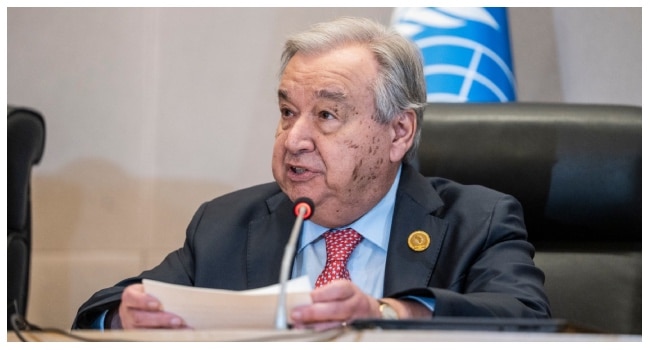
Secretary General of the United Nations Antonio Guterres speaks during a press conference after the opening session of the 38th African Union (AU) Summit, where leaders will elect a new head of the AU Commission, at the AU Headquarters in Addis Ababa on February 15, 2025. (Photo by Amanuel Sileshi / AFP)
The United Nations has reported that approximately 113 million Nigerians, representing 48.7 per cent of the country’s population, experience multidimensional poverty, characterised by deprivation in health, education and living standards.
The figure was contained in the 2026 edition of the annual Multidimensional Poverty Index report published by the United Nations Development Programme (UNDP) and the Oxford Poverty and Human Development Initiative (OPHI), released on Monday.
According to the report, the average poor Nigerian experiences deprivation in 55 per cent of the indicators used to measure health, education and living standards, while 28.7 per cent of Nigerians are classified as living in severe poverty.
The report also indicated that the progress recorded between 2018 and 2021 had been reversed.
“Like for like, the share poor fell from 42.3% in 2013 to 33.0% in 2021, then rose to 38.7% in 2024. That is nearly 18 million more poor people: three-quarters from a higher rate, one quarter from population growth,” the report stated.
Poverty Concentrated in Rural Areas, Northern Nigeria
The report identified rural communities and northern Nigeria as the areas most affected by multidimensional poverty.
It stated that 68.9 per cent of Nigerians living in rural areas are poor, compared with 24.8 per cent of those residing in urban centres.
Severe poverty is also significantly higher in rural communities, affecting 45.1 per cent of residents, compared with 9.3 per cent in urban areas.
The report further noted that poverty was most prevalent in the North-West and North-East geopolitical zones.
Lack of Clean Cooking Fuel, Electricity Worsens Poverty
The UN report identified access to clean cooking fuel and electricity as two of Nigeria’s most significant poverty challenges.
It found that 47.4 per cent of Nigerians are poor and lack access to clean cooking fuel, while 37.6 per cent experience poverty alongside a lack of electricity.
“These are gaps that policy knows how to close,” the UN noted.
The findings highlight the need for targeted interventions to improve access to essential services and infrastructure, particularly in rural communities.
Global Acute Poverty Reaches 1.2 Billion
Globally, the report found that the number of people living in acute multidimensional poverty had increased for the first time since the index was introduced in 2010, reaching approximately 1.2 billion.
The 2026 report identified 51.5 million more people living in acute poverty than in the previous year.
UNDP Administrator Alexander De Croo described the increase as a “wake-up call for the world”.
“Behind these figures are 1.2 billion people facing hardships that reinforce one another: hunger, missed schooling and a lack of clean water or electricity. This is unacceptable,” he said in a press release.
More than half of the people living in acute poverty worldwide are children, according to the report.
However, the UNDP noted that population growth was a major factor contributing to the increase in the global poverty figure. It also cautioned that new data were available for only 13 of the 108 developing countries covered by the report.
Some Countries Record Progress in Poverty Reduction
Despite the global increase, the report highlighted progress in several countries.
It found that 33 countries had reduced by half the proportion of their populations living in multidimensional poverty, as measured by the index, over the past 15 years.
Six of these countries are in sub-Saharan Africa.
The UNDP also identified Asian countries, including China and Vietnam, among those that had made rapid progress in reducing multidimensional poverty.
The report’s findings underscore the uneven progress in tackling poverty worldwide, with some countries recording significant improvements while others continue to face growing deprivation.