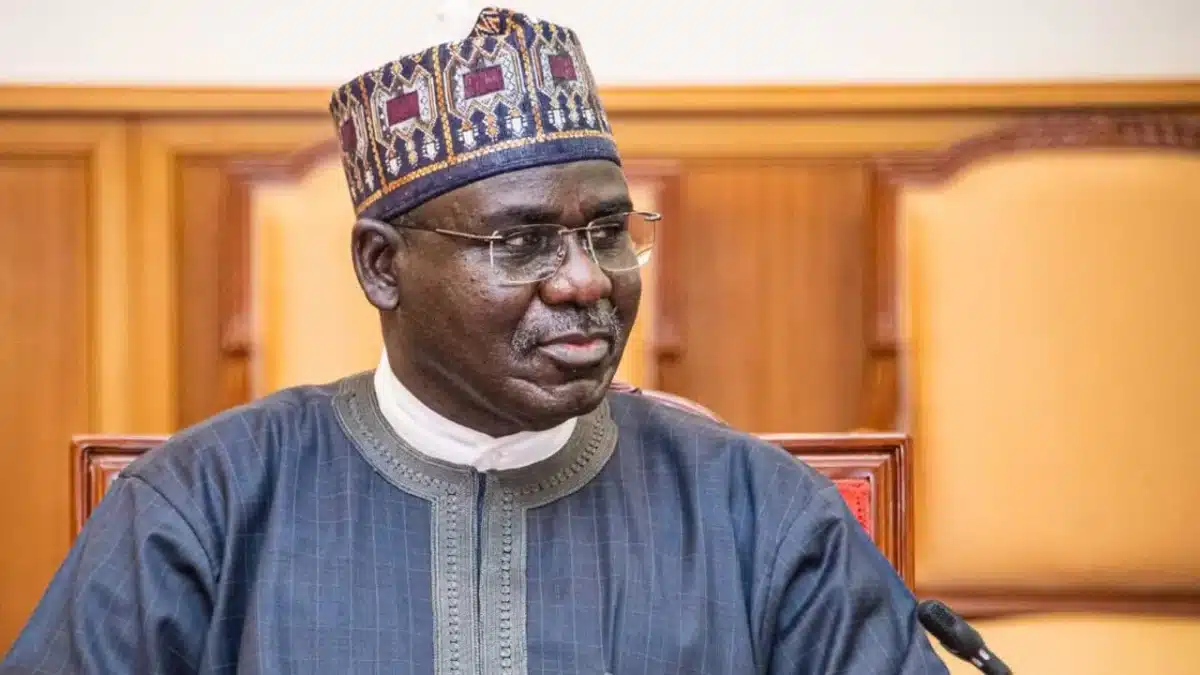
Former Chief of Army Staff, Lt. Gen. Tukur Buratai (retd.)
Former Chief of Army Staff, Lt. Gen. Tukur Buratai (retd.), has clarified that the $1bn approved for defence procurement during his tenure was released to the Ministry of Defence and did not pass through his hands or the accounts of the Nigerian Army, Navy or Air Force.
Buratai made the clarification on Monday while speaking at a conference organised by the Defence Correspondents Association of Nigeria in Abuja, describing allegations surrounding the funds as politically motivated and malicious.
He said the money was approved by the National Economic Council for defence procurement and managed by the Ministry of Defence.
“The $1 billion was approved by the National Economic Council for defence procurement. Not a single dollar of that fund passed through my hands or through the accounts of the Nigerian Army, Navy, or Air Force. The funds were released to the Ministry of Defence, and the entire procurement process was handled by that ministry,” he said.
The retired army chief explained that the military services did not receive any portion of the fund to initiate procurement directives.
He said the allegations first emerged during the 2019 election period, when opposition figures claimed the money had been diverted for electoral purposes, a claim he said the Federal Government publicly refuted.
Buratai, however, lamented that the controversy continued to damage the reputations of service chiefs rather than the institution responsible for managing the funds.
He faulted the Ministry of Defence for failing to provide a detailed public explanation of how the money was disbursed and how contracts were awarded.
“The ministry then, on its own, had not publicly explained how funds were disbursed or contracts awarded. Accountability must be properly located,” he said.
Buratai Calls for Transparency in Military Procurement
To prevent similar controversies, Buratai called for greater transparency in military procurement, proposing the establishment of a defence procurement transparency portal.
He said the platform should publish information on broad categories of contracts awarded, the companies or entities handling them, and delivery timelines, subject to national security considerations.
“The Ministry of Defence must own procurement records. The $1 billion arms procurement controversy festered because the institution that managed the funds, the Ministry of Defence, remained silent while Service Chiefs absorbed criticism,” he said.
He added that questions about the utilisation of defence funds should be answered by the ministry that managed the money rather than military officers who, according to him, had no direct access to it.
Buratai also proposed the publication of quarterly accountability bulletins summarising court-martial outcomes involving alleged human rights violations and misconduct during military operations.
He said such disclosures should be handled carefully to protect the rights of accused personnel and avoid compromising ongoing military operations.
Military Not Above the Law, Says Ex-Army Chief
On allegations of human rights abuses by members of Nigeria’s security forces, Buratai maintained that credible allegations should be investigated and prosecuted where evidence substantiates them.
“I have always maintained that where credible allegations exist, they must be investigated and, where substantiated, prosecuted. The military is not above the law,” he said.
He acknowledged the need for the military to demonstrate that its disciplinary procedures were credible, transparent and capable of addressing allegations of misconduct at every level.
The former army chief further argued that improved communication by the military and the Ministry of Defence would help address public concerns and ensure that media reports on security operations reflected the full context of events.
FG Seeks Broader Approach to Security Challenges
Speaking earlier at the conference, the Minister of Information and National Orientation, Mohammed Idris, said Nigeria’s security challenges could not be resolved through military force alone.
Idris, who was represented by the Director-General of the Voice of Nigeria, Jibrin Ndace, called for improved intelligence gathering, modern technology and stronger collaboration among security agencies and local communities.
He said military operations remained necessary but should be complemented by measures addressing the underlying conditions that enable criminal groups to recruit members and threaten the lives and livelihoods of Nigerians.