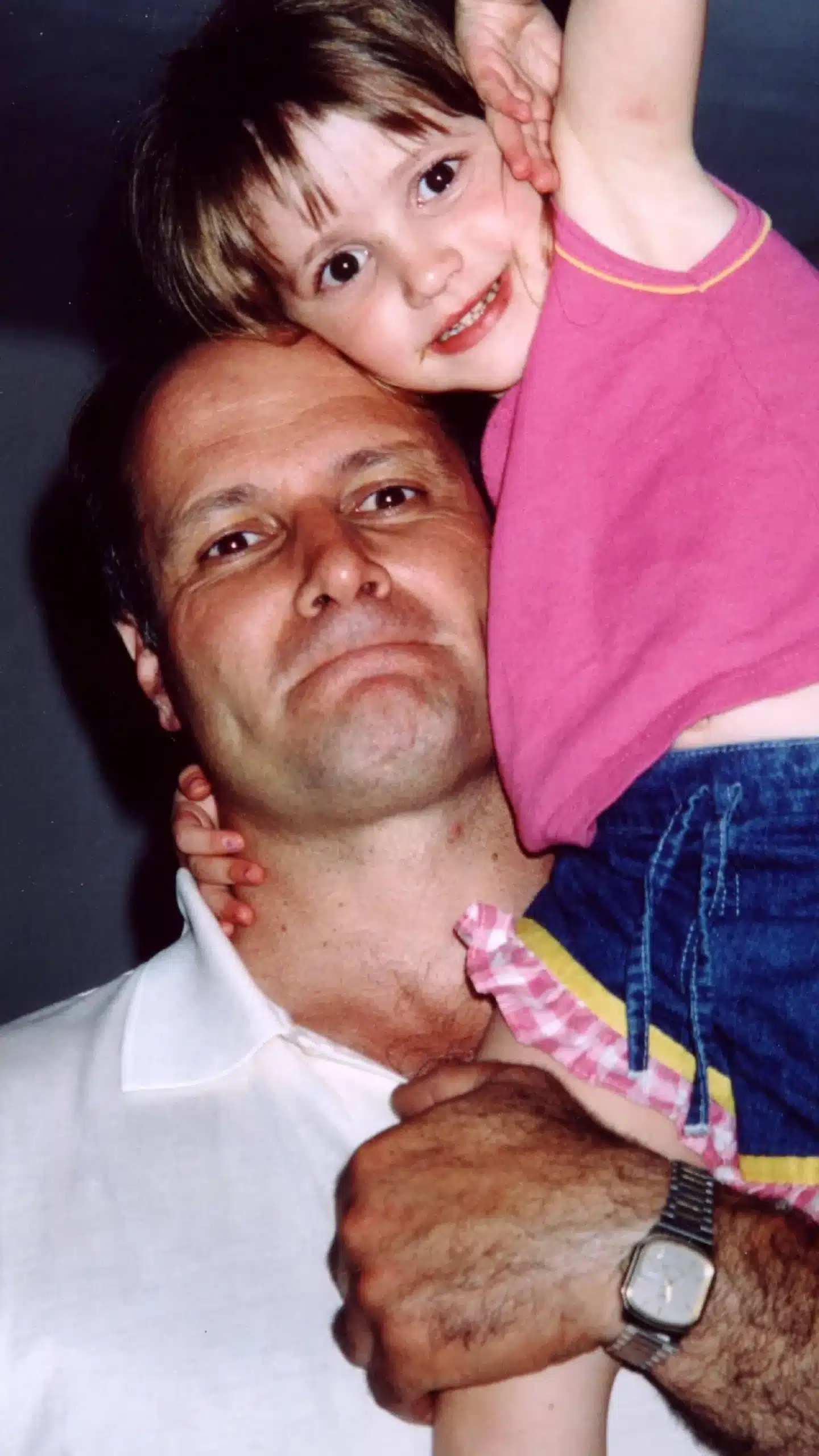





Juliette Scauso was four, the youngest of four children, when her father, firefighter Dennis Scauso, was killed in 9/11
For 25 years, the only physical reminder Juliette Scauso has had of the last day of her father’s life has been his mangled firefighter helmet.
Her father, Dennis Scauso, had served with a New York City Fire Department (FDNY) hazardous materials unit for 12 years. He was not originally scheduled to work on September 11, 2001, but agreed to switch shifts to earn overtime pay.
The Long Island father of four was believed to have been inside the South Tower of the World Trade Center when it collapsed, the family was told. Months later, rescuers found his helmet, still bearing his badge number.
“I’ve spent essentially my entire life knowing my father died, and learning to live with the fact that we never recovered him,” said Scauso, who was just four years old when her father died.
Dennis Scauso is among more than 1,000 people killed in New York on September 11 whose remains have yet to be identified, according to New York City’s Office of Chief Medical Examiner. Nearly 3,000 people were killed in the attacks that day.
Last month, the city announced the identification of a previously unidentified victim — the 1,654th person to be identified — using a technology known as forensic investigative genetic genealogy (FIGG).
“There is real promise in using this approach,” said Angela Soler, director of forensic anthropology at the city’s medical examiner’s office.
“There’s hope for more families to receive answers, and hopefully we’ll be able to test more remains in the future using this technology as well.”
Since the attacks, Soler’s office has worked to identify the remains of the 2,753 people who died at the World Trade Center. So far, about 60% of those victims have been identified.
“It’s been one of the most complex identification efforts that I think anybody has ever really experienced,” Soler said.
25 Years Later, DNA Matches Are Still Being Made
Identifying the victims has been extraordinarily difficult for several reasons.
The human remains recovered from Ground Zero were often severely damaged by the plane crashes and the intense fires fueled by jet fuel. As a result, investigators were frequently left with only small portions of victims from which to obtain DNA samples, Soler said.
Scauso said the circumstances of the attacks also complicated matters for firefighters. Many were changing shifts, while others stayed behind to help their colleagues and grabbed whatever additional equipment they could find.
As a result, some first responders were recovered wearing uniforms or equipment belonging to other firefighters, making identification even more challenging.
The scale of the loss at the World Trade Center also made the identification effort unlike those at the other September 11 crash sites.
Of the 184 people killed when American Airlines Flight 77 struck the Pentagon, five were never identified under similarly difficult conditions.
By contrast, the National Park Service says investigators recovered enough remains from the crash of United Airlines Flight 93 in Shanksville, Pennsylvania, to identify all 40 people aboard using DNA, dental records and fingerprints.
At the World Trade Center, recovered remains were carefully packaged and sealed to preserve DNA for future testing.
In the months immediately following the attacks, investigators were able to identify many victims through fingerprints and dental records. As time passed, however, DNA became increasingly important when those methods were unavailable.
Advances in technology also allowed investigators to extract additional genetic material and retest remains that had previously yielded insufficient results.
“That’s why all these years down the road, we’re still getting new identifications, because we’re just continuing to retest and retry with every new technology that becomes available,” Soler said.
According to the medical examiner’s office, DNA technology has contributed to the identification of 1,495 victims since September 11, with some identifications based entirely on DNA and others using multiple methods.
Last year, the city announced the DNA-based identification of three additional victims, 24 years after the attacks: Ryan Fitzgerald, a 26-year-old currency trader; Barbara Keating, a 72-year-old passenger aboard American Airlines Flight 11, which was traveling from Boston to Los Angeles; and a woman whose family chose to keep her identity private.
A New Technology Offers Fresh Hope
Soler said the newest FIGG technology relies on whole-genome sequencing, which allows investigators to examine an individual’s complete genetic code.
That can make it possible to identify more distant relatives of an unidentified victim, creating new leads that traditional DNA matching might not uncover.
Once potential family connections are identified, investigators work with the New York Police Department to locate closer relatives and establish the victim’s identity.
For families who have spent decades without answers, the technology offers renewed hope.
But the process can also reopen painful memories.
Reopening Old Wounds
The New York medical examiner’s office continues to receive weekly calls from relatives asking about loved ones whose remains have never been recovered.
For many families, the absence of remains has meant they were never able to bury their loved ones.
Others have made a different choice. When remains are identified, some families ask for them to remain at a repository beneath the 9/11 Memorial site in New York.
The repository was built into the bedrock of the World Trade Center site and is accessible only to medical examiner staff. Nearby, a private area known as the Reflection Room gives families a place to mourn.
“That’s where their loved one was in their last moments, and that’s where they want them to stay,” Soler said.
For some families, however, being told that remains have finally been identified may be too painful.
Soler, who helps notify families when identifications are made, said some relatives have asked not to be contacted.
After 25 years, the search continues — driven by advances in science and by families who are still waiting for an answer to one of the most painful questions left by September 11: Where is my loved one?