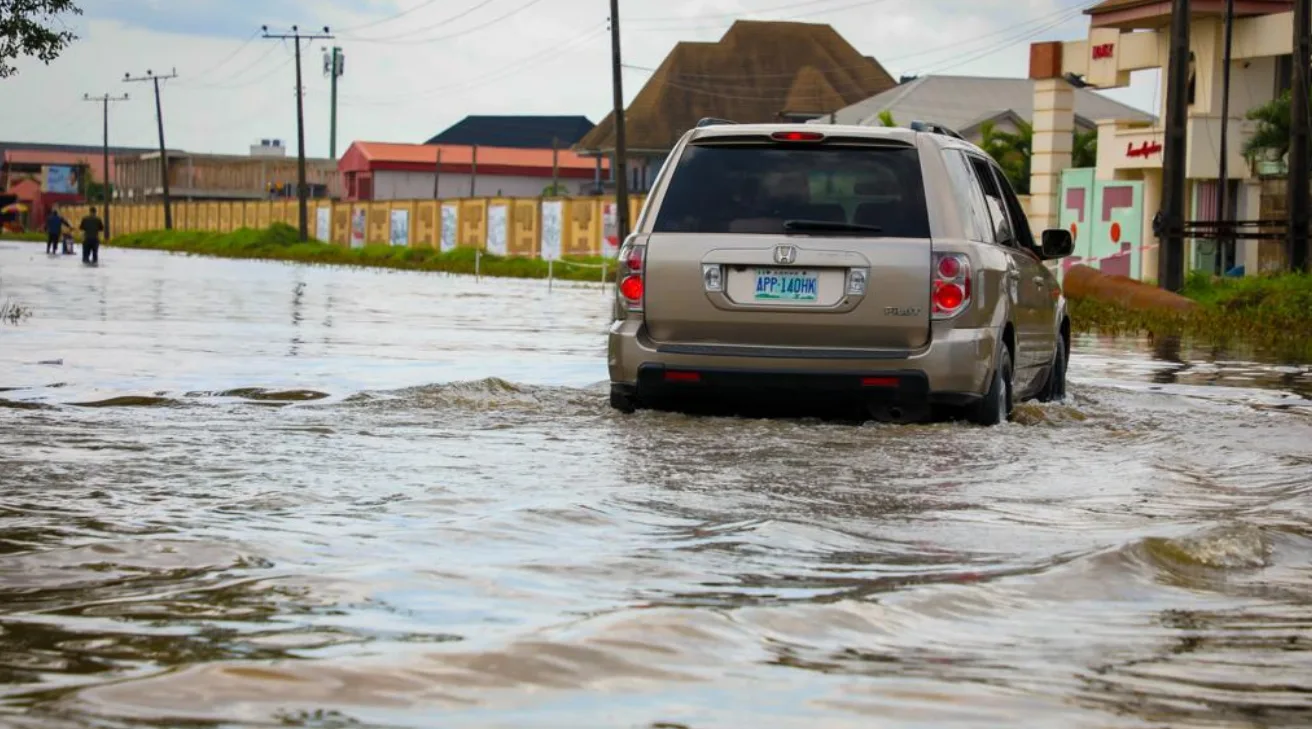












Persistent rainfall across Lagos is disrupting daily life, forcing residents to adjust their routines as they contend with flooding, traffic congestion, higher transport fares and threats to property.
From commuters leaving home before dawn to traders scrambling to protect their goods, many Lagosians say they have adopted new strategies to cope with the prolonged rainy season.
The News Agency of Nigeria (NAN) reports that umbrellas, raincoats, waterproof bags and regular weather updates have become essential items for many residents.
The experiences of residents mirror the Nigerian Meteorological Agency’s (NiMet) 2026 Seasonal Climate Prediction, which forecasts a longer-than-normal rainy season and a delayed end to rainfall in Lagos.
For Mrs Shola Opeyemi, a resident of Aguda, surviving the rainy season begins with leaving home much earlier than usual to beat the traffic.
She said carrying a backpack had become part of her daily routine because it contained her rain boots and raincoat in case of sudden rainfall.
According to her, getting caught in the rain often means spending almost twice her daily transport budget as fares typically rise during wet weather.
“I leave home early to avoid getting stuck in traffic. I always carry a backpack containing my rain boots and raincoat because you can never predict the weather.
“Whenever I am caught in the rain, I spend almost double my transport budget for the day because fares usually increase,” she said.
Mrs Cecilia Uwadi, who lives in Ogba, said careful planning and personal sacrifice had become necessary to navigate the rainy season.
She explained that she now leaves home by 4:00 a.m. and either relies on Google Maps after work to monitor traffic or remains in the office until about 9:00 p.m. to avoid severe gridlock.
Uwadi also lamented that prolonged traffic during rainfall had significantly increased her fuel consumption.
“A full tank lasts me about 10 days during normal weather, but when it rains continuously, it doesn’t even last up to seven days because of traffic,” she said.
“It is a daily struggle that I have to live with because I never get enough sleep.
“Thank God my children are not toddlers that I need to clean up after. But I don’t wish this level of stress on anybody.”
Mr Timothy, a resident of Mafoluku who works in Surulere, said the rainy season places additional pressure on his already stretched monthly budget.
“I hate it when it rains. Instead of paying my usual N2,000 transport fare, I spend N3,000 or more.
“My salary is already accounted for, which means it is never enough. Spending extra will deprive me of one essential thing or another,” he said.
While commuters worry about transportation and rising costs, traders say the rainy season presents both opportunities and challenges.
Mrs Adewunmi Yusuf, an umbrella seller at Ojota, said demand for umbrellas rises sharply whenever sudden rainfall catches commuters unprepared.
“On sunny days, I may sell only one or no umbrella. Once the rainy season starts, people rush to buy them. Some days, I sell more than 20,” she said.
She added that sales peak during the morning and evening rush hours when many commuters are caught in unexpected downpours.
Similarly, Mrs Nkiru Adedeji, a raincoat trader at Oshodi, described the rainy season as the busiest period of her business.
She noted that disposable emergency raincoats remained the preferred option for many buyers because of their affordability.
“Many people who never planned to buy a raincoat end up buying an emergency raincoat because it is cheaper.
“Some even buy extra ones for their children, spouses or to keep for later use. Emergency raincoats cost between N500 and N700, and they sell very fast during this season,” she said.
However, Adedeji observed that persistent rainfall and flooding could also discourage customers from visiting the market, resulting in reduced sales.
At Mile 12 Market, trader Temitope Alakija said the rainy season had made it increasingly difficult to leave children in charge of shops.
She explained that sudden downpours could destroy goods before anyone had time to move them to safety, leading to avoidable losses.
According to her, prolonged rainfall also keeps customers away, leaving many traders with little or no business throughout the day.
“You can’t ask your children to stay in your shop because rain usually comes unannounced and will destroy your goods.
“It is better not to open your shop at all than to leave your children in charge. Trading during the rainy season is not for the faint-hearted.
“We hardly see buyers when it rains. If it rains throughout the day, you may not record any sales at all,” she said.
Students are also adapting to the realities of the prolonged rains.
Miss Chikaodinaka Agbo, a student of the University of Lagos, said she had adopted measures to protect her books, certificates and other important documents from water damage during daily commutes.