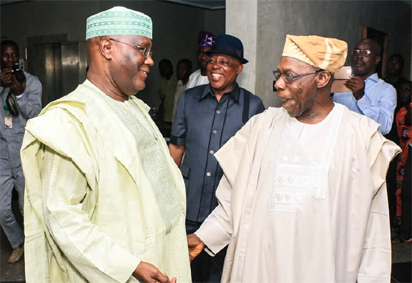



The presidential candidate of the African Democratic Congress (ADC) and former Vice President, Atiku Abubakar, has responded to former President Olusegun Obasanjo’s latest criticism, claiming he supported and cared for the former leader after his release from prison.
Atiku’s response follows Obasanjo’s recent remark that choosing him as running mate in the 1999 presidential election was the biggest mistake of his presidency.
In a statement issued by his Senior Special Assistant on Public Communication, Phrank Shaibu, Atiku said Obasanjo’s latest outburst was driven by lingering bitterness over the collapse of the controversial third-term agenda.
He said he watched the former president’s interview with “sadness rather than anger,” recalling what he described as the support he gave Obasanjo during and after his imprisonment.
According to Atiku, he stood by Obasanjo while he was in prison, supported his family, campaigned for his release and helped him rebuild his life after regaining freedom.
“History records that while Chief Obasanjo was in prison, I stood firmly by him. I supported his family, worked tirelessly with other patriots for his release and never wavered in my belief that he deserved his freedom.
“When he eventually regained his freedom, he had little to his name. I received him, clothed him, ensured he was properly cared for and extended every support necessary to help him regain his footing,” Atiku said.
The former vice president also defended his opposition to Obasanjo’s alleged third-term bid, describing it as a principled stand in defence of Nigeria’s democracy and constitutional order.
“I am proud that I stood against the third-term agenda. I am proud that I stood by the Constitution of the Federal Republic of Nigeria. I have no apology whatsoever for frustrating every attempt to subvert our democracy for personal ambition,” he said.
Atiku maintained that if Obasanjo’s continued criticism stemmed from his refusal to support an unconstitutional extension of tenure, he would wear that resentment as “a badge of honour.”
He argued that the battle against the third-term agenda was never a personal conflict but a defence of democratic governance, insisting that history had vindicated those who opposed the move.
The former vice president also referenced recent comments by the Director-General of the World Trade Organization (WTO), Dr Ngozi Okonjo-Iweala, who he said described the economic management team he led as one of Nigeria’s best.
He questioned the timing of Obasanjo’s latest remarks in light of that recognition.
“Whether or not the timing is merely coincidental is for Nigerians to judge. What is beyond dispute, however, is that while distinguished Nigerians who served at the highest levels continue to acknowledge my contributions to one of Nigeria’s most successful periods of economic management, Chief Obasanjo appears determined to diminish them,” he said.
Atiku stressed that he had no regrets about the support he gave Obasanjo, saying acts of kindness should not be viewed as transactions that require repayment.
However, he cautioned against what he described as attempts to rewrite history.
He further expressed disappointment that a former president would focus on old political disputes at a time Nigeria is battling economic hardship, unemployment and insecurity, arguing that attention should instead be directed toward rebuilding the country ahead of the 2027 general election.
According to him, his long-standing restraint in responding to Obasanjo was out of respect for the office the former president once occupied, but added that such restraint should not be mistaken for weakness.
“Chief Obasanjo is entitled to his opinions. He is entitled to his personal grievances. What he is not entitled to are his own facts.
“History is stubborn. It cannot be rewritten by bitterness, nor erased by repeated falsehoods. In the end, history will render its verdict—and so will the Nigerian people.”