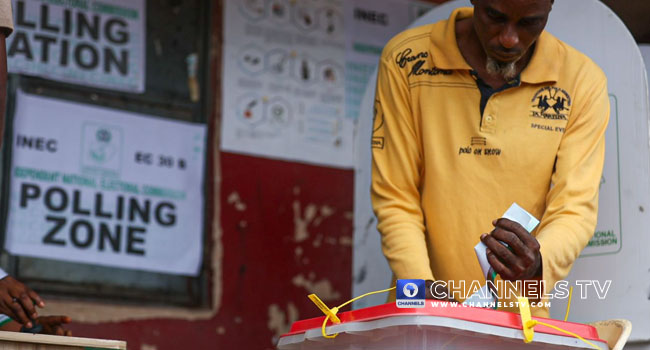
A voter casts his ballot in Edo State on September 21, 2024
A new survey by Yiaga Africa has revealed that 84 per cent of Nigerians are likely or very likely to vote in the 2027 general elections, although concerns over violence, declining trust in electoral institutions and vote buying could affect actual turnout.
The third round of Yiaga Africa’s National Voting Intentions Survey (NVIS 3.0), released on Wednesday, showed that voter intention increased from 73 per cent in March 2026 to 84 per cent in September.
However, confidence in the Independent National Electoral Commission (INEC) declined during the same period.
According to the survey, only 34 per cent of respondents expressed confidence that INEC would conduct credible elections, compared with 45 per cent recorded in each of the previous two rounds.
The report, titled “Willing but Wary: How Nigerians Intend to Vote in 2027,” was based on interviews with 2,470 Nigerians aged 18 and above across the 36 states and the Federal Capital Territory.
The interviews were conducted in September 2026 through telephone calls and, for the first time, face-to-face engagements with residents in rural communities.
Insecurity Biggest Barrier
The survey identified insecurity as the biggest potential threat to voter turnout, with 61 per cent of respondents saying fear of violence could prevent them from voting.
The figure rose to 78 per cent in the North-East, while 83 per cent of respondents said improved security would make them more likely to participate in the elections.
Yiaga Africa said the findings showed that Nigerians remained interested in participating in elections, but their willingness might not translate into actual turnout without improvements in security and confidence in the electoral process.
Confidence in INEC was particularly low in the South-East and South-South, where 62 per cent and 57 per cent of respondents respectively said they lacked confidence in the commission.
Despite the decline in institutional trust, 49 per cent of respondents said they trusted the use of the Bimodal Voter Accreditation System (BVAS) and the INEC Election Results Viewing Portal (IReV) for voter accreditation and results transmission.
Awareness of electoral reforms also increased significantly, rising from 24 per cent in December 2025 to 62 per cent in the latest survey.
Economy, Leadership Change to Shape Votes
The survey found that 49 per cent of respondents identified a desire for a change in leadership as their leading motivation to vote in 2027.
The economy and employment, at 38 per cent, and security, at 36 per cent, were identified as other major factors likely to influence voting decisions.
The findings also indicated dissatisfaction with the performance of the current administration, with 54 per cent of respondents disapproving of President Bola Tinubu’s performance.
Similarly, 71 per cent rated the state of the Nigerian economy as poor or very poor.
Yiaga Africa said the findings suggested that perceptions of government performance and prevailing economic conditions would play significant roles in shaping voters’ choices in the 2027 elections.
Young Voters Less Certain
The survey also revealed weaker voting intentions among younger Nigerians.
Only 40 per cent of young respondents said they were very likely to vote, compared with 64 per cent among respondents aged 61 and above.
Young respondents also reported greater fear of electoral violence, lower levels of trust in INEC and greater reliance on social media for election-related information.
The survey further found that 63 per cent of respondents had little or no confidence that the judiciary would resolve electoral disputes fairly. The figure increased to 81 per cent in the South-South.
Commenting on the findings, Safiya Bichi, Head of Knowledge Management and Learning at Yiaga Africa, said Nigerians had not lost interest in elections, but that fear, distrust and money remained major obstacles to participation.
“Nigerians have not given up on elections. They want to vote, they see it as their duty and they believe their votes can make a difference,” she said.
Bichi described Nigeria’s low voter turnout as a “conversion problem, not an apathy problem”, arguing that institutions and stakeholders responsible for security, electoral credibility and logistics must address the barriers preventing Nigerians from translating their willingness to vote into actual participation.
With the presidential election scheduled for January 16, 2027, she said the time available to address these concerns was limited.
Yiaga Africa consequently called on the Federal Government and security agencies to publish a national election security plan.
It also urged INEC to publicly commit to the real-time uploading of polling unit results to IReV, while calling on the judiciary to resolve pre-election candidacy disputes before ballot papers are printed.
The organisation further urged political parties and candidates to sign and honour the Peace Accord and an anti-vote-buying pledge ahead of the 2027 elections.