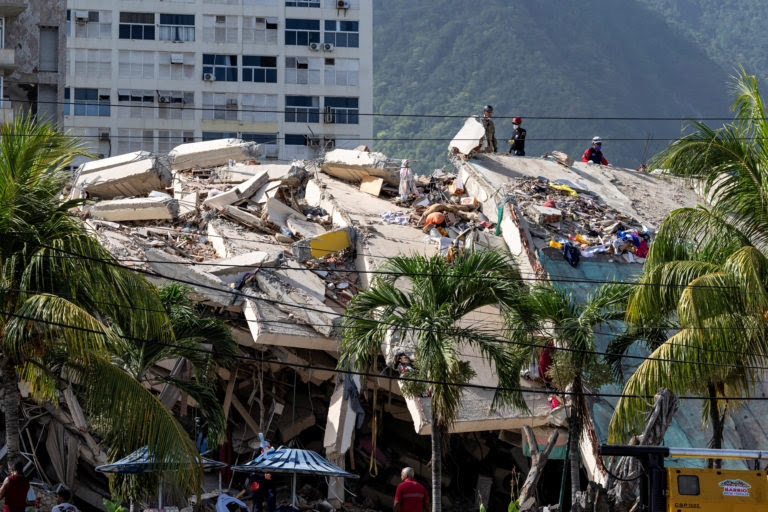





Desperation and frustration deepened across Venezuela on Saturday as rescue efforts continued following the twin earthquakes that devastated the country earlier this week, with the official death toll rising to 1,430.
Authorities said nearly 68,900 people remain unaccounted for three days after the powerful 7.2- and 7.5-magnitude earthquakes struck, leaving widespread destruction across the South American nation.
In the hard-hit state of La Guaira, residents joined rescue workers in searching for survivors beneath collapsed buildings, using shovels, ropes, heavy machinery, and even their bare hands in a race against time.
Anger mounted over what many described as a slow and inadequate government response.
“There were people alive under the rubble last night, but no one came to rescue them,” said Mileidy Romero, one of the volunteers searching through the debris in the coastal town of Caraballeda. “What are they waiting for?”
Emergency experts say the first 48 to 72 hours after a major earthquake are critical for finding survivors, although rescue chances improve if trapped victims have access to food and water.
Despite the challenges, international rescue teams continued arriving on Saturday to support ongoing search operations.
Acting President Delcy Rodríguez said more than 14,000 military personnel and police officers had been deployed to affected areas, where access has been restricted to facilitate rescue operations.
Meanwhile, Simón Bolívar International Airport sustained significant damage, though one runway has reopened with assistance from U.S. engineers working to restore operations.
Families continued to wait anxiously for news of missing loved ones.
In La Guaira, Nazareth Jiménez broke down in tears as neighbours struggled to cut through massive slabs of concrete in search of relatives trapped beneath the rubble.
“We’re calling on the government and countries around the world to help,” she pleaded. “There are still people alive in there.”
Government officials said food and drinking water were being distributed to survivors, while hospitals and emergency shelters worked to accommodate thousands displaced by the disaster.
The humanitarian crisis is expected to worsen. The International Organization for Migration estimates that up to 6.76 million people could be affected by the earthquakes, including about 2 million residents in Caracas.
The number of injured has surpassed 3,300, while authorities say 243 people have been rescued so far.
Foreign assistance from the United States, Mexico, Brazil, France, El Salvador and several other countries continues to arrive, bringing search-and-rescue teams, mobile hospitals, emergency supplies and heavy equipment.
U.S. officials described the operation as a “race against the clock” to locate survivors still trapped beneath the rubble.
Across the disaster zone, thousands of people spent another night outdoors, fearing aftershocks. Long queues formed outside shops and pharmacies as survivors searched for food, water and essential supplies, while isolated incidents of looting and panic underscored the growing humanitarian emergency.