

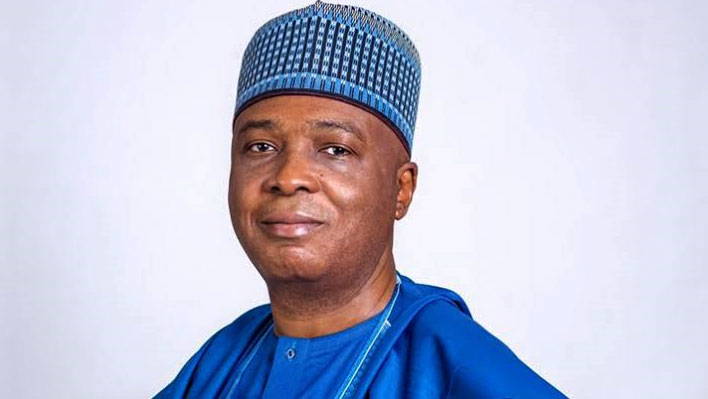
Former Senate President Bukola Saraki has issued a stirring defence of the National Assembly’s role as the “load-bearing wall” of Nigeria’s democracy, arguing that the legislature must be strengthened and protected if the nation is to avoid a repeat of the June 12, 1993 tragedy.
Speaking at The Platform Nigeria, organized to celebrate Democracy Day, Saraki opened his address by invoking the significance of June 12 — a date, he said, “the Nigerian state preferred to forget.”
“For a long time, this date was deliberately left out of the calendar of national memory. But yet, the people would not let it die. Year after year, citizens kept faith with its meaning,” the former Senate President said.
He recalled the day in 1993 when Nigerians “of every tongue, faith and every region walked out to the polls and spoke with one astonishing voice.”
That mandate was annulled, he noted. “Lives were lost defending it. A man went to prison for it and never came home. But the idea survived,” Saraki declared.
“And today we stand on Democracy Day, which exists only because ordinary Nigerians refused to surrender their belief in the ballot.” Saraki opened his address deliberately with the June 12 analogy because, he said,
“Everything I will say in this hour flows from a single truth: democracy in Nigeria was never handed to us. It was fought for.
“And what is fought for must be cherished, protected, built upon. Otherwise, it will be lost.”
The former Senate President, who led the National Assembly’s upper chamber from 2015 to 2019, then made his case for the legislature under three headings: How it secures democratic stability, how it strengthens governance, and how it drives national development.
‘Friction Is Not Dysfunction’
Saraki acknowledged that Nigerians often misunderstand the relationship between the executive and legislative arms of government.
His words: “When Nigerians think of power, they think of one office — the president. This is the reality.
“The presidency dominates our imaginations so completely that we sometimes speak as though government is the president, as though the National Assembly is just a nuisance of an institution to be managed, and the courts an obstacle to be circumvented.”
But the framers of the Constitution, he argued, understood something profound.
“The greatest danger to a free people is not a weak government, but an unchecked government. Power that answers to no one. Authority that cannot be questioned.”
Saraki stressed that the separation of powers was deliberate: “They built friction into the system. It was on purpose. It was not a mistake. That friction is not dysfunction. That friction guarantees your freedom.”
He offered a stark warning: “A legislature that cannot say ‘no’ is not a legislature at all.
“A legislature which simply receives executive proposals, approves them without scrutiny, and goes home has not fulfilled its constitutional mandate. “It has performed a ceremonial function. It is an echo. A democracy made only of echoes is only one election away from becoming something else entirely.”
‘Independence Not Rebellion’
Saraki, who often faced criticism during his tenure for asserting the Senate’s independence from the executive branch, addressed the issue directly.
“The independence of the National Assembly is not rebellion against the government of the day. I say that loudly, having been a victim where when you stand for the independence of the National Assembly, they say, ‘Ah, Saraki is a bad boy. He’s against the government.’ No. We are talking about how institutions can do what they are meant to do.”
He argued that an independent legislature actually strengthens the government’s legitimacy.
“Because a mandate that is never tested is a mandate no one can trust. How do you trust your government if it is not a government that is subjected to questions?” he asked.
‘We Did Not Lose Democracy in 1993 Because the People Failed’
Saraki drew a direct line from the annulled June 12 election to his central thesis about institutional weakness.
“The lesson is plain: we did not lose democracy in 1993 because the people failed.
“We lost it because the institutions that should have defended the people’s verdict were too weak to do so.
“The remedy is not less politics. It is stronger institutions. At the centre of these institutions stands the legislature.”
The legislature, he said, serves as the Republic’s “pressure valve.”
“When citizens are angry, they have representatives to petition.
“When a community feels abandoned, a senator can raise their name on the floor. When a policy threatens to ignite a region, there is a chamber where it can be debated, amended, softened.
“Block that valve, and the pressure does not disappear. It finds far more dangerous ways out.”
On Budget ‘Padding’ and Executive Overreach
Saraki took aim at the narrative that the National Assembly “pads” the budget when it makes amendments to executive proposals.
“How can the legitimate maker of a document be accused of fraud? The legislature is only doing what, by the Constitution, it has the power to do”, the former Senate President said.
“It is like accusing the organizers of The Platform of forging their own program today because a preferred speaker’s name did not make the final list.”
He accused the executive branch of often seeking comfort in violating constitutional provisions.
“There are many times the executive will go ahead and incur expenditure without legislative approval. Nobody raises alarm. It is seen as just something that has happened. But it is wrong. Even if it is for a good purpose.”
He recalled the 2018 purchase of Tucano aircraft from the United States government.
“Good purpose” — he said – “to fight insecurity. But money was spent before approval.”
On borrowing, he was equally firm: “When a country borrows, it is not government money. It is the obligation of Nigerians alive today, their children, and their children’s children.”
Saraki recalled that in September 2016, his Senate rejected a $29.96 billion borrowing request from the administration because it was not accompanied by proper documentation.
“What will it be used for? How will it be repaid? They said, ‘Just pass it and let us move on.’ We said no. And people said, ‘Ah, you are being anti-government.’ No. We were trying to do what is right.”
Case of EFCC Chairman
In a striking personal disclosure, Saraki revealed that he and others paid a “personal cost” for the Senate’s exercise of its confirmation powers.
His words: “We had the acting chairman of EFCC come before us. “After reviewing his qualifications and security report, we said no. But he stayed in office. Defiant. Totally disregarded our rejection.
“And some of us paid a personal cost for that. We were hunted, just because of that.”
Constituency Casework: The Corporal Williams’ Story
Saraki illustrated the legislature’s role in citizens’ daily lives with the story of Corporal Williams, a policeman dismissed in 1996 without any form of trial.
He narrated: “The Senate committee on ethics reviewed his petition and held that such punishment, confined by Police Decree 17, was inconsistent with democratic rule.
“His dismissal was reversed. He was reabsorbed into the police.”
Saraki also cited cases of pensioners and a widow who could not access her late husband’s pension for years. “Those are roles the National Assembly should be playing for you”, he said.
On the Petroleum Bill and Outdated Laws
Saraki noted that many of Nigeria’s laws are outdated, some written in the 1970s and no longer applicable to modern business.
Said he: “The Petroleum Industry Bill was not passed for 25 years. In the 8th National Assembly, we sat down and took the lead.
“Eventually, it was signed by the 9th Senate. That is an example of where the legislature comes in. Those of you who are businessmen, that is where the relationship comes from.”
‘Our Parliament Is Too Often Seen as Distant’
Despite his defence of the legislature, Saraki did not shy away from its shortcomings.
“Our parliament is too often seen as distant from the people it serves. Its proceedings feel opaque”, he noted. “Members appear more attentive to the executive, who controls resources, than to the constituents who control votes.”
The former Senate President recalled one of the speaker’s earlier remarks at the event questioning why legislators conform.
“You have to ask yourself: Those who did not conform, where did they find themselves politically? Very few people are strong enough to stand and fight against the strong arm of the executive”, Saraki said. “That is why most conform.”
@VanguardNews