
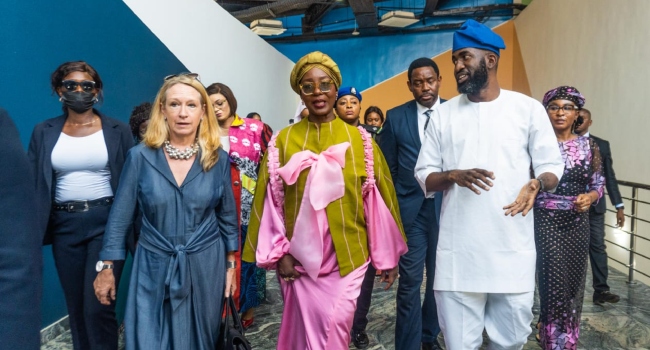
The British Deputy High Commissioner to Nigeria, Gill Lever, has said that the British government does not have any preferred candidate in Nigeria’s 2027 general elections.
She further said that the British government would not interfere in the conduct of the elections, stressing that the country would be interested in free, peaceful, and credible elections. Lever stated this in Ilorin while paying a courtesy visit to the Kwara state governor and Chairman, Nigeria’s Governors’ Forum (NGF), AbdulRahman AbdulRazaq, at Government House, Ilorin.
The deputy British High Commissioner Lever was on a three-day official visit to Kwara State.
She said the British Government would support free, peaceful, and credible elections in Nigeria next year, adding that Downing Street has no favourite political party and will not be seen interfering in local political matters.
“The British Government would support a free, peaceful, and credible election in Nigeria next year,” she said.
“Downing Street has no favourite political party and will not be seen interfering in local political matters.
“We all want to see elections that are peaceful, that are inclusive, and that are credible, with space for participation and with respect for institutions.”
The British envoy added, “The British government, as you’ll understand, Excellency, is entirely neutral. We do not favour one party or another, and we would never be in the business of telling Nigerian people how to vote.
“But peaceful and credible elections, of course, are not only a democratic objective. This is not only about the Commonwealth values and the values of democracy that we’ve long shared; they’re also an economic objective or imperative as well,” she stressed.
In his response, the state governor, AbdulRazaq, said his administration has turned around the fortunes of the state, with significant progress made in different sectors of the economy.
“We have made significant progress in different sectors of the economy: from health, education, agriculture, and road infrastructure. When we came in 2019, things just weren’t working in the state.
“From backlogs of pensions and gratuities to payment of half-salaries to the blacklist of Kwara by the Universal Basic Education Commission (UBEC),” he said, countering earlier narratives by some opposition elements.