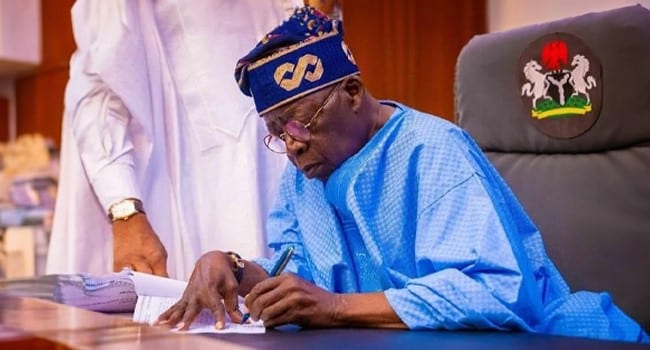
President Bola Tinubu has written to the House of Representatives, seeking approval for the implementation of external borrowings totalling about ₦10.8 trillion under the 2026 Appropriation Act.
The President said the proposed loans would finance projects captured in the 2026 budget and consolidate the macroeconomic gains recorded by his administration.
The request comes amid growing criticism of the Federal Government’s increasing reliance on external borrowing, with critics warning that mounting debts could worsen the country’s economic challenges rather than address them.
Tinubu recently defended his administration’s borrowing plans, arguing that Nigeria requires long-term investments in critical infrastructure to achieve its ambition of becoming a $1 trillion economy by 2030.
His position followed concerns raised by the Nigeria Labour Congress (NLC) over the government’s request to the National Assembly for approval to borrow $20.5 billion and €1.45 billion, despite claims that government revenue had increased following the removal of the petrol subsidy.
In a statement titled From Reforms to Delivery: Our Infrastructure Investment and Growth Strategy, the President argued that attention should focus on the benefits and economic value of projects financed through borrowing rather than the amount being borrowed.
“The key question is not how much we borrow, but what we build, the value we create and the future we leave behind,” he said.
Tinubu identified the Lagos-Calabar Coastal Highway, Sokoto-Badagry Superhighway, Trans-Sahara Superhighway, electricity grid improvements and upgrades to major commercial ports in Lagos as some of the projects earmarked for funding.
He said the projects, alongside investments in healthcare, education and vocational training, would connect economic regions, reduce transportation costs, support agriculture and industrial activities, and attract private sector investment.
According to him, the Lagos-Calabar Coastal Highway alone could reduce transportation costs along its route by 15 to 20 per cent and contribute up to two per cent to Nigeria’s Gross Domestic Product through increased trade, tourism and industrial activities.
He projected that the highway would generate about 100,000 direct jobs in construction and engineering, as well as more than 150,000 indirect jobs across logistics, building materials and related services.
“We are building more than highways. We are opening economic corridors, connecting markets, supporting industries and reshaping Nigeria’s economic geography,” he said.
The President maintained that expanding and modernising the country’s infrastructure was essential to achieving the $1 trillion economy target by 2030.
“We cannot build a $1 trillion economy with infrastructure designed for an economy a fraction of that size,” he added.
Tinubu Highlights Economic Gains
The President also highlighted improvements in key economic indicators since his administration introduced major reforms in May 2023.
He identified the removal of the petrol subsidy, unification of exchange rates, tax reforms and measures to control inflation as policies that had contributed to improvements in the economy and government finances.
According to him, Nigeria’s economy grew by 4.43 per cent in the second quarter of 2026, while headline inflation declined to 14.63 per cent in September from 20.98 per cent during the corresponding period last year.
He further disclosed that the country’s gross external reserves stood at $55.1 billion as of October 9, 2026, including approximately $46 billion in net reserves.
Tinubu said Nigeria’s tax-to-GDP ratio had increased to 12.5 per cent from seven per cent, while net allocations from the Federation Account Allocation Committee (FAAC) rose by 44 per cent, from ₦15.2 trillion in 2024 to ₦21.9 trillion in 2025.
He argued that the improved economic indicators had strengthened Nigeria’s appeal to foreign investors and enabled the country to secure loans on more favourable terms.
The President also cited positive assessments by international credit rating agencies, Nigeria’s return to Frontier Market status and its successful Eurobond issuance as evidence of improving investor confidence.
“These are not political endorsements; they are independent assessments by global rating agencies, index providers, regulators and investors, recognising stronger external reserves, improved macroeconomic management and greater financial credibility,” he said.