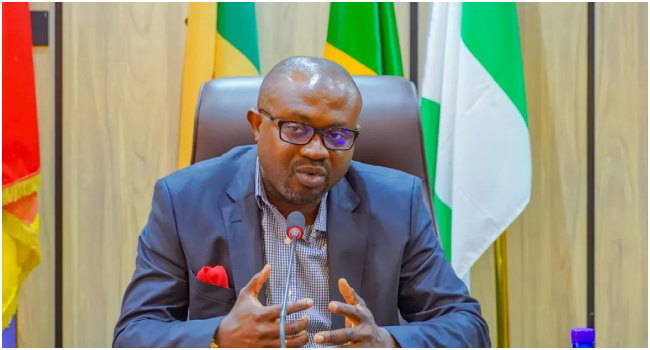
Interior Minister, Dr Olubunmi Tunji-Ojo
The Federal Government has integrated more than 17 billion migration records into a centralised system as part of efforts to automate the country’s migration management processes.
The government also announced the conclusion of negotiations with the European Union (EU) on a readmission agreement, bringing to an end discussions that lasted nearly a decade.
Minister of Interior, Olubunmi Tunji-Ojo, disclosed this on Tuesday during a meeting with the EU Commissioner for Internal Affairs and Migration, Magnus Brunner, and his delegation.
The meeting took place ahead of the formal signing of the agreement, according to a statement by the Ministry’s Head of Press and Public Relations, Mary Ali.
Tunji-Ojo explained that the automation and integration of identity databases would enable Nigerian authorities to verify the nationality of individuals being returned to the country more quickly and accurately.
He identified three categories of persons who could be subject to readmission: Nigerians with valid travel documents, those who travelled with documents but subsequently lost or destroyed them, and individuals who travelled without identification documents.
The minister said the government was developing systems to establish the identities of such persons through available national databases.
He added that similar arrangements were already being implemented with the United Kingdom, while discussions were ongoing with the United States to establish a comparable system.
Describing the agreement as significant, Tunji-Ojo said it would facilitate the return of Nigerians without legal grounds to remain in EU member states while promoting an orderly, dignified and mutually beneficial migration management framework.
He assured the EU delegation that Nigeria would comply with all provisions of the agreement, stressing that the government neither encouraged irregular migration nor supported any abuse of the trust between countries.
According to him, building mutual trust should precede discussions on easing migration procedures, as stronger confidence between Nigeria and its international partners would create better conditions for legal migration and cooperation.
On border security, the minister called for stronger international collaboration and real-time information sharing to combat human trafficking, migrant smuggling and other transnational crimes.
He noted that individual countries could not effectively address such challenges without coordinated international efforts.
Tunji-Ojo also informed the delegation that the government had recorded significant progress in correctional service reforms, with the number of repeat offenders declining from about 13,000 in 2023 to approximately 1,600 in the previous year.
In his remarks, Brunner described the conclusion of the negotiations as a major milestone in Nigeria-EU relations, expressing optimism that it would provide a foundation for cooperation in other areas.
He commended Nigeria’s efforts to modernise its border security infrastructure and said the EU was ready to strengthen collaboration through its border management agency.
The EU commissioner identified police cooperation, the fight against human trafficking and migrant smuggling, and the development of legal migration pathways as areas requiring sustained engagement.
He disclosed that approximately 260,000 Nigerians were legally resident in EU countries, emphasising the need to expand opportunities for safe and regular migration.
Also speaking, a member of the EU delegation, Jonannes Lucher, acknowledged that the negotiations had been challenging, noting that Nigeria had sought to incorporate additional areas of cooperation, including combating human trafficking, drug trafficking and developing legal migration pathways.
Lucher assured the Nigerian delegation that discussions on these areas would commence after the readmission agreement was concluded.
He further disclosed that the EU had made nearly €100 million in additional funding available to support broader cooperation, with discussions expected to begin with Nigerian migration and security officials.
The meeting ended with both parties reaffirming their commitment to strengthening cooperation, building mutual trust and developing practical solutions to shared migration and security challenges.