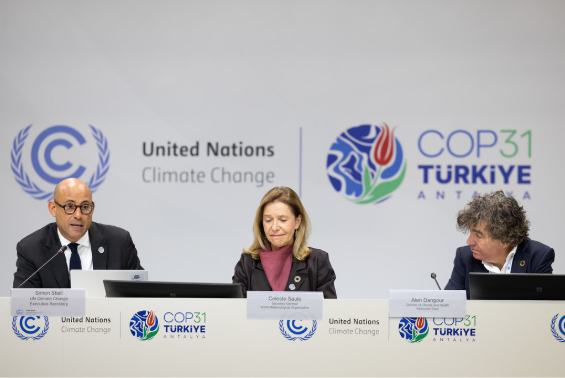
L-R: UN Climate Change Executive Secretary, Simon Stiell; WMO Secretary-General Celeste Saulo; and Wellcome Director of Climate and Health, Dr Alan Dangour, during the news conference at COP31 in Antalya, Türkiye, on Monday.
The World Meteorological Organisation (WMO) has warned that 2027 could become the hottest year ever recorded as an unusually strong El Niño combines with the effects of climate change to drive global temperatures higher.
WMO Secretary-General, Celeste Saulo, gave the warning on Monday while presenting the organisation’s State of the Climate Update 2026 at a news conference during the ongoing COP31 climate conference in Antalya, Türkiye.
Saulo said the past 12 years had been the warmest on record, with the last four years, including 2026, ranking among the hottest.
She disclosed that global average temperatures between January and September 2026 were approximately 1.47 degrees Celsius above pre-industrial levels.
According to her, the developing 2026/2027 El Niño is unusually intense, with sea-surface temperatures in the tropical Pacific expected to approach four times the 0.5-degree threshold used to classify the climate phenomenon.
“Indeed, this 2026/2027 El Niño is off the charts. It is different from any El Niño that we have monitored,” she said.
The WMO chief explained that El Niño typically has its greatest impact on global temperatures in the year following its development, raising concerns that 2027 could surpass existing temperature records.
She also disclosed that ocean heat content had reached a record high for the 10th consecutive year, while global sea levels had climbed to unprecedented levels, increasing the vulnerability of about 900 million people living in low-lying coastal areas.
Saulo warned that extreme heat, tropical cyclones and intense rainstorms were becoming increasingly severe, exposing millions of people to dangerous weather conditions in 2026.
She cited heatwaves across India, Pakistan, other parts of Asia and North America, as well as tens of thousands of excess deaths recorded in Europe.
“The human and economic cost is unacceptably high,” she said.
Saulo urged governments attending COP31 to strengthen global climate observation systems and increase investment in early-warning mechanisms.
She noted that the number of countries reporting multi-hazard early-warning systems had risen from 56 in 2015 to 136 in 2025.
“We cannot afford to fly blind,” she said, stressing the importance of sustained climate monitoring in anticipating extreme weather events and protecting vulnerable populations.
Also speaking, UN Climate Change Executive Secretary, Simon Stiell, described the climate crisis as a global health emergency, warning that extreme heat, pollution and climate-related disasters were placing growing pressure on healthcare systems.
Stiell said heatwaves during the northern hemisphere’s summer had killed an estimated 50,000 people across Europe, while hundreds of millions of people in southern Asia were exposed to extreme heat.
“The climate crisis is now a global health crisis of pandemic proportions,” he said.
He highlighted the dangers of extreme heat to pregnant women, newborns and maternal health, linking the growing risks to continued fossil fuel consumption and deforestation.
According to him, health would remain a major focus at COP31, building on progress recorded at COP30 in Belém, Brazil.
He called on countries to accelerate electrification and the adoption of clean energy, warning that continued dependence on fossil fuels would increase costs for households, businesses and governments.
“At this COP, nations face a choice: electric or shock. Rewire the global economy for the electric age. Or accept ongoing fossil fuel cost pain for families, firms, and governments,” he said.
Similarly, Alan Dangour, Director of Climate and Health at Wellcome, said fossil fuel-related air pollution and extreme heat were estimated to cause more than three million deaths annually.
He noted that climate change was already affecting communities through extreme heat, drought and changing water conditions, with serious consequences for food security, sanitation and livelihoods.
Dangour identified cleaner energy, electrification, heat early-warning systems and climate adaptation measures as some of the practical solutions available.
He also disclosed that the Climate and Health Funders Coalition had awarded more than $225 million in its first year to support interventions addressing extreme heat, air pollution, climate-sensitive infectious diseases and data systems.
The coalition, established at COP30 with an initial joint commitment of $300 million from Wellcome and more than 35 philanthropic organisations, had also secured an additional $150 million in funding commitments, he added.
Dangour urged governments and businesses to make human health a central consideration in climate policies, particularly in protecting children, pregnant women, outdoor workers and older people.
“We must change course and put the health and wellbeing of people at the heart of our response to climate change,” he said.