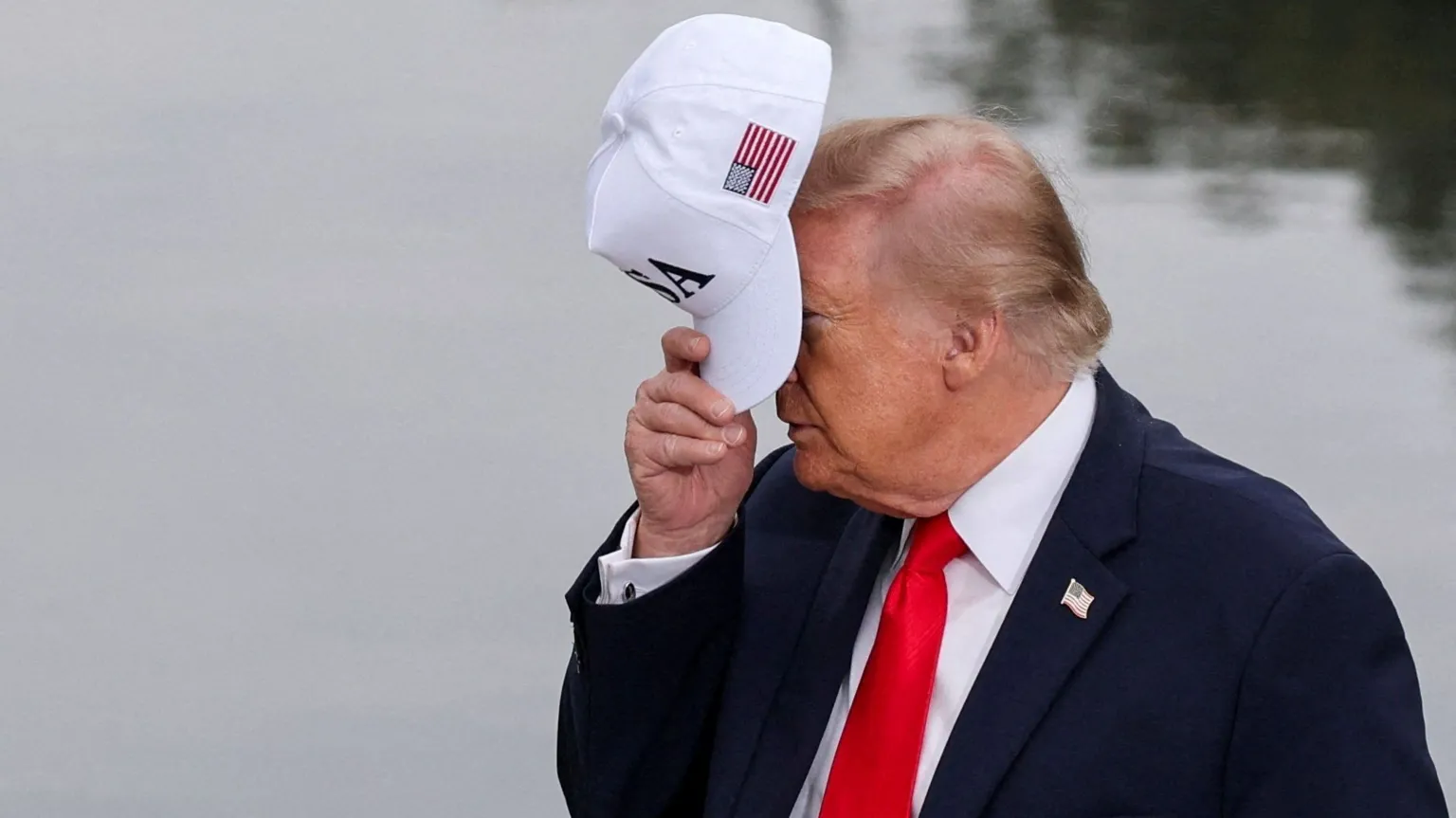
Anger and frustration have reportedly swept through the Republican Party following its disappointing performance in Tuesday’s US midterm elections, with some party members blaming President Donald Trump for the historic defeat.
After Democrats recorded major victories in traditionally Republican strongholds, including Texas, Kansas and South Carolina, several Republicans turned their criticism towards Trump, accusing him of prioritising his political legacy while ignoring voters’ concerns.
A prominent Republican lobbyist in Texas, Bill Miller, told the BBC that the outcome represented a complete rejection of Trump’s leadership.
“It’s on him. It’s not on anybody else. It’s a total, complete rejection of President Trump,” Miller said.
“This is a disaster of the first magnitude. Nobody saw it coming like this,” he added.
Although many Republicans had anticipated losing control of the House of Representatives, there had been hopes of retaining the Senate despite the challenging political environment.
However, some party officials and strategists argued that Trump’s unpopular policies, declining approval ratings and preoccupation with construction projects in Washington contributed significantly to the party’s poor showing.
“It was just one mistake after another,” Republican strategist Gregg Peppin, based in Minnesota, said.
“Clearly, in state after state, people did not like the president’s policies,” he added.
A White House ally also attributed the Republican setback to widespread dissatisfaction with Trump’s handling of the war with Iran, trade tariffs and the administration’s immigration crackdown, describing the combination of issues as a “perfect storm”.
The source said frustration within the Republican Party was considerable, with much of the anger directed at Trump.
The BBC spoke with about a dozen Republican Party operatives, campaign officials, White House allies and other political figures to assess the factors behind the party’s electoral defeat. Several spoke anonymously to provide candid opinions about Trump’s handling of the midterm campaign.
A Major Setback for Trump’s Political Agenda
Trump and his Republican allies had significant political interests riding on Tuesday’s elections.
A stronger performance would have provided the party with momentum ahead of the 2028 presidential election, similar to the relatively modest losses suffered by Democrats in the 2022 midterms under former President Joe Biden, when they lost just nine seats in the House and gained one in the Senate.
Instead, Trump now faces a Democratic-controlled Congress determined to investigate his administration, oppose his judicial nominations and frustrate key aspects of his legislative agenda.
The election outcome has opened an uncertain chapter in Trump’s second term and could compel Republicans to begin considering the party’s political future beyond his presidency.
However, some party loyalists have played down suggestions that Trump’s influence is declining.
Steve Scheffler, the Republican National Committeeman in Iowa, said before the election that he did not believe Trump’s influence within the party was weakening.
Nevertheless, he acknowledged that there were aspects of the president’s campaign messaging that could have been handled differently.
Trump remained largely silent as the election results emerged before eventually reacting on his Truth Social platform after Democrats had secured control of both chambers of Congress.
“I wasn’t on the Ballot and if I was, we would have won IN A LANDSLIDE! Thank you for your attention to this matter,” he wrote.
In subsequent interviews with The New York Times and Fox News, Trump said he was prepared to accept the election results.
He also admitted to being “a little bit surprised” by the outcome, while pointing out that the president’s party traditionally struggles in midterm elections.
Historical records show that since 1934, the party occupying the White House has gained seats in Congress in only three midterm elections.
Democrats Make Historic Gains
Although the Democrats’ 2026 performance did not establish an overall record for midterm victories, the party secured dozens of House seats, governorships and Senate victories, including in states where it had struggled to compete for decades.
Before Tuesday’s election, Democrats had not won a Senate seat in Kansas since 1932, while their last statewide victory in Texas was more than three decades ago.
The party also recorded unexpected victories in traditionally Republican states such as South Carolina, where several Republican candidates had been considered favourites just weeks before Election Day.
Trump and Vice-President JD Vance had held dozens of campaign rallies across the country in support of Republican candidates ahead of the elections.
MAGA Inc., the principal political action committee aligned with Trump, also spent hundreds of millions of dollars supporting Republican contenders.
Republicans Point to Weak Candidates
Despite the criticism directed at Trump, some of his allies have argued that it would be unfair to hold the president solely responsible for the party’s electoral losses.
They cited the historical difficulties faced by governing parties during midterm elections and blamed the poor performance of some Republican candidates in key battleground states, including Georgia, Michigan and Texas.
A Republican operative in Texas, who spoke anonymously, described Ken Paxton, the party’s Senate candidate in the state, as having run one of the weakest campaigns in the country.
“Ken Paxton ran the worst Senate campaign in the country from either side of the aisle,” the operative said.
The source questioned the effectiveness of Paxton’s grassroots mobilisation efforts, expressing doubt that his campaign had knocked on as many as 100,000 doors.
By contrast, the operative praised his Democratic challenger, James Talarico, describing his campaign as “really good and smart”.
Other Republicans defended Trump’s campaign schedule, arguing that his responsibilities as president limited the time he could devote to campaigning for party candidates.
Krish Mathrani, the Michigan Republican Party’s youth chair, said Trump could not be expected to spend all his time campaigning while also managing the affairs of the country.
“President Trump is a turnout machine,” Mathrani said, arguing that the president’s campaign rallies helped generate enthusiasm among Republican supporters.
However, the president’s ability to mobilise voters in presidential elections has not translated into similar success during elections in which his name is absent from the ballot.
Trump’s Campaign Message Fails to Convince Voters
The election results also suggested that voters were unconvinced by Trump’s claims that the economy had improved under his administration and that his policies were delivering the desired results in the conflict with Iran.
His attempts to portray Democratic candidates as extreme socialists also failed to gain significant traction in several contests.
Among the beneficiaries was moderate Democrat Roy Cooper in North Carolina, whose campaign successfully resisted Republican efforts to associate him with the political left.
A Cooper campaign official told the BBC that the strategy of portraying the candidate as a socialist liberal had failed to resonate with voters.
“Trying to tag him as some socialist liberal, that wasn’t going to fly,” the official said.
The Republican defeat has therefore raised fresh questions about Trump’s political strategy, his influence over the party and the ability of his administration to advance its agenda with Democrats controlling Congress.