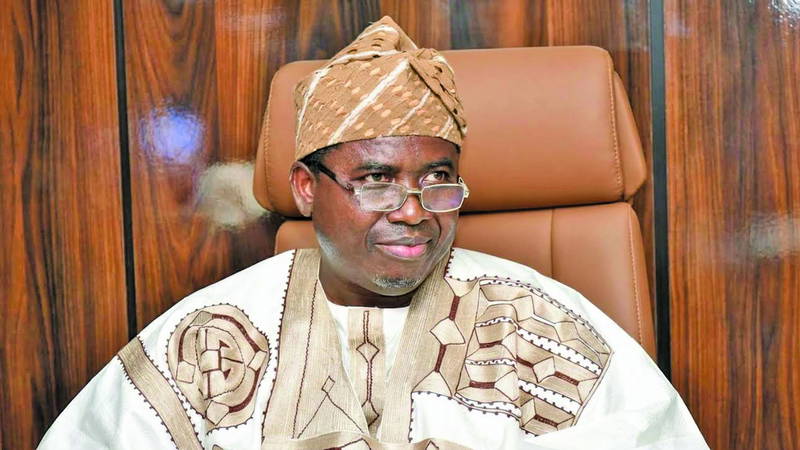
The Independent National Electoral Commission (INEC) has explained that the decline in the proportion of young people on Nigeria’s voters’ register ahead of the 2027 general election is largely due to changes in age categories, rather than reduced interest in electoral participation.
The commission’s Chairman, Prof. Joash Amupitan, SAN, gave the explanation on Tuesday at the grand finale of the INEC Campus Debate, held at the Law Theatre of the University of Abuja.
He said youths currently account for 29.79 per cent of the voters’ register being prepared for the 2027 elections, compared with 39.65 per cent recorded in the 2023 register.
Amupitan explained that many Nigerians classified as youths during the 2023 general election had since moved into older age brackets.
“Some questions have been asked, why has the number reduced compared to what we have in 2023? But the truth of the matter is that there has been progressive migration of the categories of persons that were youth in 2023, they have now migrated into different age groups,” he said.
He noted that the current register was still undergoing review through the claims and objections process.
According to the 2023 register, Nigeria had 37,060,399 voters aged between 18 and 34, representing 39.65 per cent of the 93.4 million registered voters.
The INEC chairman said the campus debate was part of efforts to address voter apathy among young Nigerians and improve their understanding of the electoral process.
“Our plan is to catch them young,” he said.
He recalled that previous engagements had exposed gaps in young people’s knowledge of the commission and electoral matters.
“When they ask who is the INEC chairman, unfortunately none of them could get it,” he said.
The University of Jos emerged winner of the debate, which was held under the theme, “Nigeria’s Electoral Process and Democracy.”
Bayero University, Kano, came second, while the University of Ibadan and the University of Nigeria, Nsukka, finished third and fourth respectively.
Amupitan, an alumnus of the University of Jos, commended the standard of the debate, saying the judges had made a fair decision.
“From the quality of the debate, it was, honestly, it could go either way and they have done justice to it,” he said.
He explained that the judges took considerable time to calculate the scores to ensure accuracy, adding that they also used technology to assist with the computations.
Amupitan jokingly ruled out the possibility of any contestant challenging the outcome in court, saying the result was clear and did not warrant the establishment of an election petition tribunal.
He also directed INEC’s Director of Voter Education and Publicity to maintain contact with the finalists, noting that their performances were impressive.
“They are not qualified to have been given automatic employment, if not I will have done that by now,” he said, adding that they would first have to graduate and complete the National Youth Service Corps (NYSC) programme.
He disclosed that one of the finalists from Bayero University studies medicine, while the two contestants from the University of Jos are law students.
The INEC chairman also highlighted what he described as improvements in the commission’s electoral performance under his leadership.
He said he had spent one year and 10 days in office and that INEC had conducted four off-cycle elections during the period: the Anambra governorship election, the Federal Capital Territory (FCT) Area Council elections in February, the Ekiti governorship election in June and the Osun governorship election in August.
“Go back to history, Anambra election and Osun election used to be inconclusive. But under our watch, we have ensured to a large extent that those elections are conclusive,” he said.
On women’s participation in politics, Amupitan said INEC had a Gender and Inclusivity Department dedicated to promoting broader participation.
He cited Belgium as an example of a country with legal provisions requiring equality in the occupation of political offices, noting that Nigeria was yet to adopt a similar law.
Addressing the finalists, he praised their performance, saying: “You have spoken with conviction, with candor and with discipline.”
In his remarks, the Vice-Chancellor of the University of Abuja, Professor Hakeem Babatunde Fawehinmi, urged young Nigerians to obtain their Permanent Voter Cards (PVCs), participate in elections and hold elected leaders accountable.
He commended INEC for organising the debate, describing it as an important platform for promoting civic awareness and responsible engagement among young people.
Fawehinmi said debate helps participants manage disagreements constructively, adding: “It can be argued that debate is the opposite of violence.”