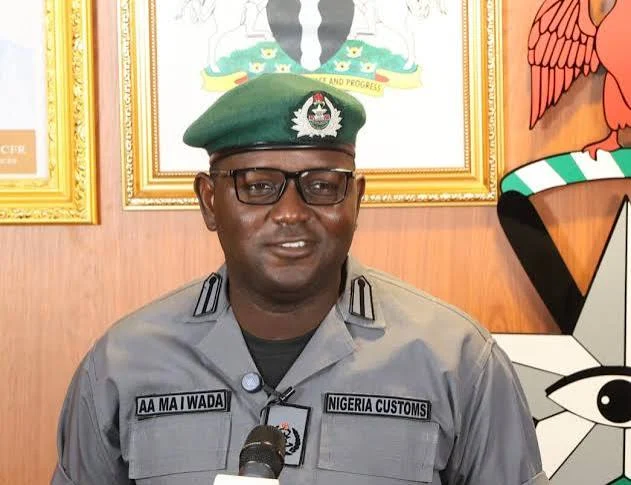
The National Public Relations Officer, Deputy Comptroller Abdullahi Maiwada
The Nigeria Customs Service (NCS) has intensified efforts to combat cross-border money laundering, terrorism financing and other financial crimes through stronger intelligence sharing and operational cooperation with six security and regulatory agencies.
The collaboration involves the Economic and Financial Crimes Commission (EFCC), National Drug Law Enforcement Agency (NDLEA), Nigeria Police Force, Nigerian Financial Intelligence Unit (NFIU), Nigeria Immigration Service and the National Counter-Terrorism Centre under the Office of the National Security Adviser.
The initiative is aimed at improving coordinated efforts to detect and disrupt illicit financial flows, strengthen border security and dismantle criminal networks operating across Nigeria’s borders.
According to a statement issued on Sunday by the Customs spokesperson, Abdullahi Maiwada, the collaboration followed a three-day engagement involving the agencies from October 27 to 29, 2026.
The exercise was organised to address existing gaps in information sharing and strengthen the detection of suspicious cross-border transactions.
Leading the engagement, the Assistant Comptroller-General in charge of Headquarters, Muhammad Shuaibu, said the initiative was designed to improve coordination among institutions responsible for combating financial crimes and threats to national security.
He explained that the exercise would go beyond routine consultations to examine practical Customs control measures at border stations and identify ways to strengthen cooperation among relevant agencies.
“The sole objective of this mission is to effectively detect and disrupt cross-border illicit financial flows. The measures include field visits to selected border stations to assess practical Customs control measures and engage with relevant agencies,” Shuaibu said.
The initiative comes amid continuing concerns over the use of Nigeria’s borders for smuggling, drug trafficking, illicit financial transactions and other forms of transnational criminal activity.
Money laundering and terrorism financing often involve complex networks operating across different jurisdictions, making cooperation among security, intelligence and regulatory institutions essential.
With its responsibility for monitoring the movement of goods and cargo across the country’s borders, the Customs Service occupies an important position in identifying suspicious trade transactions and movements that may be connected to criminal activities.
However, the success of such efforts largely depends on how effectively relevant agencies share intelligence, coordinate investigations and respond to emerging threats.
Speaking during the engagement, the Chief Executive Officer of the NFIU, represented by the Chief Operating Officer, Intelligence Security Service Sector, Muhammed-Mustapha, commended the Customs Service for its contributions to border security and the fight against smuggling.
He described the relationship between the two institutions as longstanding, recalling that the Customs Service was among the first agencies to collaborate with the financial intelligence unit following its establishment.
“When NFIU was created, NCS was the first to collaborate with us. No particular agency understands things better than how Customs does globally,” Mustapha said.
The World Customs Organisation (WCO) mentoring team, led by Shahiduzzaman Sarkar, also participated in the engagement, sharing international approaches to tackling money laundering and terrorism financing.
The team emphasised the need for stronger collaboration with the Customs Service, noting that effective responses to financial crimes require coordinated action across government institutions.
Despite the renewed commitment, discussions also brought to light some challenges affecting cooperation among the agencies.
Participants identified communication gaps, bureaucratic bottlenecks and concerns surrounding database privacy as major obstacles to effective information sharing.
The agencies subsequently explored possible solutions to these challenges, with a view to improving institutional coordination and ensuring that relevant intelligence could be exchanged and acted upon more efficiently.
The engagement also featured the presentation of Nigeria Customs Service awards and World Customs Organisation certificates to participating agencies in recognition of their contributions to the initiative.
CUSTOMS SHOWCASES DIGITAL REFORMS AT GLOBAL EVENT
Meanwhile, the Nigeria Customs Service has showcased its modernisation programme and adoption of emerging technologies at an international gathering focused on smart Customs operations and improved border management.
The Service presented its digital transformation initiatives at the World Customs Organisation Smart Customs Project Global Event 2026, held at the WCO headquarters in Brussels, Belgium, from October 29 to 30.
Represented by an Assistant Comptroller, Omolara Adedeji, the NCS highlighted its Unified Customs Management System, known as B’Odogwu, alongside investments in artificial intelligence, data analytics and electronic cargo tracking.
In a presentation titled “Nigeria Customs Service: The Journey Towards Smart Customs,” Adedeji explained that the modernisation programme was designed to improve operational efficiency, strengthen risk management and promote greater transparency in trade processes.
She said the Service was deliberately moving away from traditional Customs operations towards integrated digital systems.
“The NCS is undergoing a deliberate transition from traditional Customs operations towards integrated digital operations. Through the Service’s Modernisation Project, we are strengthening automation, electronic processing and data-driven decision-making to build a more efficient, responsive and technology-driven Customs administration,” she stated.
Adedeji identified smart technology and smart data as the two major pillars of Nigeria’s Smart Customs vision.
She explained that smart technology covered automation, integrated systems, digital platforms and modern information and communications technology infrastructure.
Smart data, on the other hand, focused on intelligence-led interventions, data-driven risk management, analytics and improved information sharing.
The presentation also highlighted B’Odogwu, the Unified Customs Management System, as a major component of the Service’s digital transformation efforts.
The platform is designed to automate Customs procedures, facilitate electronic processing and improve engagement with government agencies and private-sector operators.
The Customs Service said these technological investments formed part of its broader efforts to improve border management, strengthen revenue administration and facilitate legitimate international trade.