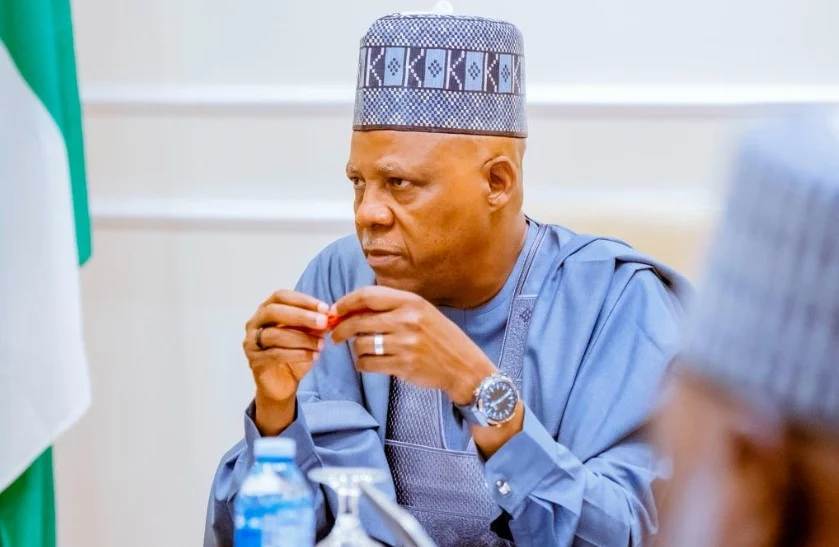

Vice President Kashim Shettima has urged the Federal Government to pay greater attention to Nigerians’ concerns over ongoing economic reforms, stressing the need for transparent communication, evidence of progress and policies that respond to citizens’ experiences.
Shettima made the call on Thursday at The Duke’s Masterclass 2026, held at Transcorp Hilton, Abuja. He was represented at the event by his Special Adviser on Economic Affairs, Dr Tope Fasua.
The Vice President said the success of the administration’s economic policies would depend not only on their implementation but also on the government’s ability to demonstrate tangible results and address the difficulties facing Nigerians.
“Government must continue to communicate, however, its policies clearly, demonstrate progress with credible evidence, and listen attentively to the experiences of citizens,” he said.
Shettima defended the economic reforms introduced by President Bola Tinubu, including petrol subsidy removal, foreign exchange market liberalisation, fiscal restructuring and revenue mobilisation.
He described the measures as necessary steps towards correcting longstanding economic distortions, attracting investment, improving business confidence and strengthening Nigeria’s productive capacity.
However, he emphasised that announcing policies was not enough, arguing that the government must also ensure that citizens understand their objectives and have confidence in their implementation.
The Vice President challenged Nigeria’s elite, professionals and middle class to acknowledge the economic pressures facing ordinary citizens while contributing to informed discussions about the reforms.
“Your role is not to defend every government action uncritically, nor to dismiss the concerns of citizens. It is to help create a more informed and constructive national conversation,” he stated.
He urged professionals engaging with traders to recognise the difficulties confronting businesses and those interacting with young graduates to acknowledge employment challenges while encouraging entrepreneurship and innovation.
According to Shettima, constructive criticism and informed public participation are essential to effective governance and the sustainability of economic policies.
“Constructive scrutiny strengthens governance. Informed public participation strengthens democracy,” he said.
He added that effective leadership required the flexibility to adjust the implementation of policies in response to evidence and changing economic circumstances without necessarily abandoning their underlying objectives.
Shettima Warns Against AI-Driven Misinformation
Addressing the growing influence of artificial intelligence and social media, Shettima warned that technological advances had made misinformation more sophisticated and easier to spread, creating risks for public confidence and institutional reputations.
“A photograph can be manipulated, a voice can be cloned, and a video can be fabricated just with a simple prompt on social media to make an individual appear to have said or done something that never happened,” he warned.
He urged public institutions to strengthen information verification, correct false claims transparently and communicate through trusted channels.
He also called for greater digital literacy and the responsible use of artificial intelligence, stressing that the speed of communication should not take precedence over accuracy.
On economic opportunities, Shettima identified banking, financial technology, oil and gas, agriculture, real estate, construction, commodity exports and the creative industry as sectors with the potential to attract investment and generate employment.
He, however, acknowledged persistent challenges, including unreliable electricity, inefficient transportation, insecurity, limited access to finance and weaknesses in education and public institutions.
The Vice President called for increased domestic production, export expansion and stronger support for small businesses, while emphasising the need to ensure that economic opportunities reach women, young people and rural communities.
Ashiru Stresses Accountability in Crisis Management
In his opening address, the Chairman of Odu’a Investment Company Limited, Bimbo Ashiru, warned that poor leadership decisions and inadequate crisis preparedness could undermine institutional credibility.
“Reputation cannot be manufactured at the point of crisis. It is built over time through our decisions, our conduct, our values and the consistency between what we say and what we do,” he said.
Ashiru noted that geopolitical tensions, technological changes and economic disruptions were making leadership increasingly challenging.
He said organisations needed to strengthen accountability, transparency and crisis-management strategies to protect their reputations and maintain public confidence.
He also disclosed plans to extend the masterclass to London in March 2027.
Anyaoku Shares Lessons from International Mediation
Former Commonwealth Secretary-General Emeka Anyaoku recounted his experience in international conflict resolution, particularly negotiations surrounding South Africa’s transition from apartheid and political tensions in Bangladesh.
He explained that successful mediation required a thorough understanding of the issues dividing opposing parties, the interests of their leaders and the appropriate timing for communicating developments.
“Because if you communicate the progress prematurely, you might sabotage the whole process,” Anyaoku said.
Adesina Faults Persistent Electricity Challenges
The Chairman of AXA Mansard and Group Managing Director of Sahara Power Group, Kola Adesina, criticised Nigeria’s persistent electricity challenges, arguing that public institutions and businesses should be assessed based on service delivery rather than explanations for poor performance.
“Rather than giving people megawatts of electricity, we are giving them excuses,” he said.
Adesina also condemned corruption, inflated public contracts and failures of accountability, warning that such practices weakened infrastructure, eroded public trust and endangered lives.
Meanwhile, the Chairman of the Duke of Shomolu Foundation, Joseph Edgar, said the masterclass was designed to equip organisations and individuals with practical strategies for anticipating crises, managing their consequences and protecting institutional reputations.
He added that the initiative complemented the foundation’s use of theatre to promote social cohesion and encourage public engagement.