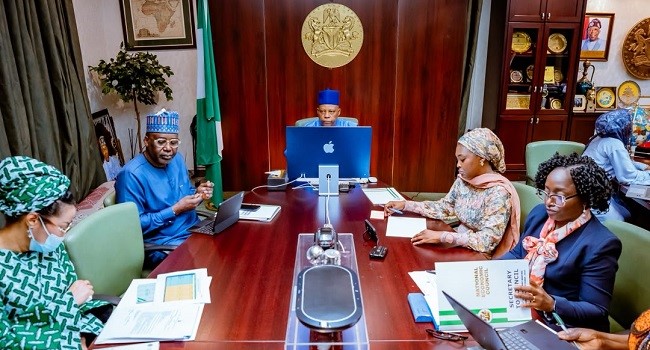
VP Shettima chairing 161st NEC meeting held virtually on Thursday, October 22, 2026. Photo credit: Presidency
The National Economic Council (NEC) has endorsed a 90-day economic action plan proposed by the Federal Ministry of Finance to consolidate the gains of President Bola Tinubu’s economic reforms, with a focus on reducing the cost of living, improving food affordability and stimulating investment.
The plan also seeks to eliminate bottlenecks hindering economic activities and accelerate the completion of projects that deliver direct benefits to Nigerians.
According to a statement by Stanley Nkwocha, Senior Special Assistant to the President on Media and Communications in the Office of the Vice President, the endorsement followed a presentation by the Minister of Finance and Coordinating Minister of the Economy, Taiwo Oyedele, at NEC’s 161st meeting held virtually on Thursday.
The meeting was chaired by Vice President Kashim Shettima.
The five priority areas identified in the plan are food affordability, tax harmonisation, completion of high-impact projects, removal of investment bottlenecks and regulated household support.
NEC also approved the establishment of a national dashboard to monitor ongoing projects across the country, promote transparency and accountability, and provide accurate information on the utilisation of proceeds from fuel subsidy removal.
Presenting the economic outlook, Oyedele expressed optimism about the progress of the Tinubu administration’s reform programme and the prospects for further economic recovery.
He identified reducing headline inflation and interest rates to single digits by 2027 as key policy objectives, stressing that the next phase of reforms would require coordinated implementation by federal and state institutions.
The presentation also underscored the need to translate macroeconomic improvements into tangible benefits for households and businesses through targeted interventions, improved fiscal coordination and the removal of barriers to investment.
Addressing Council members, Shettima said that while President Tinubu’s economic reforms were designed to achieve broader national prosperity, governments at all levels must ensure that the objectives translate into better living conditions for Nigerians.
He urged state governors and relevant institutions to prioritise affordable transportation, improved healthcare, employment opportunities and greater financial security.
“The first dividend of prosperity should be the confidence to plan a life. Our task is to make such confidence less dependent on fortune,” he said.
Shettima described the Council’s deliberations on transportation, healthcare, police reform and livestock development as critical to determining the quality of life Nigerians should expect from economic progress.
“Our separate jurisdictions must serve a common public interest,” he said, adding that Nigeria’s federal structure should promote cooperation rather than obstruct the delivery of essential services.
Shettima Tasks States on Affordable Transportation
On the National Compressed Natural Gas (CNG) Bus Initiative, the Vice President urged state governments to support affordable transportation systems that would reduce the financial burden on commuters.
He said the programme’s success should be measured by affordability and accessibility rather than the number of vehicles deployed.
“The cost of reaching a livelihood should never consume the livelihood itself. The passenger’s experience must guide our ambition, because the value of public transport resides in the journeys it makes possible. We should assess success through affordability and access, rather than fleet size alone,” he said.
Shettima urged governors to incorporate their knowledge of local conditions into national policy decisions, noting that effective implementation required clearly defined responsibilities and practical agreements among the different tiers of government.
“Our separate mandates must not become competing excuses. Each Governor carries knowledge that no federal document can supply,” he said.
He added that every policy proposal should be assessed based on its capacity to reduce uncertainty, create opportunities and strengthen public confidence in government.
“Nigerians deserve institutions on which they can organise their lives. Providing that assurance is among the most consequential uses of public authority. That is the assurance we owe them,” he said.
NEC Reviews Ebola Response, Tasks States on Preparedness
Meanwhile, NEC received an update from the Minister of Health and Social Welfare, Prof. Muhammad Ali Pate, on the reported Ebola outbreak in the Federal Capital Territory.
Pate sought to allay fears of a major public health crisis, assuring Council members that Nigeria had the institutional capacity to contain the situation.
He outlined measures being taken by the ministry and relevant stakeholders to establish a robust national response system.
The measures include improved coordination and governance, screening and detection at points of entry, laboratory testing, the provision of essential medical kits and personal protective equipment, and strategic communication.
The minister disclosed that 21 state governments had updated their response plans, urging the remaining 15 states to establish appropriate preparedness and response mechanisms without delay.
NEC Directs States to Strengthen Polio Eradication Efforts
Council also considered the report of its Ad Hoc Committee on Polio Eradication, chaired by Gombe State Governor, Muhammadu Inuwa Yahaya.
Following its deliberations, NEC resolved to direct states to conduct post-campaign reviews, particularly in areas where children were missed during immunisation exercises and communities affected by insecurity.
The Council emphasised the need for timely release of counterpart funds, stronger routine immunisation programmes, improved coordination with security agencies and closer collaboration among states to increase coverage in subsequent campaigns.
It further stressed that sustained political commitment from governors, traditional rulers and security agencies would remain crucial to eradicating polio in Nigeria.
NEC Moves to Unlock Livestock Sector’s Economic Potential
On livestock development, the Council received the report of its Ad Hoc Committee on Livestock Development, chaired by Kebbi State Governor, Nasir Idris.
NEC acknowledged the sector’s potential to drive economic growth, create employment and improve livelihoods across the country.
It noted that all states had expressed interest in supporting the Federal Government’s livestock development initiatives.
The Council consequently resolved to strengthen collaboration between the federal and state governments to accelerate reforms and unlock the sector’s economic potential.
FG, States to Establish Joint Financing Framework for CNG, Electric Vehicles
NEC also considered a presentation on the National Affordable Compressed Natural Gas Transit Programme by the Chairman of the Presidential Initiative on Compressed Natural Gas and Electric Vehicles, Ismaeel Ahmed.
The Council resolved to establish a joint financing framework between the Federal Government and state governments to accelerate the deployment of CNG-powered and electric vehicles across the country.
It directed that the programme must deliver tangible benefits to citizens by reducing transportation costs rather than merely increasing the number of alternative-energy vehicles on the roads.
NEC also resolved that relevant authorities should engage transport unions and operators to ensure that savings from the adoption of CNG and electric vehicles are passed on to commuters through lower fares.
To implement the decision, the Council agreed to constitute a committee to coordinate the proposed financing arrangement, engage relevant stakeholders and develop measures to ensure that the programme delivers affordable, accessible and sustainable transportation for Nigerians.