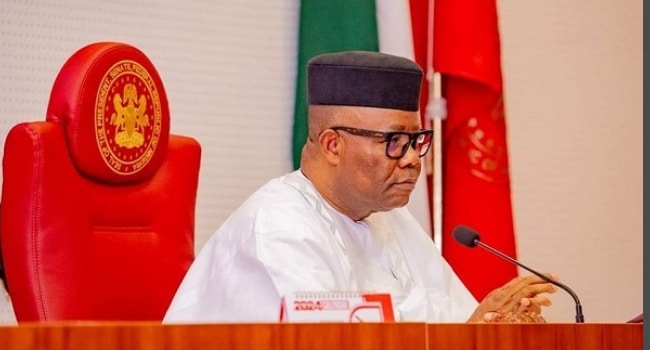

A file photo of the Senate President Godswill Akpabio
The Senate on Thursday unanimously declared that there was no vacancy in the office of the Senate President, currently occupied by Senator Godswill Akpabio, amid political tensions surrounding the leadership of the upper legislative chamber.
The resolution followed comments by Akpabio during plenary, in which he cautioned the public against misinterpreting his remarks on a bill seeking to decriminalise attempted suicide.
Akpabio said his comments on the bill, which passed second reading on Tuesday, had been taken out of context. He maintained that his position was not intended to disparage any religion, stressing that terrorism had no religious affiliation.
The Senate President also noted that suicide was forbidden in Christianity, while insisting that legislative discussions on decriminalising attempted suicide were consistent with evolving approaches to the issue.
He warned against misrepresenting proceedings in the Senate, particularly during television discussions, and cited his 19-year relationship with his Muslim aide-de-camp as evidence that he would not make disparaging remarks about any religion.
Amid the heated exchange, Akpabio suggested that the Senate presidency had become a target of political attacks, following the resolution of issues surrounding the offices of the President and Vice-President.
Supporting the position, Senator Fasuyi backed a motion moved by Senator Monguno, affirming that the office of the Senate President was not vacant and would remain occupied by Akpabio.
Similarly, Senator Babangida Hussaini commended Akpabio’s contributions to his state and expressed support for his continued leadership. Hussaini also called for urgent action to tackle hard drugs and substance abuse, warning that the problems could fuel criminality, banditry and terrorism across the country.
Controversy Over Attempted Suicide Bill
The controversy stemmed from Tuesday’s plenary, when Akpabio was reported to have said that anyone who attempted suicide in Nigeria had to succeed or risk imprisonment as lawmakers debated a bill seeking to decriminalise attempted suicide and establish a framework for suicide prevention.
The Senate President was said to have made the remarks while Senator Asuquo was explaining the objectives and provisions of the proposed legislation.
Presenting the bill, Asuquo explained that it sought to replace criminal punishment for attempted suicide with a system centred on medical assessment, treatment, referral and continued support for survivors.
He said the proposed legislation went beyond removing criminal penalties by establishing a coordinated framework through which government agencies, healthcare facilities, first responders and communities could prevent suicide and respond effectively when individuals were at risk.
Under the proposed framework, survivors of suicide attempts would receive appropriate clinical care rather than face prosecution and imprisonment.
Asuquo argued that police stations and correctional facilities should not serve as the default destinations for individuals requiring urgent medical attention.
He added that the bill would establish a foundation for coordinated suicide prevention services, including crisis helplines, referral systems and follow-up support for survivors.
The lawmaker also warned that criminalising attempted suicide could discourage people from seeking help and potentially push those experiencing suicidal crises towards ensuring that their attempts resulted in death to avoid prosecution.
Responding to the explanation, Akpabio questioned whether the proposed legislation was intended to prevent people from succeeding in suicide attempts.
Asuquo answered in the affirmative, explaining that the threat of imprisonment for surviving a suicide attempt could have dangerous consequences.
Akpabio, however, maintained that attempted suicide remained a criminal offence under the existing legal framework.
He was quoted as saying that anyone who attempted suicide should succeed or face imprisonment if the attempt failed, adding that such a person could subsequently undergo rehabilitation.
The exchange highlighted the central issue behind the proposed legislation: whether survivors of suicide attempts should face criminal prosecution or receive medical and psychological support.
The bill seeks to shift the country’s approach from punishment to prevention, treatment and rehabilitation, with the aim of ensuring that people experiencing suicidal crises can access appropriate care.