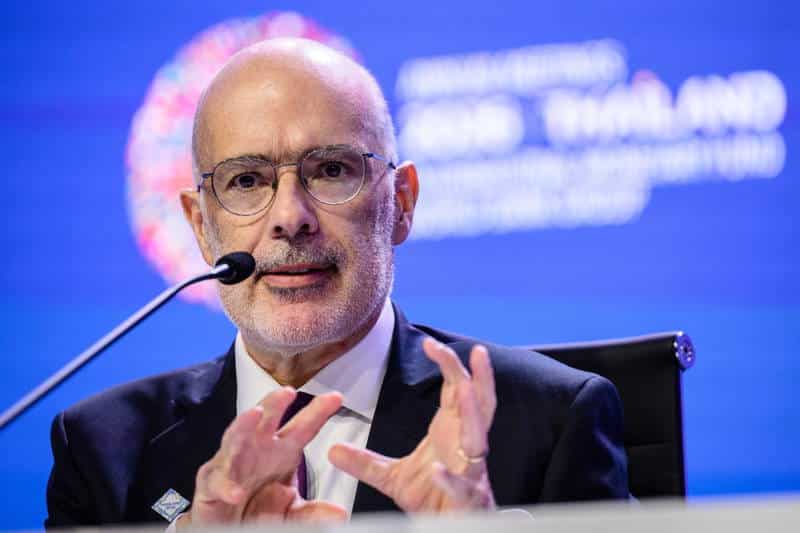
Rodrigo Valdes, Director of the IMF Fiscal Affairs Department, answers a question at a Fiscal Monitor press briefing during the 2026 IMF-World Bank Group Annual Meetings at the Queen Sirikit National Convention Center (QSNCC) in Bangkok on October 14, 2026. (Photo by ANTHONY WALLACE / AFP)
The International Monetary Fund (IMF) has cautioned Nigeria against restoring broad-based petrol subsidies, recommending targeted financial assistance and social protection programmes to shield vulnerable households from rising energy costs.
The fund warned that blanket fuel subsidies impose significant fiscal burdens, disproportionately benefit higher-income consumers and could worsen pressure on public finances amid rising borrowing costs.
Rodrigo Valdés, Director of the IMF’s Fiscal Affairs Department, gave the advice on Wednesday during a press briefing on the fund’s Fiscal Monitor at the 2026 annual meetings of the IMF and World Bank in Bangkok, Thailand.
Valdés was responding to questions about the implications of allowing energy prices to reflect supply constraints, particularly in Nigeria, where rising petrol prices could increase transportation costs, fuel inflation and deepen poverty.
The debate comes amid growing calls for the restoration of petrol subsidies ahead of Nigeria’s 2027 general elections.
“Protecting people is not the same as protecting the price of fuels,” Valdés said.
He disclosed that fuel subsidies and other measures preventing energy prices from adjusting fully to supply shocks had cost countries between one and 1.5 per cent of gross domestic product in 2026.
“It’s first fiscally very costly, and second, if you look at the pattern of consumption, it’s easy to see that that subsidy is readily regressive in many places,” he said.
The IMF official urged governments to rely on social safety nets and household data to identify those most in need of assistance instead of subsidising fuel prices for all consumers.
“There are better tools to deal with this,” he added.
In Nigeria, the Federal Government recently announced a 30-day petrol discount at Nigerian National Petroleum Company Limited (NNPC) retail outlets, with priority given to public transport operators, as part of efforts to cushion the impact of rising fuel prices.
The Minister of Finance and Coordinating Minister of the Economy, Taiwo Oyedele, explained that NNPC retail outlets would sell petrol at cost by foregoing their retail profit margins.
He described the initiative as a temporary relief measure rather than a return to the petrol subsidy regime.
The government also proposed negotiating a ceiling of ₦1,350 per litre for petrol’s ex-gantry or landing cost, subject to monthly reviews.
The IMF’s position underscores its preference for targeted interventions that provide direct assistance to vulnerable households while limiting the fiscal costs associated with broad-based fuel subsidies.