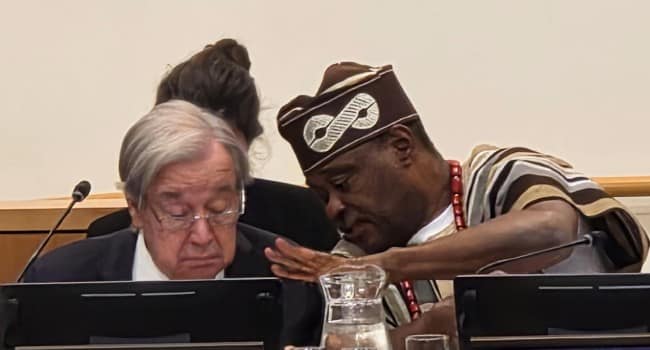
United Nations Secretary-General António Guterres (left) presented a proposed $14 billion budget to the UN General Assembly’s budget committee, chaired by Nigeria’s Permanent Representative to the UN, Senator Jimoh Ibrahim (right) in October, 2026.
United Nations Secretary-General António Guterres has presented a proposed $14 billion budget for the 2027 fiscal year to the UN General Assembly’s budget committee, chaired by Nigeria’s Permanent Representative to the organisation, Senator Jimoh Ibrahim.
Presenting the proposal in New York, Guterres said the budget was aimed at strengthening the UN’s capacity to fulfil its core responsibilities in international peace and security, sustainable development and human rights, while promoting reforms to improve efficiency and accountability.
Receiving the proposal, Ibrahim described it as a budget designed to ensure a sustainable United Nations, assuring the Secretary-General that the committee would begin deliberations and consultations on the estimates.
He also pledged the committee’s cooperation and commitment to a constructive review process.
Guterres, who is presenting a proposed budget for the final time during his tenure as Secretary-General, said the estimates reflected the organisation’s ongoing reform agenda under the UN80 Initiative.
The initiative seeks to make the UN Secretariat more efficient, effective and responsive to emerging global challenges.
According to the Secretary-General, the proposed budget provides for 11,150 posts and allocates $423 million for the continued operation of special political missions in 2027.
He explained that the approach would enable member states to gain a clearer understanding of the organisation’s financial requirements earlier in the budget process.
The proposal also includes additional funding for sustainable development initiatives, with an extra $1 million each earmarked for the Regular Programme of Technical Cooperation and the Development Account.
Other proposed allocations include $2.7 million for the United Nations Sustainable Development Group System-wide Evaluation Office and $3.7 million to advance the implementation of the organisation’s disability-inclusion strategy.
The budget further provides $1.7 million for mandate implementation reviews, $3.2 million for the Independent Investigative Mechanism for Afghanistan and $2.1 million for the next-generation upgrade of Umoja, the UN’s enterprise resource planning system.
Additionally, $22 million has been proposed to address rising costs associated with after-service health insurance for retired UN personnel.
Guterres said the proposed allocations followed a review of existing resources and potential cost-saving measures.
He added that the budget took into account new and expanded mandates while seeking to preserve the organisation’s ability to deliver its programmes effectively.