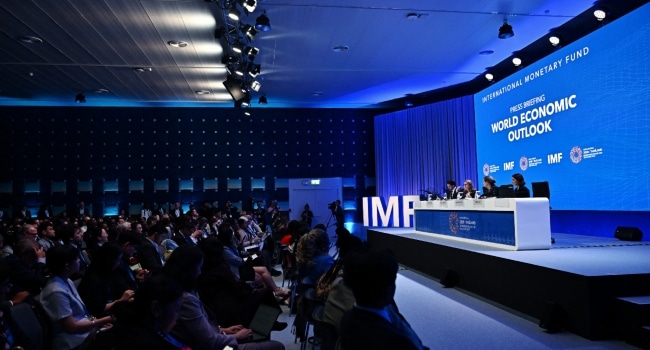
The International Monetary Fund (IMF) has warned of heightened risks to the global financial system, cautioning that a potential artificial intelligence market correction and severe cyberattacks could trigger financial instability and disrupt critical market operations.
The warning was contained in the Fund’s latest Global Financial Stability Report, released on Tuesday during its annual meetings with the World Bank in Bangkok, Thailand.
The report identified several potential triggers of financial market turmoil, including weaker-than-expected returns on artificial intelligence investments, escalating cybersecurity threats and a possible surge in government bond yields.
“These risks are plausible near-term catalysts for a sharp tightening of financial conditions and market turmoil,” the IMF said.
The global boom in artificial intelligence, accompanied by massive investments in semiconductor manufacturing and data centre construction, has supported economic growth despite geopolitical tensions, including the ongoing conflict in the Middle East.
However, the Fund warned that expectations surrounding the technology might be overly optimistic, raising concerns about the sustainability of current investment levels and market valuations.
“Growing evidence suggests that AI capabilities can be delivered at lower investment levels… or that potential economic gains may not be as large as expected,” the report stated.
It added that weaker or less sustainable AI investments and profitability could trigger a significant market correction.
Cyberattacks Pose Growing Financial Risks
Beyond investment risks, the IMF warned that the rapid advancement of artificial intelligence was creating new cybersecurity challenges capable of threatening the stability of the global financial system.
“Severe cyber incidents could undermine market confidence and disrupt critical financial market infrastructure and operations,” the report said.
Speaking after the report’s release, Athanasios Vamvakidis, Deputy Director of the IMF’s Monetary and Capital Markets Department, said the risks posed by cyber threats were both established and unpredictable.
He stressed the need for financial institutions and regulators to strengthen their defences before another major shock hits the global economy.
“The policy priority should be to strengthen resilience before new shocks hit the economy,” Vamvakidis said.
The warning comes amid growing concerns about AI’s wider implications for employment, education, economic inequality and financial security.
The IMF noted that as AI systems become more sophisticated, the likelihood of successful cyberattacks against major financial institutions and critical market infrastructure is increasing.
It warned that the consequences could be severe because rapid digitalisation had expanded the number of potential entry points available to cybercriminals.
The report also highlighted the potential misuse of advanced AI systems to develop and execute increasingly sophisticated cyberattacks.
Caio Ferreira, Deputy Division Chief in the IMF’s Monetary and Capital Markets Department, said emerging-market economies could face greater exposure to cyber threats, particularly where investment in cybersecurity and preventive measures remained inadequate.
However, the Fund noted that advanced AI models could also strengthen cyber defences by helping institutions identify vulnerabilities, detect suspicious activities and respond more effectively to attacks.
Rising Bond Yields Could Trigger Market Turmoil
The IMF also identified a potential surge in government bond yields as another major threat to global financial stability.
According to the report, sovereign bond markets play a fundamental role in the global financial system, making them particularly important channels through which financial shocks can spread.
The Fund warned that a renewed increase in energy prices could reignite inflation, forcing central banks to tighten monetary policy and potentially pushing bond yields higher.
Higher yields could increase government borrowing costs, tighten financial conditions and place additional pressure on businesses, households and financial institutions.
The IMF’s assessment underscores the need for governments, regulators and financial institutions to strengthen their resilience against interconnected risks arising from technological developments, cyber threats, inflationary pressures and volatile financial markets.