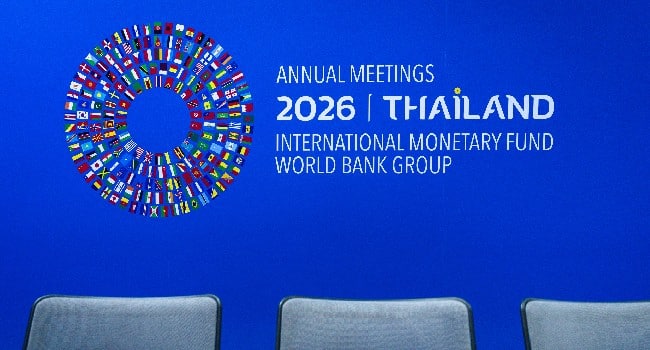
The conference logo of the IMF-World Bank Group Annual Meetings 2026 is displayed on a wall backdrop inside a meeting room at the Queen Sirikit National Convention Center in Bangkok on October 9, 2026. (Photo by Chanakarn LAOSARAKHAM / AFP)
Global debt challenges, climate change and widening inequalities are expected to dominate discussions as world leaders and economic policymakers gather in Bangkok, Thailand, for the annual meetings of the International Monetary Fund (IMF) and the World Bank.
The meetings, scheduled for October 12 to 18, come at a time when mounting debt burdens, climate-related shocks and declining financial support for developing countries are putting pressure on the global economy.
More than 15,000 delegates from 191 countries, including finance ministers, central bank governors and development experts, are expected to participate in discussions on the future of the global economy and strategies for addressing emerging challenges.
Key issues on the agenda include rising public debt, climate financing, employment generation, economic inequality and measures to strengthen international financial cooperation.
Nigeria is expected to be represented by the Minister of Finance and Coordinating Minister of the Economy, Taiwo Oyedele; the Governor of the Central Bank of Nigeria, Olayemi Cardoso; and other government officials.
The summit comes nearly a month after Nigeria called for an urgent reform of global governance structures and international financial institutions at the 2026 BRICS Summit in India.
President Bola Tinubu, represented by Vice President Kashim Shettima, had advocated a more representative, equitable and responsive global governance framework and international financial system.
Reaffirming Nigeria’s support for institutions that reflect contemporary economic and demographic realities, Tinubu maintained that the transformation being championed by BRICS should extend to the broader international system.
The call for reforms comes amid growing concerns over the ability of existing multilateral institutions to respond effectively to the economic challenges confronting developing nations.
In July, the IMF lowered its 2026 global economic growth forecast for the second time this year, warning that the artificial intelligence boom had not fully offset the economic consequences of the conflict in the Middle East.
The Fund projected global economic growth at 3.0 per cent in 2026, down from the 3.1 per cent forecast issued in April.
The projection was made before fresh exchanges of fire involving the United States during the month, adding to uncertainty surrounding the global economic outlook.
The revised forecast also pointed to a slowdown from the global growth rate recorded in 2025.
Meanwhile, global inflation is projected to rise to 4.7 per cent in 2026, higher than previously anticipated, further complicating efforts by governments and central banks to support economic growth while containing rising living costs.
Against this backdrop, the IMF-World Bank meetings are expected to provide a platform for policymakers to explore practical solutions to mounting economic pressures, particularly those affecting developing countries struggling with debt servicing, limited access to finance and growing development needs.