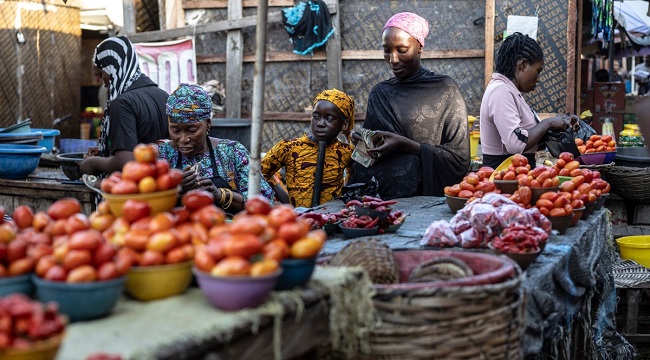
A vendor counts her money as a girls looks on at the Lokoja International Market in Lokoja on October 21, 2024. (Photo by OLYMPIA DE MAISMONT / AFP)
Nigeria’s economy grew by 4.2 per cent in the first half of 2026, while increased government revenues enabled states to expand infrastructure spending, according to the World Bank’s latest Nigeria Development Update.
The report also revealed that aggregate state revenues increased by approximately 93 per cent in real terms during the period, while expenditure rose by about 92 per cent.
Titled “Beyond the Federal Purse: How Higher Revenues Reshaped State Priorities,” the report said economic growth improved from 3.9 per cent in the corresponding period of 2025 and 3.5 per cent in 2024.
The expansion was driven largely by the services sector, supported by an improved contribution from agriculture.
According to the World Bank, the economic improvement helped stabilise Nigeria’s poverty rate for the first time since 2019, although persistent inflation continued to undermine household purchasing power.
The global financial institution noted that Nigeria’s economic performance had strengthened across growth, public finances and the external sector, but emphasised that sustained reforms and improved public service delivery were necessary to ensure that the benefits reached more Nigerians.
The report showed that gross federation revenues increased by 69 per cent in real terms between 2023 and 2025, largely due to exchange-rate reforms, the removal of petrol subsidy and improvements in revenue administration.
State governments recorded the largest increase in revenue flows from the federation.
Beyond higher statutory allocations, the states benefited from refunds, the settlement of outstanding federal obligations, dedicated intervention funds and improved Value Added Tax (VAT) collections.
The additional resources enabled state governments to increase capital expenditure, with its share of total spending rising from 46 per cent to 61 per cent.
Transport infrastructure received the largest increase in investment, while spending on housing, agriculture and other economic development projects also recorded significant growth.
However, the World Bank observed that expenditure on education, healthcare and social protection grew more slowly than spending on economic infrastructure.
The share of education in total expenditure declined from 14.9 per cent in 2021 to 12.1 per cent in 2025, while health spending remained relatively stable at approximately seven per cent.
Social protection, however, recorded an increase, with its share of total expenditure rising from 1.4 per cent to 4.4 per cent over the same period.
World Bank Country Director for Nigeria, Mathew Verghis, said the increase in government revenues presented an important opportunity for states to improve essential services and create more jobs.
“The bold macroeconomic reforms have substantially increased fiscal revenues at the state level, providing a unique opportunity to improve infrastructure, education, healthcare, and water services, which are critical to creating more and better jobs,” Verghis said.
He added that improving spending efficiency, accountability and service delivery would be critical to ensuring that increased public revenues translated into better living conditions for Nigerians.
The report also examined the mixed effects of the conflict in the Middle East on Nigeria’s economic outlook.
It noted that higher global oil prices boosted export earnings, helping Nigeria’s current account surplus rise to $12 billion, equivalent to 7.1 per cent of gross domestic product (GDP), in the first half of 2026.
This represented an increase from $8.6 billion, or 6.7 per cent of GDP, recorded in the corresponding period of the previous year.
Higher oil prices also boosted government revenues, although existing commitments under forward oil sales and oil-backed financing arrangements limited the extent of the gains.
Nigeria’s gross external reserves exceeded $54 billion in September, supported largely by foreign portfolio investments, while reforms contributed to improved functioning of the foreign exchange market.
Despite these gains, rising fuel prices following the outbreak of the Middle East conflict, coupled with seasonal food price pressures, slowed progress in reducing inflation.
Headline inflation had declined from 27.6 per cent in January 2025 to 15.2 per cent in December 2025, supported by tight monetary policy and reduced exchange-rate volatility.
Looking ahead, the World Bank projected that Nigeria’s economy would grow by an average of 4.4 per cent between 2026 and 2028.
Inflation is also expected to decline gradually to approximately 12 per cent by 2028, while poverty is projected to begin falling.
The report stressed that improved spending efficiency, stronger internally generated revenue and greater accountability at the state level would be essential to converting increased public revenues into tangible improvements in living standards.